&uuid=(email))
 |
|
&uuid=(email))
&uuid=(email))
&uuid=(email))
&uuid=(email))
&uuid=(email))
&uuid=(email))
&uuid=(email))
&uuid=(email))
&uuid=(email))
&uuid=(email))
&uuid=(email))
&uuid=(email))
&uuid=(email))
&uuid=(email))
&uuid=(email))
&uuid=(email))




 |
|
&uuid=(email)) |
|
&uuid=(email)) |
|
|
 &uuid=(email))
|
&uuid=(email)) |
|
|
Introducing "Hedgie's
Hot Takes" — A New Voice, A Continued Mission
 For
years, Gus' Tips gave this industry something rare: wisdom rooted
in experience, delivered with humility and heart. As we at The D&D
Daily continue to honor Gus Downing's legacy, we're proud to
introduce a new column that carries that same spirit forward — with a
voice uniquely his own. For
years, Gus' Tips gave this industry something rare: wisdom rooted
in experience, delivered with humility and heart. As we at The D&D
Daily continue to honor Gus Downing's legacy, we're proud to
introduce a new column that carries that same spirit forward — with a
voice uniquely his own.
Hedgie's Hot Takes will feature sharp insight, practical
perspective, and the same deep care for this profession that Gus
embodied. Written by longtime industry advocate — and all-around good
guy — Hedgie Bartol, this column offers more than just tips. It's a
space for honest takes, real-world strategy, and the occasional laugh
along the way.
Starting TODAY, catch Hedgie's Hot Takes
at the conclusion of each edition of the D&D Daily. You won't want to
miss it.
The U.S. Crime Surge
The Retail Impact
Lawmakers Continue Push for 'Combatting
Retail Crime Act'
Q&A: Organized Retail Crime Costs Families $500 Annually
With U.S. Senator Chuck Grassley
Q: How does organized retail crime impact Main
Street businesses and customers?
 A:
Organized crime syndicates are rampaging retail stores and cargo
fleets across the country through sophisticated criminal schemes.
It’s costing businesses and consumers billions of dollars a year. We’re
not talking about a kid stealing a candy bar or pack of gum near the
checkout counter. These schemes include cybercrime, fraud and other
complex cons that have surged in recent years, with the average loss per
cargo theft incident exceeding $200,000. Transnational criminal
organizations target U.S. shippers, retailers and the supply chain with
aggressive tactics overwhelming local law enforcement. Cargo theft costs
the supply chain up to $35 billion each year, contributing to higher
consumer prices and driving up insurance costs. A:
Organized crime syndicates are rampaging retail stores and cargo
fleets across the country through sophisticated criminal schemes.
It’s costing businesses and consumers billions of dollars a year. We’re
not talking about a kid stealing a candy bar or pack of gum near the
checkout counter. These schemes include cybercrime, fraud and other
complex cons that have surged in recent years, with the average loss per
cargo theft incident exceeding $200,000. Transnational criminal
organizations target U.S. shippers, retailers and the supply chain with
aggressive tactics overwhelming local law enforcement. Cargo theft costs
the supply chain up to $35 billion each year, contributing to higher
consumer prices and driving up insurance costs.
At the hearing I brought up recent efforts by the U.S. Department of
Justice that indicted 11 defendants, including nine illegal immigrants,
with stealing nearly a half-million dollars of Nike shoes from rail
cars. Even more serious is when criminals steal from the food supply
chain, like from a pallet of groceries or infant formula, since they
break the safety seal of the shipping container and ruin the entire
cargo container of goods. I also brought up another investigation that
connected thefts at a mall in Katy, Texas to a cartel that’s believed
to be responsible for over $100 million in theft across the country.
It’s a sweeping problem that demands swift justice. Homeland Security
Investigations estimate the average American family will pay more than
$500 in additional costs each year due to organized retail crime.
Q: How would your bill combat these crimes?
A: A few years ago, I convened a
roundtable in Cedar Rapids to hear concerns and learn from local retail
leaders and law enforcement about the rise in organized retail crimes.
Since then, I’ve pushed for a coordinated response at the federal level.
The Department of Homeland Security has found that cartels,
terrorists and human traffickers facilitate organized retail and supply
chain crime and use the proceeds to finance other crimes. It’s a
criminal hamster wheel that spans the globe and demands an informed and
beefed up response from the nation’s counterterrorism and intelligence
agencies. At the Senate hearing in July, I asked the District Attorney
for San Diego County why it’s important for prosecutors to aggregate the
value of stolen goods. She explained that aggregation distinguishes
between someone who shoplifts food to eat from the repeat criminal
offender who goes into a store with a calculator to stay under a $950
threshold so that the criminal would only be subject to a misdemeanor.
That misguided policy led to retail stores locking up merchandise,
instead of prosecutors locking up the perpetrators stealing the
merchandise. I was pleased to hear California changed this poppycock
policy to allow prosecutors to aggregate stolen merchandise in the
pursuit of justice. I’ll continue pushing in Congress for criminal
action to be met with criminal punishment.
grassley.senate.gov
Fencing Operations Fueling
California's Shoplifting Epidemic
‘We are all eating’: Inside California’s secret industry that props up
mass shoplifting
Over the past two years, authorities in the Bay Area say they’ve
uncovered evidence of hidden underground networks of stolen good buyers,
colloquially referred to as fences. Known only to the thieves
themselves, these groups are what largely fuel the multi-million dollar
shoplifting industry.
In one case, a massive fencing operation based out of an Oakland
clothing store was allegedly supplying stolen baby formula and allergy
medicine to retailers in New York, using a Texas-based trucking company
owned by the clothing store’s owner, according to court records. In
another case, a Pacifica woman named Elvia Esquide-Perez was allegedly
acquiring hundreds of thousands of dollars worth of high-end stolen
purses from an East Bay gang called “F— Everyone.”
“I have teams that have been working with me for four years,”
Esquide-Perez allegedly told a suspected gang member in a text message
contained in a court file. “We are all eating.”
While San Ramon police were working to arrest their shoplifters,
private investigators hired by retailers like Walgreens, Safeway and
Rite Aid were scouring flea markets in Galt and Modesto for stolen
merchandise. They reportedly found plenty of it, some with the
anti-theft devices still attached.
Other fencers have been tied to the flea market in Galt, a town on
Highway 99 between Sacramento and Stockton. Sacramento police say
several shoplifting suspects told them of an El Sobrante resident who
was buying stolen merchandise there for re-sale, resulting in a
series of 2023 raids targeting the suspect’s Parkside Drive home and
several vehicles. No criminal charges were ever filed against the
suspected fencer, court records show.
In another East Bay theft ring, police investigated suspected members of
Oakland’s F— Everyone gang who allegedly committed 34 burglaries
across California in two months, resulting in an estimated loss of
$970,000 to stores. One of the men, 23-year-old Oakland resident
Alejandro McDonald, was allegedly communicating with Esquide-Perez about
the price for new and damaged handbags.
But perhaps the most sprawling investigation in recent memory led
federal and state investigators to the 1900 block of Fruitvale Avenue,
to an Oakland business known to some seedy locals as the “h– store,”
because it sells lingeries and skimpy clothing typically worn by sex
workers. A surveillance operation in 2021-2022 — during the
coronavirus pandemic — captured people showing up with bags of suspected
stolen baby formula and allergy pills, which were transferred by
hand truck into vans and trucks.
eagletribune.com
Should Stores Be Punished When
Shopping Carts Are Stolen?
CA bill would fine stores for theft of their shopping carts
The California Senate and now a key Assembly committee have passed a
bill that would allow cities to charge businesses up to $650 for
returning shopping carts stolen from them. The measure, Senate Bill
753, was introduced at the urging of the city of San Jose, which faces
major homelessness and budget crises.
“[San Jose] Mayor Mahan has a homelessness problem and a budget problem,
and his solution to solve both of those is to charge retailers more to
get their stolen property back,” said Daniel Conway of the California
Grocers Association at the California Assembly Local Government
Committee hearing that advanced the bill. “Our property is being stolen
and taken offsite.”
Under current law, cities can only charge businesses $50 for each
shopping cart found and retrieved by the city off of the businesses’
property after the first three violations within a six-month period, or
for failing to pick up retrieved carts within three business days.
Shopping carts also currently have to be held for 30 days before the
city disposes of them, which bill author state Sen. Dave Cortese,
D-San Jose, said creates a nuisance for cities. Cortese’s bill would
authorize cities to return the carts to businesses, and charge the
businesses up to $500 for the service of returning each cart and up to
an additional $150 in fines.
“The bill modernizes California law by allowing cities to immediately
collect abandoned shopping carts, return them directly to retailers
without a three-day waiting period, and recover the actual costs
associated with managing cart recovery program,” said Cortese in support
of the bill.
Assemblywoman Rhodesia Ransom, D-Tracy, who abstained from voting for or
against the bill — which passed with zero “no” votes but four
abstentions — shared her concern that it’s unfair to charge
businesses for being victims of crime.
myhometowntoday.com
The Self-Checkout Dilemma Continues
Target, Walmart, retail theft, and the self-checkout dilemma
 To
be fair, some customers appreciated the ease and convenience of
self-checkout. Introverted shoppers, folks making personal purchases, or
people who just don't want to wait in line tend to prefer the ease of a
self-checkout kiosk. To
be fair, some customers appreciated the ease and convenience of
self-checkout. Introverted shoppers, folks making personal purchases, or
people who just don't want to wait in line tend to prefer the ease of a
self-checkout kiosk.
But as they became more popular during Covid, when many more retailers
relied almost exclusively on self checkout to keep things moving,
plenty more customers began to take advantage of the system.
Theft, whether accidental or intentional, spiked with the use of
self-checkouts. It's not all due to malicious intent — roughly one
fifth of thefts happen accidentally.
But the fact is that fewer folks are entering retail as a line of work,
which means a lot of these kiosks are here to stay. Still, retailers
that have faced the biggest challenges with the automated technology
have curtailed customer privileges.
In 2024, Target began limiting customers using self-checkout to
10 items or fewer. And Walmart has been tailoring its approach to
self-checkout on a store-by-store basis. One Walmart store in Missouri
eliminated its self-checkout options entirely after a costly bout with
theft since Covid.
thestreet.com
The Debate Over Locked Store Shelves
Everyone Hates Locked Shelves. Even the Retailers.
On today’s Big Take podcast, why
retailers started locking their shelves, and why some of them have
started to reconsider that strategy.
If you’ve been to a store like CVS, Walgreens or Target in the last few
years, you may have noticed a trend: more and more essentials are locked
up behind plexiglass walls. The strategy started as an anti-theft
measure. But there’s little evidence that it’s worked.
bloomberg.com
What's causing a spike in organized retail theft in Baton Rouge?
New task force launches in Houston to take on transnational crime
The Win-Win of Facial Recognition:
Safer Stores & Less Friction
Facial Recognition Could Revolutionize
Customer Service — Without Touching Loyalty Programs
 By
the D&D Daily staff By
the D&D Daily staff
When most people think of facial recognition in retail, they jump
straight to theft prevention. But there’s a less flashy, under-discussed
use case that could quietly reshape the customer experience:
personalized service without friction.
Retailers have spent decades chasing the holy grail of personalization—usually
through loyalty cards, apps, or email programs. But the truth is,
most shoppers don’t scan their app every time or want to be bombarded
with offers. Facial recognition opens the door to a smoother, opt-in
approach: recognizing returning customers at the door or checkout and
tailoring their experience in real time.
Imagine a customer walks into a store and is privately recognized by
a system they’ve opted into. No card swipe. No app. Just a seamless
greeting: “Welcome back, Sam. That pair of shoes you looked at last week
is on display near the register.” Or a reminder at checkout: “You have a
store credit available.”
This isn’t science fiction—it’s already being piloted in select retail
environments overseas. Facial recognition allows stores to quietly
connect past behaviors to current visits, offering helpful insights
without requiring effort from the customer. It’s like loyalty—but
invisible, automatic, and frictionless.
Critics often raise privacy concerns, but these programs are strictly
opt-in. The shopper chooses to be recognized—just like they choose to
sign up for email deals. And in return, they get faster service,
more relevant recommendations, and fewer irrelevant ads.
The potential here goes far beyond marketing. Store associates could
be alerted to preferred sizing, color preferences, or past purchases—all
without asking the customer to dig through emails or loyalty
numbers. In a world where consumers want personalization without hassle,
facial recognition may be the bridge.
Retailers have been chasing “the right message to the right person at
the right time” for years. Facial recognition, used responsibly and
transparently, might finally deliver on that promise—without a QR
code in sight.
Less Selection, Higher Prices:
How tariffs are shaping the holiday shopping season
With summer in full swing in the United States, retail executives are
sweating a different season. It’s less than 22 weeks before
Christmas, a time when businesses that make and sell consumer goods
usually nail down their holiday orders and prices.
But President Donald Trump’s vacillating trade policies, part of his
effort to revive the nation’s diminished manufacturing base and to
reduce the U.S. deficit in exported goods, have complicated those
end-of-year plans. Balsam Hill, which sells artificial trees and
other decorations online, expects to publish fewer and thinner holiday
catalogs because the featured products keep changing with the tariff —
import tax — rates the president sets, postpones and revises.
The consequences for consumers? Stores may not have the specific gift
items customers want come November and December. Some retail
suppliers and buyers scaled back their holiday lines rather than risking
a hefty tax bill or expensive imports going unsold. Businesses still
are setting prices but say shoppers can expect many things to cost more,
though by how much depends partly on whether Trump’s latest round of
“reciprocal” tariffs kicks in next month.
apnews.com
Retailers Paying the Price for DEI
Reversals?
Why many Black Americans are boycotting big-box retail stores: ‘using my
money to resist’
People are shutting their wallets to
firms such as Target and Amazon, who followed in Trump’s footsteps to
undo DEI
Renard-Wilson is among a growing group of African Americans who are
ditching corporate big-box retail stores who rolled back their DEI
programs and instead are shopping at small, minority- and women-owned
businesses they believe value their dollars more. In February, more
than 250,000 people signed a pledge to boycott Target after Rev Jamal
Bryant, pastor of New Birth Baptist church outside of Georgia, called
for a 40-day Target Fast that started at the beginning of the Lenten
season.
The boycott has become a movement across social media and within
community neighborhoods nationwide with the shared goal of rejecting
systems that do not value the African American community, and it has
already impacted Target. In the first quarter of the year, the company
reported a $500m loss in year-over-year sales, citing reaction to the
boycott and lower foot traffic.
theguardian.com
Port of Oakland shipments drop as tariffs spur ‘market recalibration’ in
trade
The Port recorded a 10.1% drop in June over
the previous month as Trump’s tariffs cast uncertainty into trade
relationships abroad
Target to stop price matching retailers
Deodorant recall: More than 67,000 cases sold at Walmart, Dollar Tree,
Amazon
FDA Authorizes Juul’s E-Cigarettes After Ban Nearly Bankrupted Firm
Last week's #1 article --
Should America Adopt the Florida Model
to Fighting ORC?
Ashley Moody wants to enact Florida approach to retail theft on national
level
Moody says her approaches as Florida's top prosecutor worked in reducing
organized retail theft.
U.S. Sen. Ashley Moody is increasing calls for tougher federal laws
to tamp down retail theft across America.
During a Senate Judiciary Committee hearing on organized retail theft,
Moody advocated the use of emerging technology to help beef up
federal stipulations that could break massive retail crime rings.
It’s the same approach she used as Florida Attorney General before she
was appointed to the Senate seat this year to replace Marco Rubio.
In Florida, Moody said she was able to develop partnerships along with
utilizing new technology in order to crack down on retail crime. She
said it’s a template that other areas of the country should start
employing.
“While most of the country watched mobs storm Los Angeles stores and
crime rings boldly target major retailers, Florida dug in, utilizing new
technology, forging novel partnerships and strengthening state laws to
make sure organized retail crime did not get a foothold in Florida,”
Moody said.
“It is time to bring the Florida approach to
the federal government to stop organized retail crime, protect consumers
and keep prices low for hardworking Americans especially as
weak state leaders fail to enforce the law.”
Moody’s template developed what was labeled the Florida Organized
Retail Crime Exchange (FORCE) in conjunction with the Florida Retail
Federation. The FORCE partnership led to a statewide task force and
database that could identify retail theft trends. FORCE was also used to
develop lists of suspects and infiltrated organized retail theft rings.
floridapolitics.com
|
|

|
All the News - One Place - One Source - One Time
Thanks to our sponsors/partners - Take the time to thank them as well please.
If it wasn't for them The Daily wouldn't be here every day for you.
|
|
|
|
|
|

&uuid=(email)) |
|
|

|
|
Retail Under
Siege:
The Rise of ORC & the Tech Fighting Back
Innovation Born
from Urgency
CIS Security
Solutions creates solutions that help our clients protect their
valuable assets. We offer products that are economical, sustainable, and
quick to achieve return on investment while securing valuable
merchandise at the Zone 1 level, at the fixture. We have become a leader
in innovation, and the evolution of our products has been saving our
clients millions of dollars per year, while preventing loss of assets
and increasing sales.
We had ideas for products years ago, but technology had to catch up
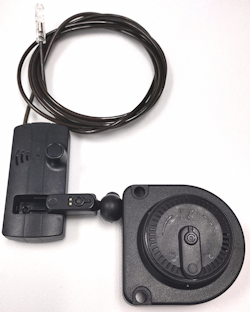
first. By 2022, development was underway on the Gen6 SP (Smart
Padlock), a new generation tether that connects to a smart padlock
tag via a sleek plug-in system, creating a multi alarmed circuit from
tether to padlock tag. It had to be intuitive, secure, and built for
speed. Early models showed promise in lab tests, but the true trial came
in multi-store pilot programs. Results from the pilot tests were
analyzed and we made some changes, with the valuable input from our
clients.
 No
Pins. No False Alarms. No Nonsense. No
Pins. No False Alarms. No Nonsense.
In 2023, The Slide Padlock Tag was born. With a smooth locking
slot, the Gen6 SP tether slides and secures in place right into the
Smart Padlock Tag. Simple for staff, impossible for thieves. It features
dual-frequency EAS technology and an IR detacher safeguard, so any
unauthorized attempt to remove the tag or tether sets off a piercing
alarm.
And best of all? Associates could now remove or transfer merchandise
with ease using an all-in-one decoder. One press deactivates the alarm
and releases the Slide Tag from the tether; plug into a new Slide Tag
and the alarm is instantly reactivated. Customers still get to feel, try
on, and interact with the merchandise, while the item remains fully
protected and secure. Security no longer comes at the cost of customer
experience.
 Securing
the Rack: Meet "The Boot" Securing
the Rack: Meet "The Boot"
But locking down individual items was just the beginning. What about
when multiple high-value items are displayed on shared fixtures like
4-way racks and H-racks?
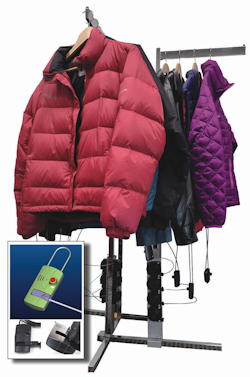
Enter The Boot. The Boot is a rugged security solution built to
secure up to 10 Gen6 SP recoiling tethers directly to a store fixture.
The first prototype looked like something from a dystopian workshop:
metal plates, bulky screws, and a vibe somewhere between Mad Max and
Steam Punk. It worked. One store saw a Return On Investment within 24
hours of installing it.
Engineers then refined the design into a clean, solid unit that fits
seamlessly around fixture legs, using just two security screws and
top-and-bottom swivel locks. The latest version installs in minutes and
has now been deployed across 2,000+ retail locations in the U.S. and
Canada with more rolling out every month.
A Safer,
Smarter Shopping Experience
High-volume theft, once considered an inevitable loss, is no longer
untouchable. Retailers are pushing back with innovation that works
behind the scenes: making stores safer, smarter, and ready for whatever
the next wave of organized retail crime throws at them.
The takeaway? High fashion may still be vulnerable to theft trends, but
thanks to evolving retail security tech like The Boot with Gen6 SP
Slide, luxury handbags and clothing is no longer vulnerable to ORC
mobs, yet it IS accessible to customers.
What is Next?
The proof of concept is there. The ROI is there. Loss percentages are
falling while sales are rising as our products protect the merchandise.
As our retailers’ needs arise, we can adapt and create solutions to
protect their merchandise. As the needs of our clients evolve, so will
we and so will our products.
What are your needs? What are your wants? Let’s have a chat and
find the right solution for you.
Contact us for more information at
info@cisssinc.com |
|
&uuid=(email)) |
|
|
 |
|
|
More Fallout From Retail Cyberattack
UK retail giant Co-op confirms hackers stole all 6.5 million customer
records
The chief executive of U.K. retail conglomerate Co-op on Wednesday said
that hackers had stolen the personal data of all of the company’s
customers during an April cyberattack.
Co-op Group CEO Shirine Khoury-Haq told BBC News that the hackers
copied the company’s member list of 6.5 million members, but that
Co-op shut down its network before the hackers could lock up its systems
with ransomware.
The members’ data includes names, addresses, and contact information.
The retailer’s network shutdown subsequently resulted in widespread
internal disruption across its U.K. back offices and grocery stores.
The breach at Co-op in April was part of a broader hacking campaign
targeting the U.K. retail sector, which also saw the theft of an
unspecified amount of customer data from Marks & Spencer and an
attempted cyberattack on Harrods. The cyberattacks were attributed to
Scattered Spider, a collective of mostly young hackers that use
deception tactics to trick companies’ IT helpdesks into granting them
access to their network.
Earlier in July, U.K. authorities arrested four people for allegedly
having links to the retail cyberattacks, including a 20-year-old
woman, two men aged 19, and a youth aged 17. The four are accused of
hacking, blackmail, and participating as a member of an organized crime
group.
Since the cyberattacks, the hackers reportedly moved on to target the
airline and transportation industry, as well as insurance companies —
sectors that store vast amounts of consumers’ data.
techcrunch.com
AI & Cybersecurity
Q&A: Amazon’s director of security on locking down enterprise AI
“We’ve seen hype cycles before, but
this one is a little different,” Mark Ryland, director of security at
Amazon, told CIO Dive.
Cybersecurity is a growing concern for organizations as they
sprint to bring AI into the enterprise.
Amid deployment efforts, AI security issues have surpassed ransomware
for nearly one-third of security chiefs, according to Arctic Wolf
data. The technology’s reliance on company data to create accurate
results puts cybersecurity front and center.
In June, CIO Dive spoke with Mark Ryland,
director of security at Amazon, about AI’s rapid rise, how
executive concerns are evolving and the impacts the technology is having
on cybersecurity defense.
How has AI changed cybersecurity work for
organizations? Where do you foresee it having its greatest impact?
It’s already having a big impact, starting with something very
simple like human language queries of analytics tools. If I’m training a
cybersecurity analyst, now they can just ask intelligent questions in
human language and get very good results very efficiently. Another area
that we see immediate benefit is contextual summarization. If there’s a
security issue, a human files a ticket that says, “Hey, I think there’s
something wrong here,” and now, an AI system can bring in an entire
corpus of similar tickets that a human might not have been able to find
with a text search. On the proactive security side, our AppSec team is
using AI for better, automatic test generation. There are lots of
benefits already that we’re seeing, and I feel like we’re just getting
started.
How will the adoption of these technologies
impact the cybersecurity sector workforce?
I think the desirable outcome, and the one that we’re working toward, is
increasing the capacity of human experts to be much more efficient and
do work that was difficult to do. At the same time, we don’t want to
stop the process by which humans develop expertise and judgment in these
areas. As an industry, we have to find a way to continue to train
people, but at the same time recognize that the tools can do a lot
of the work that they used to do. I think maintaining a goal of keeping
human expertise at a high level is important.
cybersecuritydive.com
Is Microsoft Taking a Risk?
Top US senator calls out supply-chain risk with DoD contractors
The Senate Intelligence Committee
chairman questioned the security of Microsoft’s “digital escort”
arrangement with its Chinese employees.
Senate Intelligence Committee Chairman Tom Cotton, R-Ark., wants the
Defense Department to investigate its contractors’ reliance on Chinese
workers following a report about Microsoft’s
use of engineers in China to perform sensitive tasks.
“DoD must guard against all potential threats within its supply chain,
including those from subcontractors,” Cotton wrote in a Wednesday letter
to Secretary of Defense Pete Hegseth.
Cotton’s inquiry reflects deep unease within Congress about the
security of military computer systems, given Microsoft’s unusual
arrangement with its Chinese engineers.
cybersecuritydive.com
Why silent authentication is the smarter way to secure BYOD |
|
|
|
&uuid=(email)) |
|
|
 |
|
|
Massive Amazon Prime Scam
Amazon warns 200 million Prime users about sophisticated scam emails
Amazon is warning its 200 million Prime subscribers about sophisticated email
scams that trick users into sharing personal data, including login credentials,
passwords and credit card information, by falsely claiming issues with their
subscriptions.
One scam email claims the customer’s Amazon Prime subscription “will
automatically renew at an unexpected price,” according to reporting by
TheStreet.
“These emails may also include a ‘cancel subscription’ button leading to a fake
Amazon login page,” Amazon warns.
Another scam email claims the customer’s default payment is no longer valid
and must be updated.
“We’ve recently noticed an increase in customers reporting fake emails about
Amazon Prime membership subscriptions,” Amazon’s recent email to customers
reads, according to TheStreet. “We want to help you stay protected by sharing
important information about these scams.”
The scam emails often contain personal information that makes them appear to
be authentic, according to Amazon.
“If you receive an email claiming to be from Amazon and are unsure if it’s from
us, visit Message Center to view all email correspondence sent by Amazon,’ a
notice on Amazon’s website reads. ”If the email does not appear in Message
Center, then it was not sent by Amazon."
masslive.com
AI in the E-Commerce Space
OpenAI’s next disruption: E-commerce inside ChatGPT
Could the chatbot that changed work and
school upend online shopping, too?
OpenAI is entering the e-commerce space and developing a system to enable users
to purchase products directly through ChatGPT, according to a report by the
Financial Times. Implementing this system would allow the company to earn a
commission on every purchase completed via the chatbot and could become a
significant new revenue stream. It also has the potential to challenge
Amazon’s dominance and change the way people shop for products and services.
Today, ChatGPT can already recommend products in response to relevant user
queries (such as “Where is the best place to buy a Nintendo Switch 2 in
Israel?”). These recommendations can include reviews of different options, price
comparisons, product images, and links to purchase pages on online stores. The
recommended products are selected based on user instructions (e.g., shirt size)
and “memories”, ChatGPT’s ability to remember preferences or instructions from
past conversations and apply them to new ones. The stores shown are chosen based
on information from third-party providers.
calcalistech.com
Essex Rejects Amazon's Plans to Build a Warehouse |
|
|
&uuid=(email))
|
|
New York, NY: Update: Pawn Shop Owner Pleads Guilty to Selling Property
Stolen from Bengals QB Joe Burrow's Home
A pawn shop owner has pleaded guilty to buying and selling items stolen
from the home of Cincinnati Bengals quarterback Joe Burrow in a December
robbery, according to the U.S. Attorney’s Office in the Eastern District
of New York. Dimitriy Nezhenskiy, 43, of North Bergen, N.J., pleaded
guilty Friday to one count of conspiracy to receive stolen property.
Nezhenskiy admitted to knowingly buying stolen property, including
luxury watches, handbags and jewelry. "This defendant ran a black-market
pipeline, buying stolen luxury goods from organized theft crews that
targeted homes and businesses," New York City Police Commissioner
Jessica Tisch said in a news release Friday. "It was a deliberate
operation that helped professional burglars prey on innocent people."
Co-defendant, Juan Villar, 48, pleaded guilty to the same charge in
June. Villar was the co-owner of the pawn shop. According to a press
release from the U.S. Attorney’s office, the two had been working
together since 2020 to buy and receive goods stolen from outside of New
York. “For more than five years, Dimitriy Nezhinskiy established a
demand for stolen merchandise, which allowed South American Theft Groups
to profit from repeated burglaries,” FBI Assistant Director in Charge
Christopher Raia said in a statement. “His purchases perpetuated a
ripple of criminality targeting residences and businesses across the
country.
si.com
San Francisco, CA: SFPD Arrests Prolific Grand Theft Suspects Targeting
Retail Stores; 17 charges totaling $15,000
Sparks, NV: Man arrested in connection with $5500 high-end bike theft
Houston, TX: Stolen goods recovered in Montgomery County retail theft
sting
Gastonia, NC: Pair arrested after shoplifting over $500 from Lowe’s
store
UK: Southampton, England: Four thieves jailed for 18 years after
$268,000 bike shop burglaries
&uuid=(email))
|
|
|
|
&uuid=(email))
|
|
|
|
 &uuid=(email))
|
|
|
Shootings & Deaths
Kansas City, MO: Two men killed in shooting at Truman Road convenience store
The Kansas City Police Department says that two people are dead after a shooting
in Kansas City, Missouri on Sunday afternoon. Officers were called to a
convenience store at the intersection of Truman Ave. and Brooklyn St. around
1:15 p.m., according to reports. Inside the store, they found two unresponsive
adult men suffering from gunshot wounds. Those officers then began to render aid
to the victims until EMS could respond. However, when EMS arrived, both victims
were pronounced dead at the scene. While there was a suspect at the scene who
was taken into custody, KCPD says that, at this time, there is no information
regarding the nature or what led to the shooting. They are currently not looking
for any additional suspects.
fox4kc.com
Chicago, IL: 1 dead, 2 wounded in Princeton Park strip mall parking lot shooting
A man has died and two other people were wounded in a shooting in the parking
lot of a Chicago shopping center. According to Chicago police, the shooting was
reported in the parking lot of a shopping center in the 100 block of West 87th
Street, just west of the Dan Ryan Expressway. At approximately 11:49 p.m.
Saturday, an unidentified assailant opened fire on a group of people who had
gathered in the parking lot, leaving three people with gunshot wounds. One of
those victims, a 24-year-old man, was shot multiple times and was transported to
a nearby hospital, where he was pronounced dead, police said.
nbcchicago.com
Indianapolis, IN: Woman shot, killed outside NW Indy liquor store
An investigation is underway after a woman was shot outside a liquor store on
Indy’s northwest side Saturday morning. According to the Indianapolis
Metropolitan Police Department, just before 3 a.m., officers were called to
Jack’s Liquors in the 5500 block of Georgetown Road on the report of a person
shot. When officers arrived on scene, they located an adult female just outside
the liquor store with injuries consistent with a gunshot wound. She was
transported to an area hospital in critical condition, but died a short time
later, police said. Officers quickly located a suspect and took him into custody
there at the store, police said. Investigators also located the alleged weapon
used in the incident and numerous shell casings.
fox59.com
Portland, OR: Man dies after shooting in grocery store parking lot in NE
Portland
One man is dead and another is in jail after a shooting Friday afternoon in a
grocery store parking lot in the Roseway neighborhood, according to a news
release from the Portland Police Bureau. Police responded to reports of a
shooting in the Safeway parking lot in the 6900 block of Northeast Sandy
Boulevard at about 3:50 p.m. They found a man dead outside a vehicle and
arrested a man who was inside the vehicle.
oregonlive.com
Anaheim, CA: Jewelry store owner scares off mob of thieves by firing warning
shot
 The
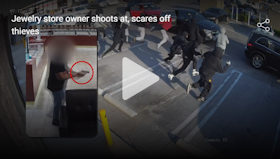
attempted robbery happened at Al-Amira Jewelry on July 17. The owner told FOX 11
that it was close to closing time, when five cars pulled up to the front of the
store. Security camera footage showed about 20 people piling out of the cars and
mobbing the store's entrance. Some of them had sledgehammers and pickaxes and
started smashing the door. Seconds later, though, the group scattered, got back
into their cars, and they all drove off. Video from inside the store showed the
other angle. When the people inside saw the thieves, they ran behind the
counter. Several came back out to the front, armed. That's when the owner fired
one shot.
foxla.com The
attempted robbery happened at Al-Amira Jewelry on July 17. The owner told FOX 11
that it was close to closing time, when five cars pulled up to the front of the
store. Security camera footage showed about 20 people piling out of the cars and
mobbing the store's entrance. Some of them had sledgehammers and pickaxes and
started smashing the door. Seconds later, though, the group scattered, got back
into their cars, and they all drove off. Video from inside the store showed the
other angle. When the people inside saw the thieves, they ran behind the
counter. Several came back out to the front, armed. That's when the owner fired
one shot.
foxla.com
Robberies, Incidents & Thefts
Lawrence, IN: Police investigating after person robbed, ran over at Wendy’s
An investigation is underway after a person was robbed behind a Wendy’s in
Lawrence Friday evening. Officers with the Lawrence Police Department were
called around 4:30 p.m. to 5765 Sunnyside Road, the listed address for a Wendy’s
in the area, in response to a reported robbery. Minutes later, medics were also
called to the scene after dispatch received reports that a pedestrian was
struck. Preliminary information indicates the suspect reportedly ran over the
victim with their car while fleeing the scene, LPD said. The victim received
medical treatment for “non-life-threatening injuries” and is expected to
recover.
fox59.com
San Ramon, CA: Improvised Explosive Device used to gain entry to ATM at San
Ramon Target
An investigation is underway in San Ramon after police said an improvised
explosive device was used to gain entry to an ATM early Sunday morning. Shortly
after 2:15 a.m., officers responded to the Target on Bishop Drive, where they
discovered an improvised explosive device had been used to gain access to an
ATM. The explosion damaged the store's interior near the eastern entrance. No
one was injured in the explosion, but now authorities are searching for
information to help in the investigation. The FBI responded to the scene to
investigate.
cbsnews.com
Sunnyvale, CA: Armed employees thwart robbery attempt at Bay Area jewelry store
Oklahoma City, OK: Armed Suspects rob Paseo District marijuana dispensary, steal
up to $1,000 worth of product
Dallas, TX: Serial cash-loan store robber sentenced to 60 years in federal
prison
|
|
&uuid=(email))
|
|
|
|
&uuid=(email))
|
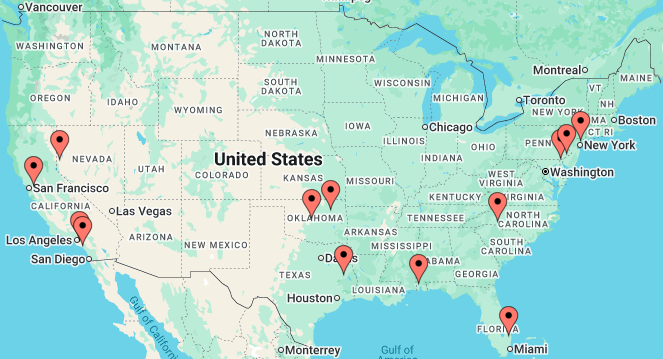
•
Bicycle – Sparks, NV –
Burglary
•
Gas Station – Mobile
County, Al – Armed Robbery
•
Gas Station – Bronx,
NY – Armed Robbery
•
Grocery –
Philadelphia, PA – Robbery
•
Gun – Laguna Niguel,
CA – Burglary
•
Hardware – Gastonia,
NC – Robbery
•
Jewelry – Anaheim, CA
– Robbery / Shot fired
• Jewelry – Lufkin, TX – Robbery
• Jewelry - Wellington, FL – Robbery
•
Marijuana – Oklahoma
City, OK – Armed Robbery
•
Motel – New Castle, DE
– Armed Robbery
•
Restaurant – Tulsa
County, OK - Burglary
•
Target – San Ramon, CA
– Burglary
|
|
|
Daily Totals:
• 9 robberies
• 4 burglaries
• 1 shooting
• 0 killed |
|
|
Click map to enlarge
|
&uuid=(email))
|
|
|
|
&uuid=(email)) |
|
|
|

&uuid=(email)) |
|
|
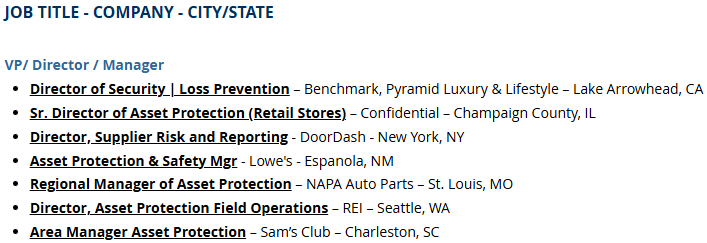
Featured Job Spotlights
|
Staffing 'Best in Class' Teams
Every one has a role to play in building an
industry.
Filled your job? Any good candidates left over?
Help Your Colleagues - Your Industry - Build
a 'Best in Class' Community
|
 |
Region Asset Protection Manager
Jackson, MI
-
Posted April 17
The Region Asset Protection Manager will be the primary
subject matter expert in regard to the training, auditing, and investigatory
needs of Dollar General. Their key efforts are to reduce shrinkage and increase
profitability through proactive training mediums, standardized audits and the
resolution of internal and external investigations...
|
Featured Jobs
To apply to any of today's Featured Jobs,
Click Here
 |
|
View Featured
Jobs |
Post Your Job
|
|
|
|
|
|

Insight,
humor & heart from
one of LP's most trusted voices |
|
|
Cross-Department Drama Is So Last Season
Asset Protection isn't a solo act. Grab
your ops, IT, and HR folks, and form the Avengers of Shrink. It truly
takes a village and I have always said that "no single function within
retail understands more about the over all retail business than the
folks in Asset Protection". So, in that regard it only makes sense to
work with these other business units (that your function touches) to
help them understand the ways in which AP can impact and support their
roles. Bonus: fewer meetings where you're the only one talking about
loss.
Follow this space every day to see more of 'Hedgie's Hot Takes' |
|
|
|
Not getting the Daily? Is it ending up in your spam folder?
Please make sure to add d-ddaily@downing-downing.com to your contact list,
address book, trusted sender list, and/or company whitelist to ensure you
receive our newsletter.
Want to know how?
Read Here |
|
FEEDBACK
/
downing-downing.com
/
Advertise with The D&D Daily |
|
 |
&uuid=(email))



&uuid=(email))
&uuid=(email))