&uuid=(email))
 |
|
&uuid=(email))
&uuid=(email))
&uuid=(email))
&uuid=(email))
&uuid=(email))
&uuid=(email))
&uuid=(email))
&uuid=(email))
&uuid=(email))
&uuid=(email))
&uuid=(email))
&uuid=(email))
&uuid=(email))
&uuid=(email))
&uuid=(email))


 |
|
&uuid=(email)) |
|
|
 &uuid=(email))
|
&uuid=(email)) |
|
Siffron's Shogun Tag™ Duo
Small Tag. Big Protection.
 The
Shogun Tag™ Duo
is a versatile retail security solution that simplifies product application
while delivering powerful protection. Offering two easy application
methods—removable adhesive or reusable elastic banding—the Shogun Tag™ Duo makes
it simple to secure merchandise across multiple surfaces and packaging types.
This streamlined setup reduces installation time for associates while ensuring
consistent, reliable theft protection. The
Shogun Tag™ Duo
is a versatile retail security solution that simplifies product application
while delivering powerful protection. Offering two easy application
methods—removable adhesive or reusable elastic banding—the Shogun Tag™ Duo makes
it simple to secure merchandise across multiple surfaces and packaging types.
This streamlined setup reduces installation time for associates while ensuring
consistent, reliable theft protection.
Built with all the standard Shogun Tag™ functions, the Duo also adds the
flexibility of reusable banding, allowing tags to be reapplied as often as
needed. Clear banding can be used for a discreet application that won’t distract
from branding or product presentation, while integrated slots on the device
allow banding to be applied cleanly and securely.
Click here to learn more
The U.S. Crime Surge
The Retail Impact
Organized Theft’s Frontline Impact
When Organized Theft Becomes a Workforce Problem
 By
the D&D Daily staff By
the D&D Daily staff
Organized retail theft is usually measured in merchandise, dollars and
arrests. But another cost is becoming increasingly difficult for
retailers to ignore: the impact repeated theft incidents can have on
frontline employees.
For associates working in stores repeatedly targeted by organized
groups, theft isn't necessarily an occasional disruption. The
same location may be hit multiple times, sometimes by offenders who
arrive in groups, quickly collect merchandise and leave before employees
or police can intervene.
That can put workers in an uncomfortable position. Employees may be
instructed not to physically intervene while still being expected to
recognize suspicious activity, follow company procedures and provide
useful information to Asset Protection. When offenders become
aggressive, the situation can quickly shift from a property crime issue
to a workplace safety concern.
The challenge becomes even greater when repeat offenders recognize
that employees are unlikely to confront them. Some theft crews have
become increasingly brazen, using large bags, carts or coordinated
distractions while making little effort to conceal what they're doing.
For retailers, that means the consequences of organized theft can
extend beyond shrink.
Repeated exposure to disruptive or threatening incidents can affect
employee confidence, morale and potentially retention. It also places
greater importance on ensuring associates understand exactly what
they're expected to do — and, equally important, what they're not
expected to do — when a theft occurs.
That makes communication between store operations, Asset Protection
and frontline teams increasingly important. Clear response
procedures, reliable reporting channels and training for potentially
aggressive encounters can help remove uncertainty during an incident.
Technology may also allow employees to play a less confrontational role.
Video analytics, license plate recognition, exception reporting and
centralized intelligence teams can increasingly document activity
without requiring store associates to become directly involved.
The merchandise stolen during an organized theft can be replaced.
For retailers confronting the problem repeatedly, protecting the
employees standing between the sales floor and the exit may prove just
as important.
Gift Card Fraud Goes Organized
Gift card fraud evolves into organized retail theft
Gift card fraud is becoming an increasingly sophisticated form of
organized retail theft, with criminals using methods that can leave
both retailers and customers with significant losses.
During a recent Washington Senate Law & Justice Committee work session
in Auburn, representatives from the Washington Retail Association and
the state Attorney General’s Office discussed how gift card theft is
evolving. Criminals may remove gift cards from store packaging, copy
barcodes, or tamper with PIN covers before returning cards to store
displays. Counterfeit barcodes can also redirect funds to accounts
controlled by thieves. Another emerging method, known as “ghost
tapping,” uses contactless payment technology to purchase gift cards in
bulk without taking cards from store shelves.
Once stolen card information is obtained, criminals can monitor
balances online and quickly drain funds after cards are loaded. In
one recent Washington case, two Snohomish County sisters were indicted
in connection with schemes that allegedly generated more than $80,000 in
gift cards.
Prosecuting these cases can be challenging. Investigators may need
records from gift card issuers to establish when cards were loaded or
used, and those records are not always readily available.
Authorities also face difficulties identifying individuals who move
stolen card information or money online.
The Washington Retail Association is developing legislation that would
make tampering with gift cards chargeable regardless of whether a card
has been activated. The association also supports expanding the
Organized Retail Crime Association statewide and restoring $500,000 in
funding that was vetoed during the previous legislative session.
The broader scale of retail theft underscores the issue. Statewide
retail theft totaled an estimated $2.7 billion in 2024, according to
the article.
washingtonretail.org
Tech-Driven Financial Theft Surge
Boise police warn of ‘significant shift’ in financial theft. Here’s what
to know
The Boise Police Organized Retail Crime Unit was notified by the loss
prevention team from a business in the 10000 block of West Overland
Road. Police said the business informed them that a man “conducted
three separate, identical transactions at a self-checkout using the
tap to pay function on a mobile device.”
Boise police said this activity was similar to other recent financial
theft cases and indicated a shift in how criminals conduct such crimes.
While police used to see more cases involving stealing physical credit
cards, they said they now see more “highly-organized
technology-driven scheme(s).”
Criminals now obtain financial data through methods like data breaches
and phishing links, according to the department. Then they enter credit
card information into digital wallets on their phones, allowing them
to make purchases without ever obtaining victims’ credit cards. They
will often travel to victims’ towns and cities, police said.
“By using payment information associated with local victims, it
reduces the likelihood that financial institutions will immediately
notice and decline fraudulent transactions,” Marshall Plaisted,
Boise Police detective, said. “This allows suspects to make multiple
successful purchases before any fraud is detected.”
Police urged Boise residents to monitor their bank and credit card
accounts and report any unauthorized purchases to their bank and law
enforcement.
idahostatesman.com
Using Drones to Fight Crime
Birmingham police launch drone program as violent crime rates see major
decline
Overall, violent crime in Birmingham is down 8.6%, and total
crime has dropped by 15%. Every police precinct saw a decrease, with the
South Precinct leading the way with a 26% drop in violent crime and a
23.2% drop in major property crimes.
To keep crime numbers moving in the right direction, the department
is rolling out a new "drones as a first responder" program. The
drones, which are piloted from the city’s Real-Time Crime Center, can
fly over scenes across all precincts to help officers spot suspects,
find missing people and gather information before police even arrive.
Pickett also urged local businesses to connect their security cameras
to the city's Real-Time Crime Center. He mentioned a recent shooting
at a McDonald's, explaining that if the business had been connected to
the network, police could have instantly seen suspect descriptions and
known exactly where victims were located, potentially saving lives.
wvtm13.com
Detroit-area business temporarily closes after theft
Trump Says Americans Who Oppose AI Data Centers in Their Communities
‘Want to Live In Crime-Infested Squalor’
&uuid=(email))
Albertsons Expands AI to Improve
Retail Experience
How Albertsons Companies is reimagining retail from the inside out
Albertsons Cos. is expanding its
work with OpenAI to improve the retail experience for millions of
customers.
Retail runs on small decisions made at enormous scale: which products to
promote, how to help an associate, what a developer should build
next—and, closer to home, what’s for dinner. Grocery shopping is one of
the most ordinary ways we take care of ourselves and the people around
us. At Albertsons Cos., these decisions play out across more than
2,200 stores, including Albertsons®, Safeway®, Vons®, Jewel-Osco®,
Shaw’s®, ACME® and Tom Thumb®, serving over 36 million customers each
week.
OpenAI is working with Albertsons Cos. as the retailer continues to
bring AI into everyday workflows, including ChatGPT Enterprise, as well
as custom AI-powered experiences for its customers, data-driven
recommendations and promotional insights built with the OpenAI API.
The new Safeway experience in ChatGPT(opens in a new window) brings
that innovation to millions of shoppers, helping them move from a dinner
idea to checkout all in ChatGPT.
Saving teams time and accelerating retail
innovation
Digital shopping, store operations, fulfillment, merchandising and
customer experience all depend on systems that teams continually build,
test and improve. Albertsons Cos. is expanding its use of AI across
the organization to help teams navigate complexity, accelerate workflows
and move promising ideas toward production faster. The work connects
the technology behind a shopping trip to practical decisions: which
products to promote, how to explain a recommendation and how to help
customers find ingredients for dinner.
That rollout is part of a broader investment in how work gets done.
Through ChatGPT Enterprise and other AI-powered tools, select teams are
exploring new ways to streamline work, improve decision-making and
identify practices that can scale across the organization.
openai.com
CEOs Unite Against AI Threats
Who's who of CEOs join group to protect critical infrastructure from AI
The Alliance for Critical Infrastructure, a recently formed CEO-led
coalition, has added dozens of new members and will focus on
preparedness. Why it matters: Growing concern about the prospect of
AI-powered attacks on public infrastructure, financial institutions and
essential businesses is fueling momentum for action.
Citi CEO Fraser, one of the new ACI board members, tells Axios that
the group's wide-ranging membership represents an acknowledgment of the
gravity of the challenge in an "incredibly interconnected" world.
"We can see that AI creates enormous opportunity to improve people's
lives, help the economy grow, and there's a tremendous amount of
upside," Fraser said in an interview. "But in capturing that, we also
have to accept the responsibility that comes with it."
ACI will be poised to coordinate on disaster prevention and reaction.
"I don't want to get the phone call at 10pm on a Friday night — just
usually when the bad things come in for you — and then at 10:01, we're
kind of scrambling to go, 'Okay, we better put a playbook together.
Who's going to call whom? What are we going to do?'" Fraser said.
"The quicker that we can be acting together, the faster we can be
stopping something and then getting different systems reactivated
and restored again."
Fraser acknowledged that the new AI tools "are incredibly powerful
models" and "they are discovering vulnerabilities that weren't known
before," so "there is a race to get those vulnerabilities identified
and patched."
axios.com
Seasonal Retail Hiring to Drop
Holiday hiring is getting ‘smaller and more surgical’
Many of the biggest U.S. companies
are staying quiet about their Q4 plans amid uneasy consumer confidence
reports and shifting staffing models.
Seasonal U.S. retail hiring is expected to fall 2.5% year over year
to about 450,000 new jobs added in Q4, down from 461,500 jobs added
in the last quarter of 2025, according to new predictive data from
Challenger, Gray & Christmas.
The report said “only a handful of companies” were publicizing their
2026 headcount plans so far, and that the “pattern of quieter
announcements suggests retailers are again planning to lean on existing
staff and on-demand pools rather than committing to large seasonal waves
this early.”
In 2025, seasonal retail hiring posted its smallest seasonal gain
since 2008, falling 15% below the 543,100 jobs added in Q4 2024,
according to Challenger’s analysis of Bureau of Labor Statistics data.
retaildive.com
Walmart Rolls Out Light-Up Digital Shelf Labels
Walmart is rolling out light-up digital shelf labels to a broader array
of its stores following a successful pilot program. The Shop to Light
feature will allow shoppers to use an app to flash the light labelling a
desired product. Further, Pick to Light and Stock to Light will
feature similar functionality aimed at improving the efficiency of the
retailer's frontline staff.
retailwire.com
The running list of major retail bankruptcies
In recent months, QVC exited bankruptcy and
Sleep Number went through with its Chapter 11 plan to merge with
Canadian company Sleep Country.
Walgreens Owner Nears Deal to Sell British Pharmacy Chain Boots
Sycamore Partners is in talks with
billionaire Weston family about deal valued at roughly $9 billion,
including debt
Barnes & Noble Education shutters 68 locations
Kroger Finds Human-Focused Ads Outperform Ads About Products, Shopping
US Consumer Confidence Plummets in September to Notable Low
|
|

|
All the News - One Place - One Source - One Time
Thanks to our sponsors/partners - Take the time to thank them as well
please.
If it wasn't for them The Daily wouldn't be here every day for you.
|
|
|
&uuid=(email)) |
|

&uuid=(email)) |
|

|
|

Police departments have changed how they answer alarms.
Verified and no-response ordinances mean an unverified signal
can sit at the bottom of the dispatch queue or draw no response
at all. For an operator with sites across hundreds of
jurisdictions, each with its own fine schedule, that turns into
recurring penalties and slower answers when something real
happens.
Multi-site risk leaders now carry two problems at once. They
have to keep police responding where ordinances have raised the
bar, and they have to get evidence out of their video systems
fast enough to matter for an investigation. The two rarely get
solved together.
Brian New leads risk management and asset protection for
Banfield Pet Hospital, where he oversees security across more
than 1,000 locations. In this session he shares what actually
works at that scale: keeping police responsive where ordinances
now demand verification, and turning an underused video system
into a dependable investigations tool. Josh Dempsey,
Interface VP of Sales brings the view across Interface’s
multi-site customer base, including what changes when a site
goes dark and when the exterior becomes the exposure. A
moderated discussion will draw out the operational details and
the results behind each.
Register Here

|
|
|
&uuid=(email)) |
|
|
 |
|
|
Cyber Risk Inside Security Systems
When the Security System Becomes the Cyber Risk
By
the D&D Daily staff
Retailers have spent years connecting more of their physical security
infrastructure to the network. Video surveillance, access control,
analytics, sensors and other systems can now be remotely managed,
integrated and increasingly tied into broader technology platforms.
But every connected security device also becomes another potential
cyber entry point.
That convergence is creating a challenge for Loss Prevention and Asset
Protection teams. A security camera may primarily exist to investigate
theft or monitor a store, but once connected to the network, it also
becomes an endpoint that must be secured, updated and monitored.
Recent industry research suggests the gap is becoming harder to ignore.
A 2026 survey of physical and cybersecurity professionals found 32% said
their physical access control systems lacked essential cybersecurity
features, while 74% said aligning physical access systems with IT
cybersecurity requirements was becoming more complex.
The concern isn't limited to access control.
The Cybersecurity and Infrastructure Security Agency has specifically
identified security cameras among the connected devices that can contain
default credentials. CISA has also warned that insufficient network
segmentation can allow an attacker who compromises one resource to move
laterally into other systems.
For retailers, that turns physical security technology into a shared
responsibility between AP, IT and cybersecurity.
A device installed to reduce one form of risk shouldn't quietly
introduce another. Retailers increasingly need to know which
security devices are connected, whether default credentials have been
changed, who has administrative access, how firmware and software
updates are handled and whether those devices are appropriately
separated from more sensitive systems.
The issue could become even more important as retailers expand
AI-powered video analytics and cloud-based security platforms.
Physical security infrastructure is becoming more capable, but also more
interconnected.
For AP leaders, cybersecurity therefore isn't necessarily somebody
else's problem anymore. Protecting the store increasingly means
protecting the technology that protects the store.
AI's Impact on SOCs
SOC staffers generally pleased with AI’s impact, but worries remain
AI is changing how security
operations centers (SOCs) work, making it easier for some to develop new
skills while hampering others’ professional development
One of the biggest questions about AI’s use in cybersecurity is how
it will affect workforce development and career advancement for security
professionals. Swimlane’s report, which is based on a survey of 500
security workers in the U.S. and the U.K. between August and September,
offers a clue as to how those and other trends are unfolding.
Nearly two-thirds (62%) of workers said AI was helping them develop
their cybersecurity skills, and 92% of those workers said their job
satisfaction had improved. At the same time, 24% of workers said AI
was limiting their ability to enhance their skills. But even among that
group, 91% reported higher job satisfaction because of AI’s integration
into their workflows. With other research showing that burnout is
prompting many cybersecurity workers to consider leaving their jobs,
AI’s ability to reduce workloads could be a major boon to security
teams.
As AI becomes more capable of performing repetitive tasks and analyzing
large quantities of data, cybersecurity professionals worry that SOC
jobs will start disappearing. Almost half (47%) of respondents predicted
that SOC analyst careers would be harder to get in the future, as
companies automate practices that can be performed more cheaply by
machines.
More than four in 10 respondents said AI had reduced the amount of
time they spent investigating known threat patterns, while roughly
one-third said it had sped up the process of creating remediation
recommendations and a similar share said it had saved them time while
reviewing and triaging alerts.
But those repetitive tasks are only part of what happens inside a
SOC, and AI still struggles to supplant human judgment. Roughly half
of respondents said they were more likely to trust their instincts over
an AI’s output when the AI’s recommendation conflicted with the
available evidence. Roughly one in five respondents said their biggest
worry about AI’s integration into the SOC was that their team would
become overly reliant on the AI’s recommendations.
cybersecuritydive.com
State-linked actor targets US AI policy experts in credential phishing
campaigns
The China-linked espionage attacks were
designed to gain insight into the country’s strategy and regulatory
environment.
16-year-old suspected leader of KillSec ransomware group arrested
Pentagon breach exposes personal data of more than 3 million people |
|
|
 |
|
|
Counterfeit Battle Moves Online
The Counterfeit Problem Has Gone
Digital
By the D&D Daily staff
For
retailers, counterfeit merchandise is no longer primarily a problem
found on street corners, flea markets or questionable storefronts.
Increasingly, the battle is taking place online.
The enormous growth of e-commerce and third-party marketplaces has given
legitimate brands access to millions of customers. But the same
infrastructure can also give counterfeiters an efficient way to reach
consumers, often while hiding behind temporary seller accounts,
misleading product descriptions and stolen brand imagery.
That creates a different challenge for retail loss prevention and asset
protection teams.
Unlike traditional retail theft, there may be no store, physical suspect
or single incident to investigate. A counterfeit operation can involve
manufacturers, distributors, online sellers and fulfillment networks
spread across multiple states or countries. When one listing disappears,
another seller can potentially take its place.
The impact goes beyond the lost sale.
Counterfeit products can damage consumer trust when shoppers believe
they're purchasing legitimate merchandise. They can also create
safety concerns when fake electronics, cosmetics, batteries, toys or
other products fail to meet the standards of the brands they're
impersonating.
That has pushed brand protection increasingly into the digital world.
Retailers and manufacturers are using marketplace monitoring, automated
image and text detection, test purchases and data analysis to identify
suspicious listings and connect seemingly unrelated sellers.
Investigators can look for patterns involving pricing, product photos,
seller information, shipping locations and repeated account activity.
The issue also demonstrates how much the responsibilities of modern
retail protection teams have expanded.
For years, the industry's attention centered heavily on protecting
merchandise inside stores and throughout the supply chain. Those
responsibilities aren't disappearing. But protecting a brand today
can also mean tracking the digital marketplace where stolen intellectual
property and counterfeit merchandise can reach consumers without ever
entering a retailer's physical location.
For AP and brand protection teams, the storefront they're protecting is
increasingly virtual.
Smart Glasses for Amazon Delivery
Drivers
Amazon’s delivery driver smart glasses will reportedly take photos
‘almost constantly’
Amazon doesn’t have much to say
about privacy when it comes to drivers wearing camera-equipped smart
glasses.
Amazon deliveries could soon come with a new catch: the delivery
driver’s smart glasses will be snapping photos of anything they see
while they’re in use, including people and private property.
Bloomberg reports that the glasses could take “several thousand captures
in a single driver’s typical shift,” which Amazon plans to upload to its
AI Wellspring platform. When asked if customers will be able to opt-out
of this, Amazon’s Viraj Chatterjee told Bloomberg, “We haven’t thought
about that.”
Chatterjee claimed Amazon’s only using the data from the glasses to
“enhance the delivery process,” adding, “The intent has never been stuff
like surveillance.” The impact of surveillance tech won’t be new to
Amazon’s delivery drivers, who have had AI cameras watching in their
vehicles and complained about it failing to register secured seat belts,
or forcing them to pull over to take a sip of coffee, or having footage
from the cameras leaked online.
theverge.com
Numerator: Almost two-in-three U.S. shoppers considering Prime Big Deal
Days
Meta’s Muse Is Taking Aim at E-Commerce, But Amazon Isn’t Playing Along |
|
|
&uuid=(email))
|
|
Columbus, OH: CPD looking for suspect accused of $34K retail theft in
Polaris
Columbus police are asking for the public’s help identifying a man
accused of stealing more than $30,000 worth of merchandise from a
business in Polaris. Investigators said an unknown male entered a
business in the 1500 block of Polaris Parkway and left without paying
for merchandise valued at $34,000.
abc6onyourside.com
New Castle County, DE: State police say Smyrna man targeted retailers
more than 25 times after failing to return to DOC supervision
A Smyrna man who failed to return to Delaware Department of Correction
facility after leaving on an employment pass has been charged in a
monthlong retail theft spree that state police say cost New Castle
County businesses more than $48,000 in stolen merchandise. Delaware
State Police arrested Steven Pozzie, 40, following an investigation into
more than 25 reported thefts at stores including Home Depot, Walmart,
Lowe’s, Target, Kohl’s, Acme and Harbor Freight.
delawarelive.com
Camarillo, CA: Cops Bust Retail Theft Ring with $16,000 in Stolen
Perfume
Redmond, OR: Drones spot burglary suspect hiding in brush after Redmond
farm store theft
Columbus, OH: CPD shoplifting initiative leads to 37 arrests, 91 cases
cleared or warrant issued
Fayetteville, NC: Thieves smash into Fayetteville's Hawley's Bicycle
World, steal $5K in bikes
&uuid=(email))
|
|
|
|
&uuid=(email))
|
|
|
|

|
|
|
Shootings & Deaths
Fresno, CA: Man turns himself in after fatal shooting outside Fresno liquor
store, another man wanted
A suspect has turned himself in to authorities following a deadly shooting last
week outside a liquor store in Fresno, while a second suspect remains at large
on a murder charge. The shooting happened Thursday around 10:30 p.m. in the
parking lot of Bulldog Liquor at Shaw and Fresno avenues. Police responded to a
ShotSpotter activation and found a man identified as 25-year-old Muhammad
Muhtaraam-Conley suffering from a gunshot wound to his upper body. He was taken
to the hospital, where he was pronounced dead. Initial investigations show there
was a fight just before the shooting.
kmph.com
Oak Brook, IL: Update: Oak Brook police identify man killed in Oakbrook Center
mall shooting; 3 suspects in custody
Oak Brook police have identified the man killed in a shooting at Oakbrook Center
as 28-year-old Justin Hill of Dolton. A woman who was injured in the shooting
remained hospitalized Thursday night. The mall has returned to normal
operations, though some shoppers said the incident has heightened concerns about
safety. Police said the shooting happened Wednesday afternoon after an
altercation between two groups in separate vehicles in the parking lot near the
LL Bean store. Authorities said shots were fired during the confrontation,
killing Hill and injuring a woman. According to police, three suspects who were
in one of the vehicles involved fled the scene. Investigators said license plate
readers helped officers quickly locate and arrest the suspects near Oakbrook
Terrace. Shoppers at the mall said they are grateful for the technology used to
help solve crimes.
abc7chicago.com
Robberies, Incidents & Thefts
New Jersey, DOJ: Six face federal charges in 3 New Jersey jewelry store
smash-and-grabs
Six people face federal charges in three New Jersey jewelry store “smash and
grab” robberies. There has been an increase in these robberies since the
beginning of 2025 across the state, according to U.S. Attorney for New Jersey
Robert Frazer. In most robberies of this type, thieves enter a store, sometimes
with customers and employees present, and use hammers and other tools to smash
display cases. They grab whatever is inside and take off in less than five
minutes. In some cases, the robbers get away with thousands of dollars worth of
merchandise. The six were charged in connection with robberies at stores in
Paterson on May 14, 2025, Union City on March 7, 2026, and Wayne on June 16,
2026. In all three, the same basic technique was used by the robbers. All were
charged with Hobbs Act robbery, a federal law that prohibits “actual or
attempted robbery or extortion affecting interstate or foreign commerce ‘in any
way or degree.’”
nj1015.com
Burlington, NC: Trading card shop has message to 'dummies' who broke in, stole
empty cases, binders
Lumberton, NC: 3 arrested after string of armed robberies in Lumberton
Leland NC: Armed man arrested after domestic dispute at Leland Walmart
Winston-Salem Gunman Gets 35 Years for 2019 Convenience Store Robbery
|
|
|
|

•
Antiques – Red Wing,
MN – Burglary
•
Bicycle -
Fayetteville, NC - Burglary
•
C-Store – Shelton, CT
– Armed Robbery
•
C-Store – Pasadena, CA
– Armed Robbery
•
C-Store –
Indianapolis, IN – Armed Robbery
•
C-Store – Atlanta, GA
– Armed Robbery
•
C-Store – Raleigh, NC
– Armed Robbery
•
Collectables -
Burlington, NC - Burglary
•
Dollar – Polk County,
FL – Robbery
•
Gaming – Campbell
County, VA – Armed Robbery
•
Hotel – Shreveport, LA
– Armed Robbery
•
Hotel – Louisville, KY
– Robbery
•
Jewelry - Columbus, OH
– Robbery
•
Liquor- Fresno, CA –
Armed Robbery / Vict killed
•
Restaurant – San
Diego, CA – Burglary
•
Restaurant – Kent, WA
– Burglary
•
Restaurant – Kent, WA
– Burglary
•
Thrift – Bakersfield, CA – Burglary |
|
|
Daily Totals:
• 12 robberies
• 6 burglaries
• 1 shooting
• 1 killed |
|
|
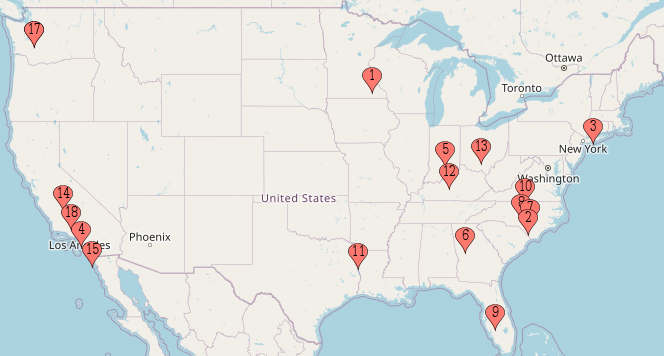
Click map to enlarge
|
|
|
|
|
&uuid=(email)) |
|
|
|

&uuid=(email)) |
|
|
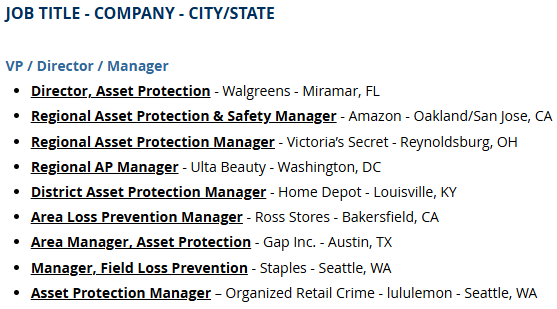
Featured Job Spotlights
|
Help Your Colleagues - Your Industry - Build a
'Best in Class' Community
|
 |
National Account Manager
Bohemia, NY
The National Account
Manager is responsible for managing and growing a portfolio of strategic
customer accounts while identifying opportunities to expand Delta Lock's
products and services within existing and prospective customers. This role
serves as the primary business relationship owner for assigned accounts... |
 |
Director, Asset Protection
Miramar, FL
The Director, Asset
Protection Operations & Execution (APD) is responsible for the development and
execution of the asset protection plan, Asset Protection talent and resources,
as well as resource and expense budgets... |

|
VP Loss Prevention & Safety
Plano, TX
Leads the enterprise-wide strategy for asset protection, loss
prevention, safety, security, and environmental compliance. Accountable for
minimizing financial and operational risk, strengthening internal controls, and
ensuring regulatory compliance across all locations...
|
Featured Jobs
To apply to any of today's Featured Jobs,
Click Here
 |
|
View Featured
Jobs
|
Post
Your Job
|
|
|
|
|
|

Insight,
humor & heart from
one of LP's most trusted voices |
|
|
Sometimes the Most Important Person in the Pilot Isn't in AP
It might be the
district manager who champions it, the IT person who makes integration
painless, the store manager who gets everyone using it, or the finance
person who finally understands the business case. Great solutions often
succeed because someone outside the original buying group says, “Wait,
this helps me too.” That's when a departmental tool starts becoming an
enterprise conversation.
Follow this space every day to see more of 'Hedgie's Hot Takes' |
|
|
|
Not getting the Daily? Is it ending up in your spam folder?
Please make sure to add d-ddaily@downing-downing.com to your contact list,
address book, trusted sender list, and/or company whitelist to ensure you
receive our newsletter.
Want to know how?
Read Here |
|
FEEDBACK
/
downing-downing.com
/
Advertise with The D&D Daily |
|
 |
&uuid=(email))



&uuid=(email))
&uuid=(email))