|
|




 |
|
 |
|
|
 
|
 |
|
Siffron's Shogun Tag™ Duo
Small Tag. Big Protection.
 The
Shogun Tag™ Duo
is a versatile retail security solution that simplifies product application
while delivering powerful protection. Offering two easy application
methods—removable adhesive or reusable elastic banding—the Shogun Tag™ Duo makes
it simple to secure merchandise across multiple surfaces and packaging types.
This streamlined setup reduces installation time for associates while ensuring
consistent, reliable theft protection.
Built with all the standard Shogun Tag™ functions, the Duo also adds the
flexibility of reusable banding, allowing tags to be reapplied as often as
needed. Clear banding can be used for a discreet application that won’t distract
from branding or product presentation, while integrated slots on the device
allow banding to be applied cleanly and securely.
Click here to learn more
The U.S. Crime Surge
The Retail Impact
Retailers Pushing Lawmakers On CORCA
Albertsons Lobbies on Retail Crime Bill Awaiting Senate Vote
 Albertsons
Cos. Inc., one of the largest food and drug retailers within the U.S.,
is lobbying on H.R. 2853, the Combating Organized Retail Crime Act of
2025. The bill, which was introduced in April 2025, has passed the
House and now awaits Senate action. The bill would expand federal
enforcement against organized retail and supply chain theft, concerning
"criminal offenses involving the interstate transportation of stolen
property, the sale or receipt of stolen goods, or theft from an
interstate or foreign shipment that is committed by, in coordination
with, or at the instruction of an organization."
Cogent Strategies LLC reported $130,000 for its third-quarter 2026
lobbying disclosure on behalf of Albertsons. That figure is
unchanged from the second quarter of 2026 and from the same quarter a
year earlier.
Across all three registrants in the third quarter of 2026, Albertsons
reported a combined $540,000: $360,000 from its in-house team,
$130,000 from Cogent Strategies LLC, and $50,000 from Ballard Spahr LLP.
That total is down $440,000 from the fourth quarter of 2025 and down
$380,000 from the third quarter of 2025.
Sponsored by Rep. David P. Joyce (R-OH-14), H.R. 2853 passed the House,
was placed on the Union Calendar on Jan. 30, and carries 206 cosponsors.
Retail and law enforcement groups, including the National Retail
Federation, Kroger, Walmart, and Target, back the bill, arguing
organized theft endangers workers and warrants coordinated federal
enforcement. The Leadership Conference on Civil and Human Rights,
the American Civil Liberties Union (ACLU), the NAACP, and allied civil
rights organizations have opposed the bill, arguing that its definition
could sweep low-level shoplifting into federal prosecution and that it
could expand Department of Homeland Security surveillance and
disproportionately harm Black and Brown people and immigrants.
Among the organizations also lobbying H.R. 2853 are the National
Retail Federation, Retail Industry Leaders Association, Kroger Co.,
Walmart Inc., and CVS Health, among more than 40 others listed on
the bill record.
legis1.com
Fallout From Retail Looting in France
More than 3,000 shops were looted, leading
to the arrest of more than 2,500 people.
Looted Goods From French Stores Flood Resale Sites After Riots
Officials in France are pressing
online platforms like eBay and Vinted to remove items that were stolen
during public disturbances over the weekend.
The online listings started appearing just hours after the looting in
France. For sale were a variety of items — handbags, skin care
products, lip glosses — suspected of being stolen by people who had
smashed windows and emptied stores in Paris, Lyon, Marseille and other
cities over the weekend.
Protests in France, which started over conditions in schools and
broadened into demonstrations against the rising cost of living,
descended into unrest on Saturday and Sunday. Several government
buildings were damaged and more than 3,000 shops were looted, leading
to the arrest of more than 2,500 people, officials said.
In Paris, many of the shops across Les Halles were looted and
vandalized, while the Place de la Bastille and Place de la Concorde
became center points for standoffs between the police and protesters.
Stores that were broken into included Louis Vuitton, Céline, Hermès and
the North Face, as well as video game shops, pharmacies and electronics
stores. A preliminary estimate showed the damage would cost several
hundred million euros.
Resale sites like Vinted said this week that they were cracking down
on items suspected to have been looted. Vinted said it was working
with the French authorities to detect malicious behavior.
“Since this weekend, our teams have taken immediate action to
identify and remove listings linked to the looting, and we have
stepped up monitoring of suspicious listings,” Vinted said in a
statement. “When our rules are breached, we act against the accounts
involved, up to permanent bans.”
President Emmanuel Macron of France warned on Sunday that “those who
looted will have to pay back, and those who sought to bring down the
republic will be held accountable.”
But many more people participated in the looting than the police will
be able to arrest, and it will be virtually impossible for resale
sites to take down all stolen items because of the scale of the theft,
said Charlotte de Montpellier, an economist at ING Bank.
nytimes.com
Which States Have the Worst
Shoplifting Scores?
Colorado could be a hotspot for shoplifting, analysis says
Colorado has signs of an issue with shoplifting, according to a
new analysis of FBI data.
The state has the fifth-highest shoplifting burden in the nation
measured in an analysis by The Law Offices of Tad Nelson. The criminal
defense and family law firm’s All-State Shoplifting Index is based on
FBI data on the reported shoplifting rate in each state in 2025, the
total volume of reports in the states in 2025, and the change in reports
between 2024 and 2025.
Colorado had an index of 77.76. It had 26,698 reports in 2025, down
1.9% from 2024 but up 20.6% from 2023. Its shoplifting rate was
447.9 reports per 100,000 covered residents. (A spokesperson for the law
firm acknowledged a typo led to inaccurate figures for the number and
rate of shoplifting reports in Colorado being published on its website.)
While the drop from 2024 to 2025 was a positive, 42 states saw
declines. There were 1,069,716 reports nationally in 2025, down 4.7%
from 2024. The rate and slower year-over-year increase are the
biggest marks against Colorado in the index.
The report carries a caveat that it is “not a measure of every
shoplifting incident, retail shrinkage, or organized retail theft loss.”
It is based solely on reports to the FBI, and agencies and jurisdictions
have varying practices for recording and reporting shoplifting
incidents.
Which states have the worst shoplifting index
scores?
-
Arizona
-
Pennsylvania
-
Maryland
-
Oregon
-
Colorado
-
New Jersey
-
Virginia
-
New York
-
California
-
Nevada
aol.co.uk
New Anti-Theft Rollout at Apple
Stores
Apple Stores Reportedly Rolling Out New Anti-Theft System for
iPhones
Bloomberg's Mark Gurman today reported that Apple is facing a
growing problem where some people will buy iPhones or other
products and either remove accessories from the box, open up the
device and remove components, and/or remove the entire device,
and then attempt to return the box hoping that the employee will not
notice.
When a customer seeks to return an iPhone, he said that Apple's
retail employees have ordinarily been instructed to open the box and
verify the contents, but Apple has since come up with a solution
that will cut down on wasted inventory.
In his Power On newsletter today, Gurman said Apple has started
providing retail employees with a device that can "scan an in-box
iPhone and run diagnostics on it to make sure the phone is fully
intact, leaving the box sealed and able to be put back into
inventory." Apple began rolling out this device to stores earlier
this month, he said.
These are the same devices that Apple's retail employees have been
using to install iOS updates on iPhones without taking them out of
the box. More recently, the devices can add a personalized greeting
to the iPhone Duo's setup screen.
macrumors.com
Businesses Worldwide Battle
Employee Theft
How employee theft is hurting small businesses in Africa
Employee theft is a huge problem for many small businesses owners
in Africa, where a handful of employees may control payments,
stock and supplier transactions, often with limited oversight.
A 2022 survey by PwC, one of the world's biggest consultancy firms,
found that 63% of respondents in East Africa said their
organisations had experienced economic crime, compared to a
global figure of 46%.
The risks are not confined to small businesses. Some of East
Africa's biggest supermarkets have also reported significant losses
linked to employee fraud and stock theft. Tuskys and Nakumatt have
both collapsed this decade amid wider financial and operational
problems partly attributed to employee theft.
At its peak, Tuskys had more than 6,000 employees and over 60
branches across Kenya and Uganda. In 2015, the retailer hired
loss-prevention firm Hipora Business Solutions East Africa to help
tackle fraud. An audit found that Tuskys was losing more than 100m
Kenya shillings (£581,000; $770,000) a month to employee theft,
Business Daily reported. The alleged schemes included cashiers
pocketing money, manipulating till transactions, and colluding with
suppliers over goods received.
Hipora, which works with businesses across East and Southern Africa,
says employee theft is a huge problem, estimating that it
accounts for more than 60% of losses recorded by small businesses.
bbc.com
Lawmaker resigns after Walmart shoplifting allegations — blames
‘cognitive’ decline
State Sen. Ron Alting, an Indiana
Republican, was reportedly caught pocketing items at Walmarts in
Lafayette and Monticello, and even took his brazen exploits to
Naples, Florida, according to the Journal & Courier.
One Checkout Trick Fell Apart When A Store Worker Grabbed The
Merchandise And Called Out A Customer For Repeatedly Manipulating
The Purchase
Why Do We Steal Things From Restaurants?

Retail Loss Goes Beyond Shoplifting
Beyond Shrink: Why 2% of Revenue Is the Number That Actually Stops
Retail Loss
 By
Tony D'Onofrio - President,
Sensormatic
Most retail loss conversation seem to start in the same place: a
shoplifter walking out the front door. The new IHL Group and Sensormatic
study, “Beyond Shrink: 2026 Global Total Retail Loss,” surveyed 1,421
retailers across twelve countries to show just how incomplete that
picture has become. External theft, including organized retail crime,
is real and rising, but it accounts for only 25 percent of what
retailers actually lose. The other 75 percent is where this report
breaks new ground, and where most of the real surprises live.
That other 75 percent breaks down across supplier fraud, employee theft,
warehouse and receiving discrepancies, return fraud, administrative
errors, and e-commerce fulfillment loss. Sixty four percent of total
retail loss never involves a shoplifter at all. This percentage was
surprising.
The study’s timing matters as much as its scope. IHL and Sensormatic
found that theft had actually begun improving earlier in 2025, until the
war in Iran pushed fuel prices up and reversed the trend almost
everywhere at once. Across all six loss categories tracked, 54 to 69
percent of retailers now report increases year over year. The
economy turns out to be the real variable moving these numbers, well
ahead of store design or staffing levels.
My favorite surprise in the whole study is what happens to the ranking
once you isolate urban retailers. Globally, external theft leads at 25
percent, well ahead of anything else. But among retailers with at
least 70 percent of stores in cities, supplier fraud and goods-receipt
discrepancies take the top spot at 19 percent, edging out external theft
at 18. Retailers have spent a decade hardening the front door. The
back door and the loading dock, it turns out, are often the easier
target, and almost nobody was watching.
A close second surprise sits in the cost data. An administrative process
error costs retailers 103 dollars and 40 cents per incident, nearly
matching the 107 dollars lost to a single employee theft incident.
Fixing paperwork errors can deliver financial benefits comparable to
stopping a shoplifter, a case almost never made in a loss prevention
budget meeting.
Click here to read Tony's full article
Using AI to Manage Seasonal Hiring
Gap Inc. Gets an AI Assist for Seasonal Hiring
The fashion retailer says it’s
piloting Bridgette, an AI-enabled virtual career guide, to make hiring
"faster, simpler, more engaging, and more human where it counts."
Gap Inc. has found a solution for better managing the complicated and
busy process of hiring seasonal workers for the holiday period —
artificial intelligence.
In June, Gap Inc. launched Bridgette, an AI-enabled virtual career
guide to help job seekers connect with seasonal opportunities at the
Gap, Old Navy, Banana Republic and Athleta brands.
According to Gap officials, Bridgette makes the hiring journey
“faster, simpler, more engaging and more human where it counts.”
The San Francisco-based fashion retailer indicated that nearly 45,000
job candidates have engaged with Bridgette in a pilot program spanning
over 100 stores and six of Gap Inc.’s regional distribution centers.
Now, Bridgette is being scaled across open roles in Gap Inc.’s stores
and distribution centers.
“For store leaders, the technology has scheduled over 7,000
interviews, reducing time spent on administrative tasks and giving
managers more time for the work that matters most in stores — leading
teams, coaching associates, running the business and serving customers,”
Gap said in a statement to WWD.
wwd.com
AI Compliance Shortcuts Increase
Regulatory Risks
Skipping AI Review of Compliance Results in Higher Fines
40% of compliance teams act on
AI-generated regulatory guidance without expert review, says study from
Enhensa.
AI adoption in compliance has become nearly universal as regulatory
complexity rises. While the technology offers many benefits, it must be
reviewed for errors. However, many companies seem to be skipping this
step.
A new survey, The state of AI in regulatory compliance: 2026 benchmark
report, from Enhesa found that 40% of compliance teams act on
AI-generated regulatory guidance always or often without expert review.
The consequences of this could prove costly since teams that skip
verification entirely are nearly three times as likely to report a
regulatory fine (37%) against those that don’t (13%).
Enhesa tracked more than 22,000 major regulatory changes in 2025,
along with over 15,000 major changes in 2026 through August, and the
study is based on responses from 273 senior compliance, risk, EHS, legal
and sustainability decision makers at multinational companies with 5,000
or more employees.
To manage regulatory pressure, 76% of teams now run AI across the
entire compliance function or fully autonomously on at least one core
compliance task. Fifty-six percent (56%) have already faced a
negative outcome tied to unverified or incorrect AI output.
ehstoday.com
Study: Halloween events, attractions to drive $1.2B in extra spending
How retailers can turn free in-store Wi-Fi into a marketing channel
Kroger to open 110 stores; unveils three updated formats
Last week's #1 article --
Who and What Is Fueling Self-Checkout
Theft?
27% of Americans Have Stolen Something at Self-Checkout
 More
than a quarter of Americans admit to having stolen something at a
self-checkout register. In a survey carried out by LendingTree in
October of 2025, 27 percent said they had ever intentionally taken an
item at a self-checkout without paying. More than a third of respondents
said they had unintentionally taken something without scanning it.
Members of Gen Z as well as Millennials are most likely to have
stolen something intentionally, at between 37 percent and 41 percent
admitting to it as part of the survey. Gen X members and Baby Boomers
are much less likely to say they swiped something from the store.
A study by retail technology company Grabango recently found that
self-checkout registers cost stores on average 3.5 percent of sales.
Despite the low number, this still translates to millions of dollars for
larger retailers, prompting many of them to take action against
self-checkout theft. Of course, retailers are also saving personnel
costs when deploying self-checkout terminals.
Difficulty affording the items in question and price increases are
the most cited reasons, given by almost half of those who stole
something at self-checkout for each case. This is followed, at 39
percent, by prices feeling unfair or too high in general and, at 35
percent, by self-checkout feeling like a task customers should reimburse
themselves for. 29 percent find that the harm seems minimal at larger
stores, while 21 percent say the chance of being caught is low and
between 14 percent and 17 percent say negative experiences at the store
in question made them justify the behavior. 13 percent say they started
by copying friends and family. The survey also found that men were twice
as likely as women to admit to self-checkout theft.
statista.com
|
|

|
All the News - One Place - One Source - One Time
Thanks to our sponsors/partners - Take the time to thank them as well
please.
If it wasn't for them The Daily wouldn't be here every day for you.
|
|
|
 |
|

 |
|

|
|
10% of Offenders Responsible for 70% of Retail Crime Loss and Harm,
Auror Data Shows
New findings highlight the growing
importance of collaboration, intelligence-sharing and technology in
combating organized retail crime.
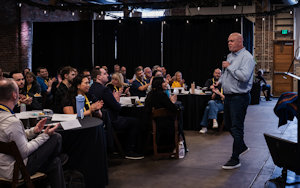 A
relatively small group of repeat offenders is responsible for a
disproportionate share of retail crime, according to new data released
by Auror
following its North America Network Summit in
Denver on October 15.
Retailers using the Auror platform reported that the top 10% of
offenders account for 70% of external loss and harm in their stores
globally, underscoring the importance of identifying and disrupting
repeat offenders rather than treating every retail crime incident as an
isolated event.
The findings were shared as major U.S. and Canadian retailers gathered
to discuss retail crime challenges and opportunities for greater
collaboration over the next 12 months.
Over the past five years, North American retailers have recorded
approximately 11.6 million retail crime events through Auror's platform.
That reporting has helped identify 18,000 repeat offenders operating
across multiple organizations, illustrating how shared intelligence can
reveal patterns that individual retailers might otherwise miss.
Auror also reported that more than 3 million events have been linked
to repeat offenders worldwide through its network, which includes
more than 62,000 stores across North America.
The figures highlight a growing emphasis within loss prevention on
connecting incidents, identifying repeat offenders and building stronger
cases that can support investigations and law enforcement partnerships.
Technology
is also helping streamline the reporting process. According to Auror,
some major retailers have reduced average crime reporting times to just
six minutes, potentially allowing store teams to document incidents
more efficiently while maintaining their focus on daily operations and
safety.
"Tackling organized retail crime syndicates requires retailers, law
enforcement and industry partners to all come together as a united
network," said Jon Briegel, Auror's Global
Director of Solution Engineering.
 The broader takeaway for the retail industry is that effective crime
prevention increasingly depends on what happens beyond an individual
store's walls. Connecting information across locations and
organizations can help investigators recognize patterns, prioritize
high-impact offenders and develop a more coordinated response to retail
crime.
As retailers confront persistent theft, violence and organized criminal
activity, collaboration and actionable intelligence remain central
to protecting employees, customers and merchandise.
|
|
 |
|
|
 |
|
|
Low-Skilled Hackers Become A Lot More
Dangerous
Agentic AI helps hackers level up, even without detailed instructions
Low-skilled hackers are likely to
become a lot more dangerous over the next 12 months, CrowdStrike warned.
Threat actors are deploying agentic AI in more sophisticated ways to
automate aspects of their hacking campaigns, according to
CrowdStrike.
“In 2026, CrowdStrike Intelligence has documented several incidents in
which threat actors used AI not only to create tooling or artifacts, but
to conduct agentic campaigns in which AI agents make decisions and
execute commands,” the security firm said in a report published on
Wednesday.
The report details the activities of four threat actors, two using
sophisticated AI harnesses — the software connecting a large
language model to external resources, giving it agentic capabilities —
and two using simpler harnesses.
The two groups that used simple harnesses were still able to hack into
“numerous organizations,” CrowdStrike said, “demonstrating that the
primary barrier to scaling an AI-orchestrated intrusion campaign is not
engineering complexity but token budgets.”
Security experts have spent years predicting that hackers would
eventually weaponize AI capabilities in sophisticated ways, moving
beyond improved phishing emails to automated activities that used to be
too complex for humans to hand off to machines. CrowdStrike’s report
provides fresh evidence of that evolution in AI hacking techniques — and
serves as a warning to businesses about the need to rapidly modernize
defenses to stay ahead of increasingly relentless adversaries.
“This delegation allows Al to operate at potentially faster speeds,
and for longer durations, than some human actors,” CrowdStrike said
in its report. And beyond improving the speed of attacks, “Al also
solved problems not explicitly covered in playbook guidance provided by
threat actors.”
cybersecuritydive.com

The Growing Cost of Cyberattacks
Large businesses’ cybersecurity insurance claims are now less frequent
but more expensive
AI-powered attacks and hidden
supply-chain weaknesses are making insurers’ work more difficult,
according to a new report.
The size of the cybersecurity insurance market is growing quickly as
more businesses try to guard against the damage from a major hacking
incident.
“Total U.S. domestic cyber direct written business has nearly tripled
since 2020, making cyber insurance one of the fastest-expanding segments
in insurance,” the National Association of Insurance Commissioners said
in a statement Wednesday about its new report on the topic.
Chubb, Beazley and St. Paul Travelers are the top three insurers by the
value of their direct written premiums, according to the report.
Insurance payout data illustrates how much costlier cyberattacks are
becoming, as AI empowers even low-skilled hackers to carry out
sophisticated and wide-ranging attacks.
For businesses with at least $1 billion in annual revenue, the average
size of a claim in 2025 was $4.4 million — double the figure from 2024
and up 586% since 2021. NAIC attributed the skyrocketing growth to
“rising business interruption expenses and the growing cost of data
breach and privacy-related litigation.”
The average claim size also rose for businesses in the mid-market,
but more modestly. In 2025, it was $759,000, a 23% increase from the
2024 figure of $619,000. Smaller firms saw a decline in their average
claim size between 2024 ($215,000) and 2025 ($142,000).
cybersecuritydive.com
Website Spoofing Threat
Weak encryption certificates could have let hackers easily spoof
websites
Major web browsers blocked the
eMudhra TLS certificates to prevent them from being weaponized.
An Indian company’s serious error in creating high-level encryption
certificates has prompted major web browsers to block the
certificates before hackers can use them to spoof websites.
The issue involves intermediate certificates created by the Indian firm
eMudhra, a company with the authority to issue certificates that are
trusted by Google Chrome, Microsoft Edge, Mozilla Firefox and other
browsers. Certificate issuers use intermediate certificates to “sign”
individual website certificates that assure users of the sites’
legitimacy and security. But eMudhra recently failed to apply the proper
procedures when creating eight of its intermediate certificates,
producing keys that were shockingly weak.
Key strength is measured in the number of bits of entropy used to
randomly create them. Private keys usually contain hundreds of bits of
entropy. eMudhra’s faulty keys contained between three and eight.
Because it was trivially easy to break the encryption protecting
eMudhra’s intermediate certificates, hackers could have weaponized them
to sign fraudulent transport layer security (TLS) certificates that
would let them impersonate major companies.
“An attacker can create a forged certificate for any domain and use
it to impersonate servers to intercept or modify traffic,” internet
infrastructure firm Cloudflare said in a blog post. “This is a
serious security incident with implications across the internet.”
cybersecuritydive.com
PHP exploitation moves at slower-than-expected pace, but millions remain
at risk
Washington's message to AI execs: Please shut up |
|
|
 |
|
|
Walmart Rolls Out AI Shopping Agents
Walmart prepares its ecommerce platform for AI shopping agents
Walmart introduced tools to help customers shop through AI agents and
make it easier for those agents to operate on its platform. The
retailer also laid out clearer guidelines for what AI agents can and
cannot do within its ecosystem.
Starting next month, shoppers will be able to create agent profiles
to better distinguish such purchases from their own. Customers will
be able to authorize each individual AI agent via dedicated profiles
within their account, allowing them to see each agent’s purchases and
determine how much autonomy—if any—to allow. Shoppers can require
approval for each purchase or permit agents to make transactions below a
predetermined spending limit.
Walmart’s guidelines emphasize that customers are in the driver’s
seat, and agents can only take action as directed by the shopper.
Agents are also blocked from accessing or changing customers’ payment
information and any other data irrelevant to their assigned task. Those
that don’t follow Walmart’s terms risk being barred from the retailer’s
site.
Having stricter controls could give shoppers more confidence in
outsourcing purchases to agents. US consumers place greater
importance on controlling AI shopping agents and reviewing and approving
purchases than on the potential money or time savings that such tools
can provide, according to Synchrony’s 2026 AI in Commerce Study.
Walmart is also making sure its website is equipped to handle the
needs of AI agents, which have different requirements than human
shoppers. The retailer’s new “Walmart Agent Gateway” uses a model
text protocol (MCP) to give agents a faster, more reliable way to shop.
The gateway limits the amount of customer data agents have access to,
giving them just enough information—such as frequently ordered
products—to carry out tasks without revealing a shopper’s entire
purchase history or other personal information.
Still in its beta stage, Walmart Agent Gateway could become one of
the company’s most critical investments. As agentic adoption grows,
retailers will have to find ways to appeal to the LLMs themselves—a
significant challenge, given their black-box nature. Features like the
gateway that help make websites more accessible and readable to agents
can enhance AI visibility and deliver a smoother shopping experience,
which in turn could help shoppers overcome their hesitance to use
agentic tools.
emarketer.com
Etsy Cracking Down on AI Listings
Etsy updates AI use policies to emphasize craftsmanship
While it’s implementing more AI, the
online marketplace now requires at least one authentic, non-AI generated
image in most seller listings.
E-commerce marketplace Etsy is cracking down on AI use in product
listings.
Etsy now mandates that most listings include at least one unedited photo
of the product against a real background, according to a company blog
post Thursday outlining its updated policies.
Functional guides — such as patterns, recipes and instructions — can no
longer be AI-generated and must showcase real results made by using the
guide.
Buyers who open cases with Etsy because the product is materially
different than the listing may receive a refund from sellers if the
listing didn’t meet Etsy’s updated image requirements. Bot-generated
listings aren’t allowed and such listings will be removed.
retaildive.com
The Booming Business of Beauty on TikTok Shop
Wonder scales mid-Atlantic Grubhub robotic delivery |
|
|

|
|
Salem man arrested for theft, $10,000 of merchandise recovered
A Salem man was arrested on outstanding warrants for theft and
coercion, the Keizer Police Department said on Thursday, Oct. 22.
The arrest brought the recovery of over $10,000 of merchandise,
police said in a statement, including tools, household appliances
and electronics. The items appeared to be in their original
packaging and in new condition, according to a document detailing
probable cause for the arrest. The department announced the arrest
of Carlos D. Chale, 27, of Salem, in a statement. He was arrested on
Tuesday, Oct. 20, in an operation coordinated by Keizer Police and
involving the Salem Police Department’s Street Crimes Unit and the
United States Drug Enforcement Administration. A small amount of
what is suspected to be illegal drugs was also recovered, the
statement said. When he was arrested, Chale had a glass smoking pipe
and a small bag containing one gram of what initial tests indicated
was methamphetamine, according to the probable cause document.
During the operation, law enforcement searched a Salem apartment and
storage unit, the statement said. A “large amount” of what law
enforcement suspects is stolen property was in the storage unit
associated with Chale, according to the probable cause document. The
arrest followed a multi-year investigation by Keizer Police that
began in February 2025 after a residential burglary involving
property damage and threats against a family. Chale was identified
as a suspect, and warrants were issued for his arrest, the statement
said. In 2026, Chale was linked to suspected drug activity and
stolen merchandise in the Salem area, the statement said.
Investigators also found outstanding arrest warrants related to
cases in multiple counties.
salemreporter.com
Washington County, VA: Pair accused of stealing $37K in merchandise
from Walmarts across region
Authorities have recovered hundreds of suspected stolen items and
arrested two people who were allegedly part of an “organized retail
theft operation” that involved Walmarts in Southwest Virginia. The
Washington County Virginia Sheriff’s Office (WCSO) announced in a
news release that Kayla Watson, 35, and Ricky Denning, 34, were
identified as suspects. Watson and Denning, both of Raleigh, NC,
were taken into custody in Raleigh on Tuesday.
wjhl.com
St Louis, MO: Alabama duo accused in $22K theft spree targeting St.
Louis, multiple states
Corte Madera, CA: 3 Youths arrested in $6,000 Luluemon theft probe
Catawba County, NC: Man charged with stealing more than $1,200 worth
from hardware store
Coram, NY: Man wanted for fraudulently returning items stolen from
Coram Home Depot

|
|
|
|

|
|
|
|

|
|
|
Shootings & Deaths
Towson, MD: Armed Security Guard kills man who brandished knife in restaurant
Baltimore County police are investigating the circumstances that led to a
security guard shooting a man inside the Crackpot Bar in Towson early Sunday
morning. Police said officers arrived at the Crackpot Bar on Loch Raven
Boulevard shortly before 1 a.m. for a reported shooting. Upon arrival, officers
learned a man brandished a knife during a fight inside the restaurant. Police
said an armed security guard shot the man, who died on the scene. A woman inside
the restaurant was also injured and is currently receiving treatment, according
to police. Officials said the security guard remained on the scene and is
cooperating with the investigation.
wbaltv.com
Butler County, NE: Nebraska State Patrol releases additional information on
homicide, trooper-involved shooting investigations
NSP said law enforcement identified 45-year-old Nathan Dohmen of Clarks as the
suspect. The resident of the home, 47-year-old John Cyza of Duncan, was found
dead at his home with multiple gunshot wounds. According to NSP, Dohmen left the
scene before law enforcement arrived. The 911 caller provided information that
Dohmen may be targeting a second person. The second person was found and is
safe. NSP said law enforcement responded to the area to search for Dohmen. The
Butler County Sheriff’s Office found the vehicle on a rural road in Butler
County. As the sheriff began checking the vehicle, Dohmen reportedly fired at
the sheriff with a rifle. The sheriff was not hit. Dohmen then drove away in the
vehicle. After fleeing that scene, Dohmen stopped at a store in Bellwood and
stole a case of beer. A short time later, Dohmen’s vehicle was found by
troopers. A brief pursuit ensued before Dohmen pulled into a farmhouse driveway.
NSP said Dohmen then fired at the troopers, who returned fire. Dohmen was hit
and died at the scene. No troopers were injured in the shooting, and the
resident of the farmhouse was also not injured.
knopnews2.com
Florence County, SC: Two people shot in vehicle outside Food Lion in South
Carolina
Two people were shot Saturday outside a Food Lion supermarket in South Carolina,
according to the Florence County Sheriff’s Office. The gunfire happened inside a
vehicle in the parking lot and two people inside the car suffered
life-threatening injuries, the sheriff’s office said at about 9 p.m. in a news
release. Further information on the victims’ conditions was not available. No
other injuries were reported.
amp.thestate.com
Robberies, Incidents & Thefts
Bell County, TX: Grand Jury hands down 3 armed robbery indictments
Pacifica, CA: Three arrested for allegedly stealing from Spirit Halloween in
Pacifica
|
|
|
|

•
Beauty – St Louis, MO
– Robbery
•
C-Store – San Antonio,
TX – Armed Robbery
•
C-Store – Hopewell, PA
– Armed Robbery
•
C-Store – Nassau
County, NY – Armed Robbery
•
C-Store – Chicago, IL
– Burglary
•
Clothing – Pacifica,
CA – Robbery
•
Clothing – Corte
Madera, CA – Robbery
•
Dollar – El Paso, TX –
Burglary
•
Grocery – Polk County,
FL - Robbery
•
Hardware - Catawba
County, NC – Robbery
•
Hardware - Coram, NY –
Robbery
•
Pharmacy – Baltimore,
MD – Robbery
•
Restaurant – Tampa, FL
– Armed Robbery
•
Restaurant – Newport
News, VA – Armed Robbery
•
Restaurant – Chicago,
IL – Burglary
•
Storage – Long Island,
NY – Robbery
•
Walmart - Leesburg, FL
– Robbery |
|
|
Daily Totals:
• 14 robberies
• 3 burglaries
• 0 shootings
• 0 killed |
|
|
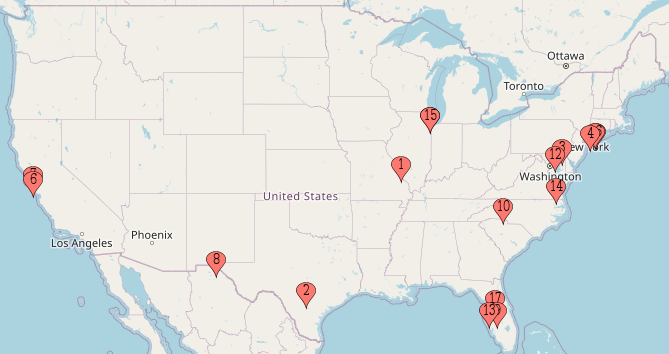
Click map to enlarge
|
|
|
|
|
 |
|
|
|

 |
|
|
Featured Job Spotlights
|
Help Your Colleagues - Your Industry - Build a
'Best in Class' Community
|
 |
National Account Manager
Bohemia, NY
The National Account
Manager is responsible for managing and growing a portfolio of strategic
customer accounts while identifying opportunities to expand Delta Lock's
products and services within existing and prospective customers. This role
serves as the primary business relationship owner for assigned accounts... |
 |
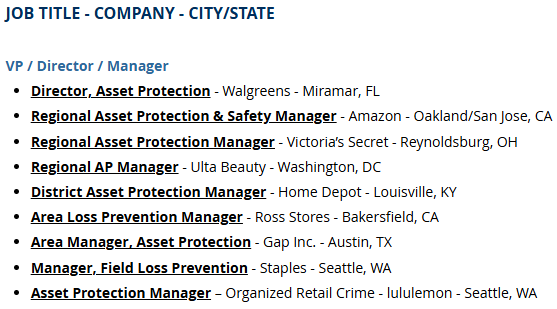
Director, Asset Protection
Miramar, FL
The Director, Asset
Protection Operations & Execution (APD) is responsible for the development and
execution of the asset protection plan, Asset Protection talent and resources,
as well as resource and expense budgets... |

|
VP Loss Prevention & Safety
Plano, TX
Leads the enterprise-wide strategy for asset protection, loss
prevention, safety, security, and environmental compliance. Accountable for
minimizing financial and operational risk, strengthening internal controls, and
ensuring regulatory compliance across all locations...
|
Featured Jobs
To apply to any of today's Featured Jobs,
Click Here
 |
|
View Featured
Jobs
|
Post
Your Job
|
|
|
|
|
|

Insight,
humor & heart from
one of LP's most trusted voices |
|
|
Never Underestimate the Power of the Person
Who Actually Knows How Everything Works
Every company has
one. They may not have the biggest title, but when something breaks, six
people say, “Call Susan.” Susan knows which system talks to which
system, who owns the process, why the policy changed in 2019, and where
the metaphorical bodies are buried. Identify Susan early. Respect Susan.
And for heaven's sake, make sure Susan takes vacations before Susan
decides to retire.
Follow this space every day to see more of 'Hedgie's Hot Takes' |
|
|
|
Not getting the Daily? Is it ending up in your spam folder?
Please make sure to add d-ddaily@downing-downing.com to your contact list,
address book, trusted sender list, and/or company whitelist to ensure you
receive our newsletter.
Want to know how?
Read Here |
|
FEEDBACK
/
downing-downing.com
/
Advertise with The D&D Daily |
|
 |