&uuid=(email))
 |
|
&uuid=(email))
&uuid=(email))
&uuid=(email))
&uuid=(email))
&uuid=(email))
&uuid=(email))
&uuid=(email))
&uuid=(email))
&uuid=(email))
&uuid=(email))
&uuid=(email))
&uuid=(email))
&uuid=(email))
&uuid=(email))
&uuid=(email))


 |
|
|
 |
|
|
Michael Riley appointed
Director of Field Asset Protection & Safety for Village Super Market
 Village
Supermarket & the Wakefern Corporation is incredibly proud to announce
that Michael Riley, LPC, has been appointed Director of Field Asset
Protection & Safety for Village Super Market, Inc. Village
Supermarket & the Wakefern Corporation is incredibly proud to announce
that Michael Riley, LPC, has been appointed Director of Field Asset
Protection & Safety for Village Super Market, Inc.
Mike’s appointment represents an important step forward as we continue
building a Best-In-Class Asset Protection, Safety, Food Safety and
Investigations organization across Village Super Market’s ShopRite,
Fairway Market and Gourmet Garage operations.
In this expanded leadership role, Mike will lead field execution of our
enterprise strategy—strengthening operational standards, developing
high-performing teams, advancing innovative asset protection solutions
and helping foster a culture in which safety is personal and every
associate understands the role they play in protecting our people,
customers and business.
Congratulations, Mike! |
See All the LP Executives 'Moving Up' Here | Submit
Your New Corporate Hires/Promotions or New Position |
|
&uuid=(email)) |
|
|
 &uuid=(email))
|
&uuid=(email)) |
|
|

Most LP resources
are built for full departments. This session is a
conversation with retailers who don't have large teams
but are getting real results anyway. They'll share what
life looked like before, what it took to get started,
the moment they saw their investments pay off, and the
lessons they learned along the way.
What attendees will take away
-
What success looks like for a lean LP team
-
How to evaluate and implement new technology without
overwhelming your workload
-
What a real return on investment looks like, from
retailers who've seen it firsthand
-
Practical ideas for increasing your team's impact
without increasing headcount
-
Lessons other retailers wish they'd known before
they got started
Register here
|
The U.S. Crime Surge
The Retail Impact
CORCA Debate Heats Up As Bill Inches
Toward Passage
The bill has widespread bipartisan support
in Congress, but progressive groups are trying to sink it
Congress has a plan to fight retail crime. Advocacy groups call it a
‘Trojan horse’ to expand federal surveillance, deportation initiatives
Retail industry leaders and
bipartisan federal lawmakers say a new fusion center in the Department
of Homeland Security will fight sophisticated crime rings. Civil
liberties advocates see a thinly-veiled expansion of ICE’s stated
mission.
A new bill likely to pass the United States Senate would create a new
crime coordination center for a subdivision of U.S. Immigration and
Customs Enforcement to fight organized retail crime, worrying civil
rights advocates.
 However,
retail industry leaders have for years pushed for congressional
action on organized retail and supply chain crime, which they say costs
businesses billions of dollars per year. The
Combating Organized Retail Crime Act has the support of
hundreds of leading retail companies and Congressional leaders of both
parties. Retailers say the legislation is aimed at taking down
sophisticated retail theft groups rather than shoplifters. An FBI report
in 2025 found that individuals participating in “flash mob”-style retail
crimes from 2020 to 2024 stole more than $8 million worth of products. However,
retail industry leaders have for years pushed for congressional
action on organized retail and supply chain crime, which they say costs
businesses billions of dollars per year. The
Combating Organized Retail Crime Act has the support of
hundreds of leading retail companies and Congressional leaders of both
parties. Retailers say the legislation is aimed at taking down
sophisticated retail theft groups rather than shoplifters. An FBI report
in 2025 found that individuals participating in “flash mob”-style retail
crimes from 2020 to 2024 stole more than $8 million worth of products.
David Johnston, vice president of retail asset protection and operations
for the National Retail Federation, argued the collaboration that
CORCA would create for retail crime is necessary to help local
authorities track down the individuals Johnston said are organizing such
crimes, who may be operating far from where the store-level crime
occurred.
In addition to shoplifting, Johnston said organized crime groups are
targeting cargo shipments — which the retail industry says can cost
up to $6.6 billion a year — as well as performing supply chain thefts,
expanding digitally-based scams, and reselling stolen products.
“These groups have become so sophisticated, the breadth of these
groups have become transnational to a degree,” Johnston said. “It’s
very similar to what we do with human trafficking, drug trafficking, and
other crimes that expand across our nation and even our borders.”
NY-22 Representative John Mannion, a Democrat, in a statement to Central
Current, said that CORCA provides law enforcement the necessary
resources to respond to complex crimes that may involve interstate or
foreign shipments.
Mannion voted for the bill, which he said does not grant ICE any new
data collection or immigration enforcement authority.
centralcurrent.org
Gap in New York's 'Retail Worker
Safety Act'
Op-Ed: New York Violence Policy Forgot Restaurants
In 2024, New York State passed the
Retail Worker Safety Act to better equip its workforce for
aggressive and problematic behavior on the job. The informational video
for the program uses a restaurant façade to illustrate applicable
businesses, but the law itself explicitly excludes restaurants. This
exclusion from mandatory workplace violence prevention is a deliberate
choice—and one that can be changed.
Restaurants are the second-largest private employer in New York State
and are operating without a healthy and consistent way to protect
employees’ well-being and mitigate any problematic behavior.
Restaurant violence has two main sources: the first is
customer-on-employee violence (For example, aggression around alcohol or
threats over refused service) and the second type would be violence
between coworkers and/or employers (For example, an abusive chef or
retaliation from a manager). Documented abuse like this has long been
normalized as a part of the industry.
New York has already built the tool to address this. Retailers with
more than ten employees must adopt a prevention policy, provide
prevention training, and provide a risk assessment of the workplace.
Risk assessments can include: “Employer review of worker and police
reports of incidents of assault or aggressive behavior from the past two
years” or “Solicitation of worker feedback on their experience of
violence or aggressive behavior and areas of risk within the store.”
Retailers with more than 500 employees must provide a “silent response
button” and training for said button. The NYS Department of Labor’s
website includes a policy model, additional tips for training, and
encourages a violence “report system.” Training must be provided every
one to two years.
According to the act, a “retail store” is “a store that sells
consumer commodities at retail and which is not primarily engaged in the
sale of food for consumption on the premises.” This is a line that
has gone unchanged since the bill’s original version, introduced in
January of 2024.
While the RWDSU has organized with those involved with the restaurant
industry (such as the She Wolf Workers Union), they were not included as
an example of an at-risk worker in the justification for the bill.
Instead, it highlighted jobs such as grocery store workers who are
“targeted for racially motivated mass-shootings,” particularly in the
wake of the Tops Supermarket shooting in Buffalo in 2022. It seems
like restaurant workers weren’t cut in the negotiation, rather they were
never considered because there weren’t advocates representing them.
nycfoodpolicy.org
The Odd Crime-Fighting Couple
Former gang member & prosecutor who put him in prison team up to fight
street violence
Jarrell Daniels found an ally in his fight to tamp down gang violence
in the most unlikely of people — the prosecutor who put him behind
bars for six years.
After being convicted for shooting a rival gang member, Daniels, now 31,
is a PhD student in psychology and social intervention at New York
University. He’s also the founder of Columbia University’s Justice
Ambassadors Youth Council, a three-month program where young adults,
particularly those involved in gangs, work with public officials to push
reforms to the city’s justice system.
At Daniels’ side is Nigel Farinha, the Office of Special Narcotics
prosecutor who worked on his case and helped get him convicted.
nydailynews.com
Crime in the Spokane area continues to fall, data shows
See the murder total, violent crime rate in 300-plus Michigan
communities
&uuid=(email))
Hidden Sources of Retail Loss
When Shrink Starts Behind the
Scenes
By the D&D Daily staff
 Not
every loss prevention challenge begins with a theft. Not
every loss prevention challenge begins with a theft.
For retailers, some of the most persistent sources of loss can
originate far from the sales floor — inside receiving areas,
stockrooms, distribution networks and everyday operational
processes.
Inventory can disappear without anyone intentionally taking it.
A shipment may be received incorrectly. Merchandise can be damaged
but never properly recorded. Products can be sent to the wrong
location, counted twice or missed entirely. Returns can be processed
incorrectly. Even a simple breakdown in communication between
stores, distribution centers and vendors can create inventory
discrepancies that become difficult to untangle months later.
That makes operational excellence an increasingly important part
of modern asset protection.
For AP teams, the challenge is identifying where those breakdowns
occur before they become recurring sources of loss. That can
mean reviewing receiving procedures, analyzing inventory
adjustments, examining unusually high damage rates or looking for
patterns among stores experiencing unexplained shrink.
Technology is making that work easier. Modern inventory
systems can give retailers greater visibility into the movement of
merchandise from distribution center to store and eventually to the
customer. Analytics can also flag unusual discrepancies, allowing AP
and operations teams to investigate problems that might otherwise
remain hidden until the next physical inventory.
But technology only goes so far. Clear procedures and consistent
execution remain critical. Employees need to understand how
merchandise should be received, transferred, damaged out and
returned — and why accurately completing those processes matters.
The broader lesson is that asset protection isn't simply about
stopping someone from walking out the door with merchandise.
Sometimes protecting assets means finding the small operational gaps
quietly costing the organization money every day.
For today's AP teams, reducing shrink increasingly requires
looking beyond individual incidents and examining the entire
lifecycle of inventory. Because when merchandise goes missing on
paper, identifying exactly where the process broke down can be just
as important as knowing where the product went.
Green Scorecards and Fatalities:
The Executive Case for Safety Capacity
Lagging indicators show what has
already happened, but safety capacity reveals what an organization
can do when conditions change unexpectedly.
Every executive recognizes the feeling. The quarterly safety review
opens, the dashboard loads, and the indicators glow green.
Recordable rates are down. No serious injuries this period. Audit
actions are closed on schedule. Around the table, shoulders relax.
The system appears to be working.
Green scorecards are reassuring, but they are incomplete.
Lagging indicators describe what has already happened under the
conditions that existed. They say very little about what an
organization is capable of when conditions shift, when the
unexpected arrives, or when the next decision carries a risk no one
anticipated. That gap between measured performance and underlying
capability is where most serious events quietly incubate while the
numbers still look good.
The discipline that closes the gap is safety capacity.
Safety capacity is an organization’s latent ability to keep
people safe when reality departs from the plan. Performance
tells you how the system did. Capacity tells you what the system can
do. The two are related but not the same, and confusing them is one
of the most expensive errors leadership teams can make. A plant can
post its best safety numbers in a decade in the same year its
capacity is eroding. The scorecard will not warn you. The signals
will, if you know where to look.
Capacity reveals itself across four dimensions: Prevention,
Recovery, Leadership, and Ownership. Each dimension sends either
a weak or a strong signal. Executives who learn to read the
difference gain foresight that a typical safety dashboard cannot
give them.
ehstoday.com
Largest Retail Tariff Refund Yet
Here’s how Walmart is using $2.9B in tariff refunds
Walmart says its $2.9 billion tariff refund is going toward lowering
prices for shoppers. The retailer said Thursday it delivered more
than 11,000 rollbacks — temporary price cuts — across its U.S.
business in the second quarter, up from 7,200 in the first
quarter.
“We’re investing heavily in price because customers need us to
and because we believe it drives market share gains over time,”
Walmart CEO John Furner said during the company’s earnings call.
John David Rainey, Walmart’s chief financial officer, said the
company has received “substantially all” of the $2.9 billion in
tariff refunds it was eligible for and is directing the money
toward “customer experience” and “price leadership,” with an
emphasis on grocery and general merchandise.
Walmart’s nearly $3 billion tariff refund is the largest reported
by a U.S. company since the government began returning money
after the Supreme Court struck down a broad swath of President
Donald Trump’s import taxes.
Court filings show the government had paid out roughly $100
billion in tariff refunds by the end of July.
woodtv.com
Who Benefits Most from AI Jobs?
AI Jobs Are Booming for Gen Z, Not Everyone
Artificial intelligence has not been around long enough to reward
seniority the way most fields do, and that gap is starting to
show up in who gets hired.
Generation Z accounted for 69% of new hires for two of the
highest-paying individual contributor roles in AI in 2025,
forward-deployed engineers and AI engineers, The Wall Street Journal
reported Tuesday (Aug. 18). The median annual salary is $199,000 for
a forward-deployed engineer and $166,000 for an AI engineer,
according to LinkedIn research published in August.
Millennials, by contrast, dominated the layer just above that,
claiming 60% of new “head of AI” roles in 2025, the WSJ
reported, a role that pays a median annual salary of $236,000, per
the LinkedIn research.
“Companies are just gorging on AI talent,” said Kory Kantenga,
LinkedIn’s head of economics for the Americas, CBS News reported
April 16.
The split compresses a career timeline that has traditionally
taken a decade or more. A company hiring for AI engineering
roles is not primarily rewarding years of institutional tenure. It
is rewarding hands-on technical fluency with a technology that
barely existed five years ago, giving some young workers leverage
against colleagues.
pymnts.com
Worse Than the Dot-Com Crash?
How the AI bubble will burst
The AI bust is going to be even
more damaging than the dot-com crash.
As often happens in the early buildout of a new technology, a fierce
argument is raging about whether the AI spending boom is a
rational investment or a speculative bubble. The answer, very
likely, is… both.
AI will radically change the economy and society — just as
the internet, computers, cars, trains, canals, electricity, and
other technologies did. And… Much (most?) of the money being
invested right now will probably be lost — just as much of the money
invested early in the prior booms was.
The early AI boom will likely end the way most prior eras have
ended — with a gigantic bust that clobbers the first wave of
companies and investors, followed by a long boom that helps build
huge new companies and transforms the way we live.
businessinsider.com
In off price, Ross is the new boss
UK retail sales volumes drop 0.5% in July following June surge
Last week's #1 article --
Stopping the Cart, Not the Person
How Cart-Based Technology Is
Helping Retailers Stop Pushout Theft While Reducing the Need for
Confrontation
As retailers look to reduce
confrontation, cart-based technology offers another way to address
pushout theft while keeping merchandise inside the store
By
the D&D Daily staff
As we wrote about
earlier this week in the D&D Daily, one of the biggest challenges in
retail loss prevention is stopping theft without creating a more
dangerous situation in the process.
Pushout theft illustrates that challenge particularly well. An
offender can load a shopping cart with unpaid merchandise and attempt to
walk directly out of the store, leaving employees with a decision
about whether — and how — to respond.
Increasingly, technology is giving retailers another option: stop the
cart instead of confronting the person pushing it.
Cart-based pushout prevention systems are designed specifically for
that purpose.
Gatekeeper Systems' Purchek technology, for example, uses its
SmartWheel technology to prevent unauthorized carts containing unpaid
merchandise from being pushed out of the store.
Rather than identifying or physically stopping an individual, the
technology focuses on the shopping cart. When the system determines
that a cart has not met the criteria for an authorized exit, the cart
can be disabled at the door, keeping the merchandise inside the store.
 It's
a relatively simple idea with potentially important implications for LP
teams. It's
a relatively simple idea with potentially important implications for LP
teams.
Preventing the cart from leaving can interrupt the theft while
reducing the need for an associate to physically confront, chase or
apprehend the individual. In many cases, the goal becomes
merchandise protection without escalating the encounter.
The technology can also be paired with additional intelligence
capabilities. Gatekeeper offers Theft Intelligence Services that
use event-based video from pushout incidents to help retailers classify
events, identify theft trends and investigate potential repeat or
organized retail crime activity.
Technology alone won't eliminate retail theft, and pushout prevention
addresses one particular method of stealing rather than the broader
shoplifting problem. But it represents an important direction for modern
loss prevention: finding ways to intervene in the theft itself
without necessarily intervening with the person.
As retailers continue balancing shrink reduction with employee and
customer safety, sometimes the most effective intervention may be the
one that stops the merchandise at the door.
Learn more about Gatekeeper's solution
here.
|
|

|
All the News - One Place - One Source - One Time
Thanks to our sponsors/partners - Take the time to thank them as well
please.
If it wasn't for them The Daily wouldn't be here every day for you.
|
|
|
&uuid=(email)) |
|

&uuid=(email)) |
|
|

|
|
|
|
&uuid=(email)) |
|
|
 |
|
|
Connected Store Cyber Risk
The Cyber Risk Hiding in Retail’s Physical Devices
By the D&D Daily staff
When
retailers think about cybersecurity, attention naturally turns to
corporate networks, customer data, payment systems and employee
accounts. But an expanding portion of the retail attack surface is
sitting in plain sight inside stores.
Cameras. Digital displays. Electronic shelf labels. Access control
systems. Smart sensors. HVAC controls. Self-checkout equipment. Even
connected refrigerators and lighting systems.
As stores become more connected, the line between physical security
and cybersecurity continues to disappear.
Many of these devices fall under the broad category of Internet of
Things technology, and retailers can operate thousands of them across
hundreds of locations. While each device may perform a relatively
simple function, every connection potentially creates another point that
must be managed, updated and secured.
The challenge is particularly significant because connected store
technology doesn't always fall neatly under one department. Security
may oversee cameras and access control. Operations may manage building
systems. Merchandising could own digital displays or electronic shelf
labels. IT may maintain the network connecting everything.
That fragmented ownership can create cybersecurity blind spots.
A device installed years ago may still use outdated software. Default
credentials might never have been changed. A vendor could retain remote
access that nobody remembers exists. Equipment may remain connected long
after the retailer stops actively using it.
For loss prevention and asset protection teams, this creates a new
reason to work closely with IT and cybersecurity leaders.
AP professionals don't need to become cybersecurity engineers, but they
often have something cyber teams don't: detailed knowledge of what
technology actually exists inside stores, who uses it and which vendors
have access to it.
That knowledge is increasingly valuable.
As retailers add more connected technology, cybersecurity inventories
should extend beyond laptops, servers and payment terminals.
Understanding every device connected to the retail environment — and who
is responsible for securing it — is becoming an important component of
protecting the modern store.
Sometimes the overlooked cybersecurity vulnerability isn't hidden deep
inside a corporate network. It may be mounted directly above the
sales floor.
Rethinking Cybersecurity in the AI Era
Canadian businesses seeking a new cybersecurity playbook in the age of
AI
Artificial intelligence is transforming cybersecurity but not always
in ways that favour defenders. As AI tools become more powerful and
accessible, cybercriminals are gaining the ability to launch attacks
faster, automate reconnaissance, create more convincing phishing
campaigns, and identify vulnerabilities at unprecedented speed. For
Canadian organizations, the challenge is no longer simply preventing
cyberattacks; it is building resilience in an environment where attacks
are becoming increasingly intelligent and adaptive.
The Canadian Centre for Cyber Security recently warned that frontier
AI models are helping threat actors discover and exploit weaknesses much
faster than before, compressing defenders’ response times from days
or weeks to, in some cases, only hours. The agency also noted that AI is
lowering barriers to entry, enabling less technically skilled actors to
conduct sophisticated cyberattacks. Against this backdrop, many
enterprises are reassessing how they approach cybersecurity. Traditional
security architectures, which are often built from multiple disconnected
products and vendors, can struggle to deliver the visibility and
response speeds needed in today’s threat landscape.
For many organizations, security infrastructure has evolved piecemeal
over time. Different tools protect networks, endpoints, cloud
environments, applications, and user identities. While each solution may
be effective individually, fragmented deployments can create blind
spots.
This problem is particularly acute in Canada, where businesses
increasingly operate across distributed workforces, hybrid cloud
environments, and geographically dispersed facilities. The expansion
of remote and hybrid working models has effectively dissolved
traditional network perimeters. Employees, contractors, suppliers, and
technologies now connect from multiple locations and devices, creating
an increasingly complex security environment.
In such environments, cyber resilience depends on an organization’s
ability to see and protect its entire digital ecosystem rather than
managing security as a collection of separate functions.
digitaljournal.com
Impersonating AI to Spread Malware
Attackers impersonate popular AI brands to spread malware
Attackers are impersonating popular AI brands like Perplexity,
Claude, ChatGPT, and Copilot to spread information stealers, backdoors,
malicious browser extensions, and other malware, according to
Sophos.
Sophos X-Ops reviewed 12 months of managed detection and response cases,
covering July 2, 2025 through June 29, 2026. Of 86 cases initially
tagged for AI involvement, 34 were confirmed as malicious activity
involving AI. Researchers added four cases uncovered during separate
investigations, bringing the dataset to 38 incidents.
In 35 cases, criminals targeted AI products, brands, or their
surrounding ecosystem. Software impersonation accounted for 30 of
the 38 incidents. Claude was the brand attackers reached for most often,
showing up in 26 of the cases reviewed.
Many of the incidents involved InstallFix, a spin on the well-known
ClickFix technique.
“Whereas ClickFix attacks mimic an error or verification step, such as a
fake CAPTCHA, an InstallFix page may present a polished, step-by-step
installation guide. Both end with the user copying and running (often
obfuscated) commands that ultimately result in a malware infection,”
researchers wrote.
helpnetsecurity.com
OpenAI leader warns of threat of ‘persistent’ AI cyber-attacks
A $25 template helped scammers build hundreds of phantom bank domains |
|
|
 |
|
|
Amazon Drone Delivery Security:
Can packages be stolen, tampered with or hacked?
Amazon’s planned expansion of its Prime Air drone delivery network into
hundreds of additional U.S. communities, including the Cleveland area,
is generating excitement among shoppers who could receive eligible
orders in less than an hour. But as drone delivery moves closer to
becoming a mainstream shopping option, consumers are increasingly asking
a simple question: How secure are drone deliveries compared with
traditional package deliveries?
The answer is more complicated than many people realize. Experts say
drone delivery may reduce some risks associated with traditional
delivery methods while introducing new concerns involving package
theft, delivery security, cybersecurity and operational reliability.
One of the biggest advantages of drone delivery is that packages
remain airborne until moments before reaching the customer’s property.
Unlike traditional delivery trucks, which travel through neighborhoods
and often leave packages in visible locations for extended periods,
drones significantly limit opportunities for packages to be intercepted
while in transit. Sources: Amazon Prime Air, Amazon safety materials.
Security specialists generally view that as a major benefit because
potential thieves cannot easily track a route, follow a driver or
identify high-volume delivery locations the way they can with
conventional delivery vehicles. Sources: Amazon Prime Air, Amazon policy
materials.
Amazon says its Prime Air drones rely on cameras, sensors and
autonomous navigation systems to monitor their surroundings while
traveling to a delivery location. Before lowering a package, the drone
verifies that the designated drop zone is clear of people, pets,
vehicles and other obstacles.
The company says these systems are designed primarily to improve
safety, but they may also create additional protection against
interference during the final stages of delivery.
Experts say drone delivery does not eliminate the risk of porch
piracy once a package reaches the ground. If a customer is not home
and a package remains unattended, a thief could still take it after the
drone leaves.
The difference is that drone deliveries may shorten the amount of
time a package sits outside because deliveries can arrive within minutes
of an order being placed. Even so, faster delivery does not
completely prevent theft.
cleveland.com
Delivery is Key to Amazon's E-Commerce
Growth
Walmart fast delivery helps fuel 24% growth in e-commerce sales
Walmart on Thursday credited continued momentum in e-commerce and
fast delivery with helping to drive 5.9% revenue growth during the
second quarter, highlighting speed as a feature that attracts more
online sales.
But U.S. comparable sales growth slowed from 4.6% a year ago to 2.6%
and sales guidance was lower than the second half of the previous fiscal
year. The retail giant’s global e-commerce sales increased 23%,
year over year, indicating consumer preference for convenient, quick
commerce.
Deliveries fulfilled from local stores increased 43% alongside more
than 50% growth in marketplace net sales. It was the 10th
consecutive quarter of e-commerce growth over 20% for the domestic unit.
Using stores as fulfillment centers, combined with freelance drivers
using its Spark app, allows Walmart to achieve faster delivery speeds on
a broad assortment of goods.
freightwaves.com
Online streamers sue Twitch, Amazon over generative AI training
The proposed class of video streamers claims
their content is being used to train Amazon's AI models without
permission or compensation.
Home Depot rolls out express delivery in 3 hours or less across US
Video: Amazon's drone delivery rollout is off to a bumpy start |
|
|
&uuid=(email))
|
|
Columbus County, NC: Four arrested in theft investigation
Four people have been arrested in connection with an alleged
multi-county theft ring that authorities say operated across Bladen,
Columbus and Robeson counties and involved approximately $100,000 in
stolen property. According to the Columbus County Sheriff’s Office, the
investigation led authorities to execute a search warrant at a property
on Peacock Road in Chadbourn. Investigators said approximately $100,000
worth of stolen property was recovered during the search. Authorities
said the property has since been returned to its owners. Four suspects
have been identified in connection with the investigation.
bladenjournal.com
Texas Family Dollar Looting Spree Caught on Camera as Carts of Soda Roll
Out the Door: ‘Going to Jail Over Soda Is Crazy’
Retail theft caught on camera is nothing new, but a video from a Texas
Family Dollar is getting attention for turning a chaotic store run into
an internet meme. The clip shows people loading carts with cases of soda
and pushing them out of the store, while a joke about things getting
worse plays across the screen. The video was originally posted on TikTok
by @riahslimetoo, who wrote, “this job was not for the weak my sister
recorded this but there’s moreee from my store.” It was filmed inside a
Family Dollar in Dallas, Texas. In the footage, a man wearing a dark
hoodie and shorts can be seen quickly grabbing cases of Fanta, 7UP, Big
Red, and other drinks from displays and placing them into a shopping
cart. At least one other person is nearby around the carts and entrance.
thenerdstash.com
Monroe Township, PA: Man racks up 13th retail theft conviction at Best
Buy
&uuid=(email))
|
|
|
|
&uuid=(email))
|
|
|
|

|
|
|
Shootings & Deaths
Lake County, IN: Woman killed, suspect dead in strip mall shooting near I-65
A woman has died and a suspect is dead after a shooting inside of a northwest
Indiana antique shop Saturday night. According to a press release, Lake County
police and the Indiana State Police were called to an antiques shop located in
the 2900 block of West 181st Avenue in Hebron shortly after 7 p.m. Saturday.
According to the sheriff’s department, a man allegedly shot and killed a woman
inside the location, then shot and wounded a 24-year-old woman who was trying to
flee the scene. It is then believed the suspect died from a self-inflicted
gunshot wound at the scene. The 24-year-old woman's condition has since been
stabilized at a local hospital, according to authorities. No further details
were available on the shooting.
nbcchicago.com
Crockett County, TN: TBI confirms death of store clerk in Bells armed robbery
We received information from the Tennessee Bureau of Investigation confirming
the death of a clerk shot during an armed robbery Sunday morning at Exxon Safari
Corner Market/McDonalds located at 5054 Highway 412 S. in Bells. The following
statement was released from TBI:
wbbjtv.com
Eunice, LA: 2 dead, 3 others injured in shooting outside Eunice daiquiri shop
Two people are dead and three others are injured after an overnight shooting
outside a Eunice daiquiri shop, according to the Eunice Police Department.
Police Chief Kyle LeBouef reported the victims killed have been identified as
Davion Fugett, 22, of Opelousas, and Rico Morgan, 34, of Eunice. He said one of
the surviving three victims has since been transferred to Our Lady of the Lake
in Baton Rouge in critical condition in ICU, while the other two remain
hospitalized in a Lafayette-area trauma center with serious injuries. He stated
officers responded to a shooting at Chip's Daiquiris on West Laurel Avenue on
Saturday, Aug. 22, just before 12:15 a.m.
kadn.com
El Cerrito, CA: Man killed in El Cerrito shopping center parking lot shooting,
suspects on the run
Police in El Cerrito are searching for two suspects after a man was shot and
killed in a parking lot early Sunday morning. The El Cerrito Police Department
responded to the parking lot of Del Norte Plaza shopping center on San Pablo
Avenue around 12:15 a.m. Police said they found a man shot in the parking lot
near Los Moles Restaurant. The man died, police said. His identification has not
been released. Witnesses said the suspects were involved in a fight with a
victim at his car and shot him, police said.
cbsnews.com
Detroit, MI: 15-year-old arrested for shooting woman to death outside Detroit
liquor store
Robberies, Incidents & Thefts
Dollar General robber goes to prison, SC official says
Dollar General robber goes to prison; pleaded guilty
to one count of armed robbery, two counts of kidnapping, two counts of pointing
and presenting a firearm, one count of assault and battery of a high and
aggravated nature and possession of a firearm during the commission of a violent
crime
Los Angeles, CA: Pair Armed With Six-Inch Knife Burglarizes West L.A. Ross
Chicago, IL: Masked Crew Hits Rogers Park, West Ridge in Armed Robbery Spree,
CPD Warns
Las Cruces, NM: 17-year-old pleads guilty to Las Cruces gun store burglary
involving 5 other teens
|
|
|
|

•
Antique – Lake County,
IN – Armed Robbery / Female killed
•
Auto – Los Angeles, CA
– Burglary
•
Beauty – Pompano
Beach, Fl - Robbery
•
C-Store – Crockett
County, TN - Armed Robbery / Clerk killed
•
C-Store – Memphis, TN
– Armed Robbery
•
C-Store – Altoona, PA
– Robbery
•
C-Store – Mobile, AL –
Armed Robbery
•
C-Store – New York, NY
– Armed Robbery
•
Clothing – Los
Angeles, CA – Armed Robbery
•
Collectables – New
York, NY – Robbery
•
Dollar – Dallas, TX –
Robbery
•
Dollar – Jackson
Township, PA – Robbery
•
Dollar – Hamlet, NC –
Robbery
•
Grocery – Baltimore,
MD – Robbery
•
Guns – Las Cruces, NM
– Burglary
•
Vape – El Paso, TX –
Burglary
•
Walmart - Leesburg, FL
– Robbery |
|
|
Daily Totals:
• 14 robberies
• 3 burglaries
• 2 shootings
• 2 killed |
|
|
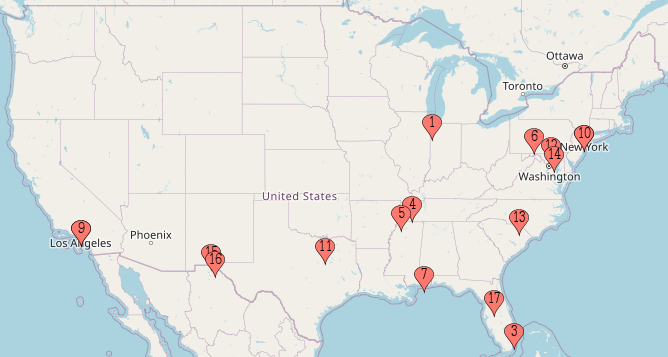
Click map to enlarge
|
|
|
|
|
&uuid=(email)) |
|
|
|

&uuid=(email)) |
|
|
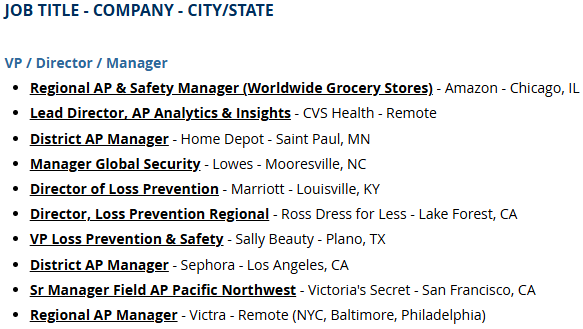
Featured Job Spotlights
|
Help Your Colleagues - Your Industry - Build a
'Best in Class' Community
|
 |
VP Loss Prevention & Safety
Plano, TX
Leads the enterprise-wide strategy for asset protection, loss
prevention, safety, security, and environmental compliance. Accountable for
minimizing financial and operational risk, strengthening internal controls, and
ensuring regulatory compliance across all locations...
|
 |
Lead Director, Asset Protection Analytics & Insights
Remote
The Director of AP Analytics and Investigations is responsible for
leveraging analytics, technology, and investigative strategies to support Asset
Protection operations, investigations, and risk mitigation efforts across the
organization...
|
Featured Jobs
To apply to any of today's Featured Jobs,
Click Here
 |
|
View Featured
Jobs
|
Post
Your Job
|
|
|
|
|
|

Insight,
humor & heart from
one of LP's most trusted voices |
|
|
If Everyone Agrees Immediately, Somebody Probably Has Questions They
Aren't Asking.
Healthy conversations
have friction. Respectful disagreement is often a sign that people are
actually thinking instead of simply waiting for the meeting to end.
Follow this space every day to see more of 'Hedgie's Hot Takes' |
|
|
|
Not getting the Daily? Is it ending up in your spam folder?
Please make sure to add d-ddaily@downing-downing.com to your contact list,
address book, trusted sender list, and/or company whitelist to ensure you
receive our newsletter.
Want to know how?
Read Here |
|
FEEDBACK
/
downing-downing.com
/
Advertise with The D&D Daily |
|
 |



&uuid=(email))
&uuid=(email))