&uuid=(email))
 |
|
&uuid=(email))
&uuid=(email))
&uuid=(email))
&uuid=(email))
&uuid=(email))
&uuid=(email))
&uuid=(email))
&uuid=(email))
&uuid=(email))
&uuid=(email))
&uuid=(email))
&uuid=(email))
&uuid=(email))
&uuid=(email))
&uuid=(email))


 |
|
&uuid=(email)) |
|
|
 &uuid=(email))
|
&uuid=(email)) |
|
Your LP Tech Roadmap. From Devices to Agentic AI.
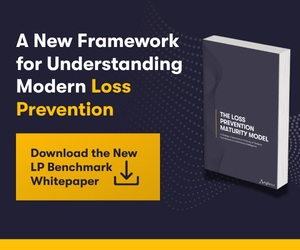 This
Agilence
whitepaper introduces the Loss Prevention Maturity Model, a
practical framework grounded in real-world operations. It outlines four
stages of LP evolution: Devices, Analytics, AI, and Agentic AI. Each
stage has clear characteristics, specific technological requirements,
and defined advancement criteria. This
Agilence
whitepaper introduces the Loss Prevention Maturity Model, a
practical framework grounded in real-world operations. It outlines four
stages of LP evolution: Devices, Analytics, AI, and Agentic AI. Each
stage has clear characteristics, specific technological requirements,
and defined advancement criteria.
The model clarifies how foundational LP technologies build on one
another, progressing from physical devices to the use of data generated
by those devices. We then explore the potential of AI and how LP
technology is in a process of shifting from reactive surveillance to
proactive intelligence and ultimately toward autonomous action.
It offers benchmarks for self-assessment, the implementation challenges
and prerequisites of each stage, and the steps LP organizations can take
to progress through the stages. Most importantly, it provides a coherent
roadmap for navigating rapid change, empowering organizations to move
from doing more with less to achieving more with technology.
Click here to download
The U.S. Crime Surge
The Retail Impact
ORC's Hidden Financial Impact
The Hidden Cost of Organized Retail Crime Investigations
 By
the D&D Daily staff By
the D&D Daily staff
When organized retail crime (ORC) makes headlines, the focus is often on
the value of stolen merchandise. While product losses remain
significant, they represent only part of the financial impact retailers
face. Behind every ORC investigation is a substantial investment of
time, labor and resources that rarely appears on a balance sheet.
Asset protection teams may spend hours reviewing surveillance
footage, compiling evidence, interviewing witnesses and coordinating
with law enforcement. In many cases, investigators are working to
connect incidents across multiple stores, identify repeat offenders and
build comprehensive case files capable of supporting prosecution. These
efforts often extend over weeks or even months before an arrest is made.
The operational impact reaches well beyond the loss prevention
department. Store managers and associates may be pulled away from
daily responsibilities to provide statements, preserve evidence or
assist investigators. Legal teams may become involved as cases advance
through the court system, while finance departments help document losses
for insurance or restitution purposes. Even IT teams may be asked to
retrieve digital records or maintain video evidence.
ORC investigations can also require retailers to invest in technology
that improves case management, evidence sharing and collaboration across
multiple locations. As theft rings become more organized and mobile,
businesses increasingly rely on centralized reporting systems that help
identify patterns and connect seemingly unrelated incidents.
Perhaps the greatest hidden cost is opportunity. Every hour spent
investigating an organized theft ring is an hour that investigators
cannot devote to proactive initiatives such as safety programs, internal
investigations, training or operational improvements. For organizations
with limited asset protection staff, balancing reactive investigations
with preventive strategies can become an ongoing challenge.
Although successful ORC investigations often lead to arrests,
merchandise recovery or criminal convictions, retailers continue to
absorb significant operational costs long before those outcomes are
achieved. As organized retail crime grows increasingly
sophisticated, understanding the full cost of investigations—not just
the value of stolen goods—can help organizations better allocate
resources and strengthen long-term loss prevention strategies.
Retail Theft Diversion Bill Sparks
Debate
Public Safety Advocates Clash With Democratic Legislators Over Bill
Expanding Diversion for Retail Theft
Opponents say AB 2108 would weaken
voter-approved Proposition 36, while supporters argue it offers early
intervention to break the cycle of theft
A coalition of California law enforcement officials and public safety
advocates is urging lawmakers to reject Assembly Bill 2108, arguing
it would undermine the voter-approved Proposition 36 by expanding
diversion programs for retail theft offenders.
Supporters of the measure, however, contend the bill complements
Proposition 36 by addressing the root causes of low-level theft before
offenders become repeat criminals.
The debate centers on whether California should allow more people
accused of retail theft to participate in diversion programs that
can result in charges being dismissed after successful completion of
treatment or services.
Opponents argue California already offers ample diversion programs
and that implementation of an additional treatment option would be
costly to taxpayers.
Democratic Assemblymember LaShae Sharp-Collins of San Diego authored AB
2108, which would create a diversion option for certain nonviolent
retail theft offenses, including shoplifting and vandalism.
Under the proposal, defendants charged with qualifying low-level,
nonviolent retail theft offenses could be granted diversion regardless
of whether they are first-time offenders. If they successfully
complete a court-approved treatment or rehabilitation program, the
charges would be dismissed.
Supporters say the measure is intended to intervene earlier than
Proposition 36 by connecting defendants with services before they
accumulate multiple convictions. Opponents argue the bill would
weaken one of Proposition 36's central goals: increasing accountability
for repeat theft offenders.
abc10.com
Easiest Retailer to Shoplift From?
Walmart has a shoplifting problem it helped create
The retail giant tops a new survey
that no company would want to be the leader in.
Shoplifting numbers, who’s stealing, and why they’re stealing have
become hot-button talk-show topics, so it’s no surprise that
retailers have reported an increase in theft.
“Retailers report increases across various methods of external theft
(cargo/supply chain theft, shoplifting, and walkout/pushout theft) as
well as digital and online fraud (phone scams, ecommerce fraud, and
repeat offender theft). The survey showed a combined 19% increase in
external shoplifting and merchandise theft incidents from 2023 to 2024,”
according to the National Retail Federation’s (NRF) 2025 Impact of
Retail Theft & Violence Report.
More Americans are shoplifting, according to Lending Tree’s
survey.
“30% of Americans say they’ve shoplifted, up significantly from 23%
in 2024. The behavior is most common among younger consumers, with
39% of Gen Zers and 38% of millennials reporting they’ve shoplifted.
Among those who’ve shoplifted, 37% say they did so within the past year,
up from 23% in 2024,” the report showed.
The state of the economy has been the key factor explaining why
more people are stealing from retailers.
One retailer, Walmart, appears to be facing a bigger problem than its
rivals, according to a new Lending Tree report.
“When asked which retailers are easiest to shoplift from, respondents
most frequently identify Walmart (47%), followed by Family Dollar
(21%), Amazon Fresh (14%), Kroger (11%) and Costco (10%). Another 14%
say they aren’t sure which retailers are the easiest to shoplift from,”
LendingTree reported.
thestreet.com
Australia Malls Face Security Push
ICYMI: Call for security boost at shopping centres to clamp down on
knife risk
A Sydney shop assistant says she faced a man claiming to have a knife,
while in Victoria, officers recently arrested a man allegedly carrying
one at a centre in Forest Hill. A retail workers' union is calling
for large shopping centres to increase onsite security and implement
violence control plans.
The NSW government is still considering a recommendation from the Bondi
Junction stabbing inquest to widely push 'Escape. Hide. Tell' safety
messaging.
The NSW branch of retail workers union SDA said its members were facing
workplace safety concerns like physical violence or verbal abuse, with
more than a quarter reporting not feeling safe at work.
SDA is pushing for large retailers and shopping centres to implement
violence control plans — including risk assessments, training and
reporting systems — as well as increased onsite security and improved
coordination with police.
abc.net.au
D.C. crime stats system experienced ‘breakdown’ of internal controls,
report says
Aurora police chief shares new data that shows crime down 25% over past
2 years
&uuid=(email))
Safety Violations Go Unreported
Why are Workers Silent About Safety Risks?
54% of logistics workers have seen a
coworker repeatedly violate safety rules without facing disciplinary
action.
A gap in safety compliance could be the result of how the safety
rules are perceived by the workers on the job. A recent survey from
TRADESAFE, conducted with 503 blue-collar workers, found that a number
of factors determined whether compliance occurs.
The survey found that three specific factors account for underreporting
of safety violations: violations are not
punished, discipline is inconsistent and there is a fear of retaliation.
Nearly 2 in 5 blue-collar workers, 38%, had seen a coworker
repeatedly violate safety rules without facing disciplinary action.
Workers in non-union workplaces reported seeing unpunished violations
more often (44%) than workers in unionized workplaces (36%).
Over half of respondents (52%) also said safety rules felt more like
suggestions than enforceable policies. This was most common among
logistics and transportation workers (61%), while 51% of healthcare
workers reported the same.
Managers were more likely than frontline workers to say safety rules
were enforceable (57% vs. 43%). They were also more likely to say
enforcement was very consistent (45% vs. 35% of frontline workers).
Another 36% of respondents said deadlines pressured them to bypass
safety procedures. This pressure was highest in manufacturing (47%)
and still significant in logistics and transportation (41%).
ehstoday.com
AI Burnout Already Taking a Toll
The AI race is taking a toll on founders. Not everyone can afford to
take a break.
Some AI startup leaders step away to address health concerns, but for
others, the cost of leaving may be too steep.
Lilian Weng, a cofounder of the high-profile AI startup Thinking
Machines Lab, stepped down Tuesday after suffering what she described as
a stress-induced illness. Other tech leaders have recently scaled
back their roles or left them altogether for health reasons, too,
including OpenAI executive Fidji Simo and xAI cofounder Greg Yang.
"The amount of consistent stress and workload have pushed me
beyond what my health can sustain physically," Weng wrote in a post on
X.
Burnout and intense demands are hardly new challenges for tech
leaders and their employees. In Silicon Valley, some AI companies
have embraced "996" schedules — 9 a.m. to 9 p.m., six days a week —
despite the toll it may take on workers' health.
Yet despite the importance of self-care, not every leader has the
financial cushion or trusted staff needed to step back when that strain
becomes unsustainable. Some may have little choice but to keep going, as
the AI race adds pressure to raise money, recruit scarce talent, and
ship products ahead of rivals.
"It's really hard for leaders with lots of responsibility and
stakeholders to deprioritize work," said Mandy Haskett, a leadership
consultant who advises CEOs, executive teams, and boards of midsize
companies and startups.
businessinsider.com
In-Store Holiday Shopping to Rise?
Study: In-store expected to top online shopping this holiday season
Amid tighter budgets, more consumers plan to shop in person at
brick-and-mortar stores than make purchases online this year.
Nearly 36% (35.8%) of holiday shoppers plan to shop in physical
stores compared to 31.1% who expect to shop online (retailer
sites/apps), according to a report by Alchemer, while 19.2% of shoppers
anticipate an even mix of online and in-store shopping.
Alchemer’s “2026 Holiday Shopper Report” found that economic
pressures have set the stage for holiday shopping this year as consumers
carefully evaluate every purchase. Nearly 40% (38.2%) of shoppers
say tighter budgets will have the biggest impact on their holiday
spending. Another 27% expect rising prices to influence their purchasing
decisions.
In related findings, 69% of shoppers rank price and value among the
most important factors when deciding what to buy. Significant price
increases are the leading reason shoppers say they would abandon a
retailer they otherwise like.
chainstoreage.com
Johnson & Johnson agrees to pay $5.5B to settle talc lawsuits
The deal must be accepted by 95% of
claimants before becoming final, with payouts starting in 2027
Five 2026 holiday predictions from Salesforce
Grocery growth has stalled as retailers compete for a shrinking pool of
trips
|
|

|
All the News - One Place - One Source - One Time
Thanks to our sponsors/partners - Take the time to thank them as well
please.
If it wasn't for them The Daily wouldn't be here every day for you.
|
|
|
&uuid=(email)) |
|

|
|
|

|
|
Strengthen Retail Security and Enhance Workplace Safety
with Off-Duty Law Enforcement
Discover how off-duty law
enforcement enhances safety and
deters crime while protecting employees and assets.

Retailers are under more pressure than ever to prevent theft, ensure
employee safety and maintain business continuity across stores. Criminal
activities are on the rise, and they can severely disrupt operations,
leading to financial losses and a tarnished reputation. Workplace
security not only safeguards assets and sensitive information but also
protects employees and visitors, fostering a safe and productive
environment.
 Hiring
off-duty law enforcement is a proven way to level up your retail
security strategy. Off-duty personnel are uniquely positioned to deter
criminal activities, respond swiftly in emergencies and provide an added
layer of protection. By integrating off-duty law enforcement into your
security strategy, you can create a safer, more secure workplace
environment. Hiring
off-duty law enforcement is a proven way to level up your retail
security strategy. Off-duty personnel are uniquely positioned to deter
criminal activities, respond swiftly in emergencies and provide an added
layer of protection. By integrating off-duty law enforcement into your
security strategy, you can create a safer, more secure workplace
environment.
Protos Security's workplace security blog explores ways that
off-duty law enforcement can benefit retailers and increase workplace
safety by:
-
Creating Safer Store
Environments: Law enforcement provides a strong visual deterrent and
offers peace of mind to both employees and shoppers.
-
Deterring Theft and
Workplace Threats: Regular patrols, surveillance and expert situational
awareness reduce the risk of crime before it starts.
-
Responding Swiftly to
Emergencies: Off-duty law enforcement react quickly to high-stress
situations, minimizing harm and restoring order with calm precision.
When you need trained law enforcement,
Protos Security offers second- to-none coverage through the nation’s
largest off-duty law enforcement network. With 60,000 off-duty personnel
and more than 1,400 agencies, we provide expertise when and where you
need it.
Want to reduce shrink, strengthen operations and keep your workplace
secure?
Learn More Here
 |
|
&uuid=(email)) |
|
|
 |
|
|
Cybersecurity Becomes Core to LP
Cybersecurity Is Becoming Central
to Modern Loss Prevention
By
the D&D Daily staff
For years, loss prevention focused primarily on protecting physical
stores. Teams worked to reduce shoplifting, investigate organized retail
crime (ORC), prevent employee theft and improve store safety. Today,
however, retailers are facing a different reality: many of the
threats that ultimately result in financial loss now begin on a keyboard
rather than in a store aisle.
As retail operations become increasingly connected, cybersecurity is
no longer just an IT responsibility. It is becoming an essential
component of modern loss prevention and asset protection strategies.
Retailers now rely on interconnected systems that manage everything
from point-of-sale transactions and inventory to self-checkout,
surveillance cameras, access control, electronic article surveillance (EAS)
systems and cloud-based reporting platforms. A cyberattack targeting
any of these technologies can disrupt operations, create opportunities
for theft and expose sensitive business data.
The convergence of physical and digital security is changing how many
organizations approach risk management. Rather than operating in
separate silos, LP, information security and fraud teams are
increasingly sharing intelligence to identify threats that cross
traditional boundaries.
Organized retail crime groups have also evolved. Many
sophisticated theft rings now combine physical theft with cyber-enabled
tactics, including stolen employee credentials, phishing attacks, gift
card fraud, account takeovers and attacks on loyalty programs. Criminals
may compromise retailer systems to identify high-value shipments,
exploit return processes or obtain customer information that can later
be used in fraud schemes.
These threats rarely fit neatly into one department. A
compromised employee account, for example, may begin as a cybersecurity
incident before ultimately resulting in fraudulent refunds, inventory
loss or unauthorized access to stores or distribution centers.
Artificial intelligence is further accelerating this convergence.
While retailers increasingly use AI to detect suspicious transactions
and identify unusual patterns, cybercriminals are also leveraging AI to
create more convincing phishing emails, automate credential attacks and
exploit software vulnerabilities more quickly than ever before.
As a result, cybersecurity awareness is becoming an increasingly
valuable skill for LP professionals. Understanding common cyber
threats, recognizing suspicious digital activity and collaborating
closely with IT security teams can help organizations detect incidents
earlier and reduce overall risk.
The future of loss prevention is no longer defined solely by what
happens inside a store. As retail operations continue to digitize,
protecting company assets increasingly means safeguarding both physical
merchandise and the technology that keeps the business running.
Organizations that successfully integrate cybersecurity into their
broader asset protection strategy will be better positioned to address
the increasingly interconnected threats facing retail today.
AI Governance Gaps Raise Risks
As data breaches grow costlier, ungoverned AI creates new risks
Meanwhile, many companies still
aren’t doing the basics to protect on-premises data, IBM found.
Half of organizations that experienced a data breach in 2025 are
using AI agents to hunt for threats, but fewer than one in five of
those organizations are using agents for the task for which they’re most
suited: scanning for and managing vulnerabilities on a network.
That data point comes from IBM’s 2026 Cost of a Data Breach Report,
which also found that 85% of breached organizations plan to spend
more money on “security tools and governance.”
The report, published on Wednesday, also covers businesses’ use of AI
agents in security operations centers, organizations’ post-quantum
cryptographic migrations and ways to reduce breach costs.
Data breaches now cost businesses an average of $5 million, according to
the new report, a 12% increase over the figure from IBM’s 2025 research.
Some attacks on AI tools cost businesses much more — inversion and
prompt-injection attacks cost organizations an average of roughly $6
million.
“Unlike traditional exploits that compromise systems, these
behavioral attacks undermine how AI models reason and respond,” IBM
researchers wrote, “expanding remediation beyond technical recovery into
trust and governance.”
The vast majority (92%) of organizations that suffered attacks on
their AI models failed to properly control access to those tools,
even as businesses describe identity management as one of their best
defenses against costly breaches. Only four in 10 organizations said
they limited access to their AI systems.
Identity controls “have failed to keep pace” with AI’s sprawl
across corporate networks, IBM researchers said. “The outcome is
predictable: expanded attack paths, higher financial impact and
incidents driven by basic enforcement gaps that don’t even require
attacker sophistication.”
cybersecuritydive.com
Fighting AI-Based Attacks
Microsoft launches agentic security platform designed to combat AI-based
attacks
The rollout comes amid growing
concerns about the ability of hackers to launch campaigns using
autonomous methods.
Microsoft on Monday announced the launch of Project Perception, an
agentic security system designed to help defenders combat a rapidly
evolving threat of AI-based attacks by malicious actors.
The company also introduced MAI-Cyber-1-Flash, an AI model that helps
users identify and remediate vulnerabilities through an integration
with the company’s MDASH code-scanning harness.
The launch is part of a major industry push to implement AI-based
security that can protect corporate IT and critical infrastructure
systems from sophisticated attacks. In the past year, threat actors
have demonstrated the ability to speed and scale attacks in a way that
traditional security technologies cannot match.
“So, if you think about it, we’re now in a world where we’ve moved from
AI-assisted attacks to AI-operated attacks to now autonomous AI
attacking customers,” Hayete Gallot, executive vice president of
Microsoft Security, said at a San Francisco launch event Monday. “The
physics of cyber have fundamentally changed.”
cybersecuritydive.com
Your AI agents can reach data no one approved
Cloudflare reveals what’s behind major internet outages |
|
|
 |
|
|
Product Data Strengthens Loss
Prevention
How Better Product Data Can
Quietly Reduce E-Commerce Losses
By
the D&D Daily staff
For many retailers, e-commerce loss prevention begins after an order is
placed — fraud screening, payment verification, shipment tracking, or
return validation. But one of the most overlooked opportunities to
reduce losses starts much earlier: the quality of a retailer's
product data.
Incomplete or inaccurate product information can create a surprising
number of downstream loss issues. Incorrect dimensions may result in
higher shipping costs or fulfillment errors. Outdated product
descriptions can lead to customer dissatisfaction and unnecessary
returns. Poor inventory data increases the likelihood of overselling,
canceled orders, and costly manual interventions.
Each issue may seem minor on its own, but at scale they contribute to
unnecessary operational expenses while creating opportunities for fraud
and abuse.
Return fraud is one example. When product listings contain vague
descriptions or inconsistent specifications, customer service teams
often have a more difficult time determining whether returned
merchandise matches what was originally sold. Clear product attributes,
serial number tracking, and detailed product imagery help retailers
validate returns more efficiently while reducing disputes.
Accurate product data also improves inventory visibility across
warehouses, stores, and distribution centers. Better inventory
accuracy reduces substitution errors, duplicate shipments, and "lost"
inventory that may actually exist elsewhere in the network. That
visibility becomes increasingly important as retailers continue
expanding buy online, pick up in-store (BOPIS) and ship-from-store
fulfillment models.
Artificial intelligence is also amplifying the value of high-quality
product information. AI-powered merchandising, search,
recommendation engines, and fraud detection systems all rely on accurate
data to generate reliable decisions. Poor data quality doesn't just
affect the customer experience — it can reduce the effectiveness of the
very systems retailers deploy to improve operational efficiency and
identify suspicious activity.
As e-commerce operations become more automated, retailers are
recognizing that data governance is no longer simply an IT
responsibility. Merchandising, supply chain, asset protection, and
e-commerce teams all benefit from consistent product information that
supports smarter decision-making throughout the order lifecycle.
While product data management may not traditionally fall under the loss
prevention umbrella, strengthening that foundation can help retailers
reduce avoidable costs, improve operational accuracy, and close gaps
that bad actors are often quick to exploit.
More Amazon AI Moves
Amazon just made a major move to reshape its entire AI strategy
In 2024, Amazon had launched
alternative AI models to rival OpenAI, Anthropic, and Google.
Amazon launched its Nova family of AI models at re:Invent in
December 2024 with much fanfare: Nova Premier, Nova Omni, Nova Reel,
Nova Canvas.
The pitch was that Amazon was building affordable, capable
alternatives to the models from OpenAI, Anthropic, and Google. It
was a broad lineup designed to show the market that AWS wasn’t just
cloud infrastructure anymore. It was an AI company.
Less than two years later, Amazon is quietly pulling most of those
models. Reuters reported on July 28 that Amazon has begun
deprecating most of its flagship Nova models and reorganizing its AI
teams around a single frontier-model effort.
The overhaul is the most significant reset of Amazon’s AI strategy
since the Nova launch.
thestreet.com
Kroger Has a New AI Shopping Assistant
Amazon Prime Day not immune to consumer pressures, competing sale events |
|
|
&uuid=(email))
|
|
Comal County, TX: Update: California man gets 18 years for identity
theft scheme targeting H-E-B
A California man has been sentenced to 18 years in prison after
admitting to possessing more than 50 pieces of stolen identifying
information as part of an organized retail theft scheme, according to
the Comal County Criminal District Attorney's Office. Prosecutors said
Meng Cao pleaded guilty on June 16 to fraudulent use or possession of
identifying information involving more than 50 items. The investigation
began in November 2024 when New Braunfels Police responded to an H-E-B
on South Walnut Avenue after the store's regional loss prevention
manager spotted Cao on surveillance cameras. Investigators said he had
previously been linked to a theft ring operating throughout San Antonio
and surrounding communities. Authorities said the group used stolen
financial information, believed to have been purchased on the dark web,
to buy gift cards and other merchandise using digital payment methods on
cellphones. Officers detained Cao after watching him purchase multiple
gift cards at a self-checkout register. Investigators later found eight
gift cards worth $180 each, two cellphones and additional evidence. A
forensic examination of the phones uncovered between 100 and 200 stolen
credit card account numbers belonging to numerous victims.
Investigators also found $2,661 in cash, additional gift cards and other
items inside Cao's vehicle. The case was investigated by the New
Braunfels Police Department, Texas Department of Public Safety's
Organized Crime Unit, San Antonio Police Department, and H-E-B's
regional loss prevention team.
kens5.com
League City, TX: League City Police Investigation Recovers More Than
$400,000 in Stolen Merchandise
The League City Police Department's Business District Unit (BDU) has
successfully dismantled a major organized retail crime operation,
resulting in the recovery of more than $400,000 in stolen merchandise
(over 15,000 individual items) and the arrest of 52-year-old Claudia
Ivonne Higuera-Torres of Houston. The investigation began after officers
responded to a theft report at Sephora at Kohl's in League City on July
12, 2026. What initially appeared to be a routine retail theft quickly
expanded into a complex, multi-jurisdictional investigation spanning
numerous cities and several counties throughout the region. As a result
of the BDU’s investigation, Higuera-Torres was arrested on July 21,
2026, and charged with First Degree Felony Organized Retail Theft. Bond
was set at $150,000; however, the judge denied release due to an ICE
detainer.
leaguecitytx.gov
Forest Lake, MN: Update: Masked Burglars Took Up to $50,000 in Pokémon
Merchandise in 90 Seconds
Two masked burglars smashed through the front of a Minnesota gaming
store and escaped within approximately 90 seconds with Pokémon
merchandise valued at as much as $50,000. Surveillance footage from
Punch-Out Gaming in Forest Lake shows the pair breaking a window shortly
before 4 a.m. on Saturday, July 25. Once inside, they emptied display
cases and pulled high-value sealed products from shelves. The store
estimated that between $30,000 and $50,000 in merchandise was taken.
Police had not identified the suspects or announced any arrests.
yahoo.com
Ascension Parish, LA: Police seeking 2 men wanted for theft of $7200 in
cigarettes from Circle K
Phoenix, AZ: Thief targets Pokémon cards in North Phoenix
smash-and-grab: $5000 to 10,000 loss
&uuid=(email))
|
|
|
|
&uuid=(email))
|
|
|
|

|
|
|
Shootings & Deaths
Mobile, AL: Man dies in auto store shooting
A man has died after a violent altercation at the auto store near the Crestview
Neighborhood in southwest Mobile. According to the Mobile Police Department,
Evans Bagley, 25, was shot and killed after he started an argument with a man at
Chips Auto Glass on Halls Mill Road. At one point, Bagley allegedly pointed a
gun at the unidentified shooter but was shot first. MPD responded to the
incident at about 3 p.m., and Bagley was found dead in the store’s parking lot.
lagniappemobile.com
Pomona, CA: Pomona police respond to reports of shots fired at WinCo Foods
grocery store
Police responded to reports of shots possibly fired at a grocery store in Pomona
Wednesday morning. It all unfolded around 3 a.m. at the WinCo Foods on Rio
Rancho Road, according to the Pomona Police Department. Employees and customers
ran out of the 24-hour store after reports of shots fired, but no injuries were
reported. AIR7 was over the scene where several police units surrounded the
store. Officers even sent in a robot dog to help in the search, but a suspect
was not located. Employees were eventually let back several hours later.
abc7.com
Fresno, CA: Shot fired inside Northeast Fresno restaurant during fight, police
say
Police are investigating after a shot was fired inside a Northeast Fresno
restaurant during a fight. Officers responded to El 701 Mariscos Y Sushi near
Fashion Fair Mall after reports of a shooting inside the restaurant. According
to police, a physical fight broke out inside the business. During the
altercation, one person drew a firearm and fired a single shot into the ground.
The individual who fired the weapon fled the scene before officers arrived.
Detectives are working to identify the shooter. No one was injured and no one
was struck by the bullet.
abc30.com
Houston, TX: Sunnyside shooting: 3 women injured in shooting outside c-store
HPD Lieutenant R. Willkens says two victims, both in their mid-30s, were
standing in the parking lot of a convenience store on Scott Street when each was
shot once in the arm. A third victim was sitting inside her vehicle when she was
shot in the hand. The woman left the scene and drove to Vera Lou Street before
stopping. All three victims were taken to local hospitals and are expected to be
okay, according to HPD Lt. Willkens.
fox26houston.com
Raleigh, NC: Shots fired into Raleigh Wingstop; no one was hurt
Robberies, Incidents & Thefts
Los Angeles, CA: Third Stabbing In Months Reported At Topanga Mall
A reported stabbing occurred at Westfield Topanga Mall on Tuesday, July 28,
before 1 p.m. The incident transpired inside a parking garage and reportedly
involved two possibly intoxicated individuals. Firefighters and paramedics
arrived around 1 p.m. at 6600 Topanga Canyon Boulevard, just north of Victory
Boulevard. One person was taken into custody by the Los Angeles Police
Department, and the other individual was rushed to the hospital. A video
circulating online shows the entrance to the parking structure temporarily
blocked off as police began their investigation. Both individuals remain
unidentified, and their conditions are unknown. Westfield Topanga Mall remained
open for business and maintained its usual hours of operation. This is the third
stabbing incident at Westfield Topanga Mall within the past seven months. On
December 18, 2025, two teenagers were robbed of their gold chains and stabbed
near the mall’s entrance. On March 13, 2026, a separate robbery-related stabbing
occurred inside the mall itself, at the Pro Image Sports store on the second
floor.
canyon-news.com
Central, LA: One arrested, one wanted after clerk dragged 30 feet in Circle K
Hennessy robbery
Central Police Department has arrested one woman and is looking for a second in
connection with a robbery at a Circle K convenience store on Hooper Road in
which a store clerk suffered severe arm injuries after being dragged by a
fleeing vehicle. The incident occurred at approximately 1:30 a.m. on July 19,
2026, at the Circle K located at 9530 Hooper Road. According to investigators,
Destani Harrington — a passenger in a 2017 Jeep Cherokee — entered the store and
spoke briefly with a store clerk before taking ten small bottles of Hennessy
Cognac from within the clerk’s immediate control and fleeing without paying.
wafb.com
Indianapolis, IN: DOJ: Three Indianapolis Men Sentenced to Federal Prison for
String of Armed Robberies
|
|
|
|

•
C-Store – Ascension
Parish, LA – Robbery
•
C-Store – Chicago, IL
– Burglary
•
C-Store – Westbrook,
ME – Burglary
•
C-Store – Midwest
City, OK – Robbery
•
C-Store – Baton Rouge,
LA – Robbery
•
C-Store – El Paso, TX
– Burglary
•
Clothing – Stafford
County, MD – Armed Robbery
•
Collectables –
Phoenix, AZ – Robbery
•
Dollar – Dover, DE –
Armed Robbery
•
Gas Station – Chicago,
IL – Burglary
•
Grocery – Fairfax, VA
– Robbery
•
Guns – West Jefferson,
OH - Burglary
•
Hardware - Fairfax,
Virginia - Robbery
•
Jewelry – Bronx, NY –
Robbery
•
Liquor – Dover, DE –
Armed Robbery
•
Mall – Erie, PA –
Robbery
•
Mall – San Mateo
County, CA – Robbery
•
Marijuana – Belgrade,
ME – Armed Robbery
•
Restaurant – Temple,
TX – Armed Robbery |
|
|
Daily Totals:
• 14 robberies
• 5 burglaries
• 0 shootings
• 0 killed |
|
|
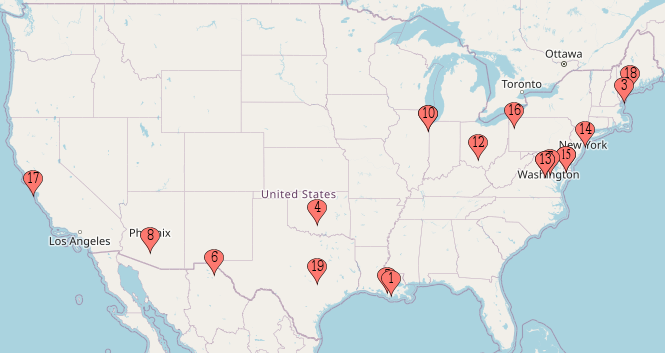
Click map to enlarge
|
|
|
|
|
&uuid=(email)) |
|
|
|

&uuid=(email)) |
|
|
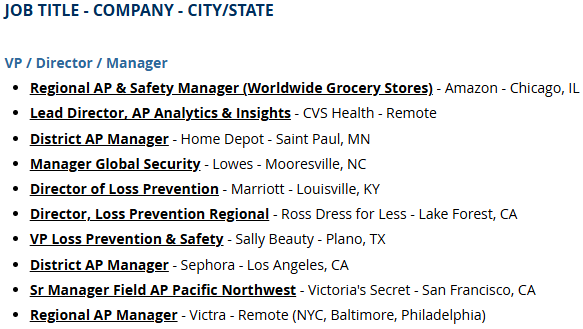
Featured Job Spotlights
|
Help Your Colleagues - Your Industry - Build a
'Best in Class' Community
|
 |
VP Loss Prevention & Safety
Plano, TX
Leads the enterprise-wide strategy for asset protection, loss
prevention, safety, security, and environmental compliance. Accountable for
minimizing financial and operational risk, strengthening internal controls, and
ensuring regulatory compliance across all locations...
|
 |
Lead Director, Asset Protection Analytics & Insights
Remote
The Director of AP Analytics and Investigations is responsible for
leveraging analytics, technology, and investigative strategies to support Asset
Protection operations, investigations, and risk mitigation efforts across the
organization...
|
Featured Jobs
To apply to any of today's Featured Jobs,
Click Here
 |
|
View Featured
Jobs
|
Post
Your Job
|
|
|
|
|
|

Insight,
humor & heart from
one of LP's most trusted voices |
|
|
The Most Dangerous Words at Any Conference Are:
"We've Always Done It This Way.
Retail changes too quickly for nostalgia
to be a strategy. Tradition has its place, but sometimes "the way we've
always done it" is just another way of saying, "We haven't looked
lately."
Follow this space every day to see more of 'Hedgie's Hot Takes' |
|
|
|
Not getting the Daily? Is it ending up in your spam folder?
Please make sure to add d-ddaily@downing-downing.com to your contact list,
address book, trusted sender list, and/or company whitelist to ensure you
receive our newsletter.
Want to know how?
Read Here |
|
FEEDBACK
/
downing-downing.com
/
Advertise with The D&D Daily |
|
 |
&uuid=(email))



&uuid=(email))
&uuid=(email))