&uuid=(email))
 |
|
&uuid=(email))
&uuid=(email))
&uuid=(email))
&uuid=(email))
&uuid=(email))
&uuid=(email))
&uuid=(email))
&uuid=(email))
&uuid=(email))
&uuid=(email))
&uuid=(email))
&uuid=(email))
&uuid=(email))
&uuid=(email))
&uuid=(email))


 |
|
&uuid=(email)) |
|
|
 &uuid=(email))
|
&uuid=(email)) |
|
How Organized Retail Crime is Threatening the Retail Industry
 Organized
Retail Crime (ORC), the coordinated theft of merchandise for resale, has
grown exponentially in the U.S., necessitating increased security
measures and even causing store closures. The issue is projected to
escalate, demanding modern, tactical security solutions that allow
retailers and law enforcement to combat ORC while maintaining a pleasant
shopping environment. Organized
Retail Crime (ORC), the coordinated theft of merchandise for resale, has
grown exponentially in the U.S., necessitating increased security
measures and even causing store closures. The issue is projected to
escalate, demanding modern, tactical security solutions that allow
retailers and law enforcement to combat ORC while maintaining a pleasant
shopping environment.
Cloud video security is a powerful tool in fighting ORC.
OpenEye's comprehensive
guide delves into the current methods for defining and measuring ORC's
impact on businesses and the economy. It explores effective security
strategies for mitigating inventory loss and enhancing the shopping
experience. The guide also highlights the advantages of cloud video
surveillance in tackling ORC, and how the integration of other security
systems can provide a more robust solution for retailers.
Learn more
The U.S. Crime Surge
The Retail Impact
States Expand Organized Retail Crime
Laws
States expand fight against organized retail crime, gift card fraud
More than a dozen states have passed
new laws this year.
 From
hijacked freight shipments to tampered gift cards hanging on store racks,
states are responding to new forms of organized retail crime with a
fresh round of legislation. From
hijacked freight shipments to tampered gift cards hanging on store racks,
states are responding to new forms of organized retail crime with a
fresh round of legislation.
More than a dozen states this year have passed
laws creating new criminal offenses, increasing penalties and
establishing specialized task forces and advisory boards designed to
better investigate and prosecute organized theft rings.
While organized retail theft has been a growing focus for state
lawmakers in recent years, this year’s legislation reflects how the
crime has evolved beyond traditional shoplifting. Many of the new laws
target fraud schemes that authorities say are increasingly tied to
organized criminal groups, including cargo theft, gift card scams and
identity theft used to steal freight or merchandise.
Reported shoplifting increased 4% in the first half of 2026 compared
with the same period in 2025, according to the nonpartisan think
tank Council on Criminal Justice’s latest crime trends report. Across
the 18 cities included in the analysis, shoplifting rates were about
5% higher than in 2019 and reached their highest level in the
nine-year period tracked by the group.
Several states expanded criminal penalties or gave prosecutors new
tools to pursue organized retail theft cases this year. In
Tennessee, Republican Gov. Bill Lee
in May signed into law a measure creating a registry of people convicted
of retail theft or organized retail crime, including attempted offenses
and conspiracies. The registry is only available to law enforcement.
A new Wisconsin law allows
prosecutors to aggregate multiple retail theft offenses when
determining criminal penalties and increasing sanctions for repeat
offenders.
Two new laws in Wyoming, both of
which went into effect this month, increased penalties for repeat
theft offenders and created the new offense of absconding for
criminal purposes, aimed at people who cross county or state lines to
commit additional crimes or conceal stolen property.
In Oklahoma, a new law broadens
the state’s organized retail crime and identity theft statutes by
expanding the types of fraud covered and closing loopholes involving
elderly people and minors.
stateline.org
The Debate Over California's Crime
Push
Opinion: Soft on crime? Not Gavin Newsom.
Prop 36 was a response to a dramatic spike in high-profile crimes
targeting businesses in Los Angeles, San Francisco and other parts of
the Golden State that began in 2019. It was so bad that, in 2021,
the Hoover Institute at Stanford University said, “Shoplifting
Is Now De Facto Legal In California.”
Without such hyperbole, the California Public Policy Institute reported
that “Between 2019 and 2023, retail theft (both shoplifting and
commercial burglaries) increased in 11 of the state’s 15 most populous
counties but generally decreased in smaller counties. Most notably,”
it added, “retail theft increased by almost 70 percent in Sacramento, by
65 percent in Alameda, by 41 percent in San Mateo, and by 40 percent in
Los Angeles.
Newsom has been clear that in his view that “Organized retail theft
is not a victimless crime — it drives up costs for families, harms
small businesses, and threatens workers.” He has backed those words with
action. And the data suggest that what Newsom is doing has borne fruit.
Among other things, under his leadership, the California Highway
Patrol Organized created a Retail Crime Task Force. As Newsom noted
in January, “organized retail crime investigations at the local and
state level have increased by 3,000 percent, from 24 in 2019 to 734 in
2025.” In addition, in just the first two months of 2026, the Task Force
launched “75 investigations, made 35 arrests, and recovered 33,354
stolen items worth over $3.3 million.”
And, as a result, California experienced a 9 percent decrease in
shoplifting in 2025, “the first time [it has declined] since 2020.”
Commercial burglaries are also down, now 6 percent lower than their
pre-pandemic levels.
While Newsom’s record on crime is far from perfect, he has done
what was needed to implement Prop 36 and to fix its problems, including
those that have plagued its mental health diversion program. thehill.com
Editor's Note: As part of our
ongoing coverage, D&D Daily also
published an article yesterday examining criticism of California's
organized retail crime strategy, including arguments that recent
enforcement efforts have not been as effective as state leaders have
suggested. We encourage readers to consider both perspectives.
UK Police Build National Data Hub
Inside police plans to share intelligence and crime data across the UK
Computer Weekly examines how UK police will use Palantir’s AI
tools to dramatically increase intelligence sharing between forces,
enabling investigators to analyse mobile phone data and sensitive
information at scale
UK police are developing a national service for sharing local
intelligence and police force data across the law enforcement and
justice estate.
Announced by the National Police Chiefs’ Council (NPCC) earlier this
year, the National Data Integration and Exploitation Service (NDIES)
will allow local police forces to access and share data, including local
force intelligence and digital forensics, from across the country.
A “police data factory” within NDIES will incorporate data from over
50 law enforcement agencies, the Home Office, the Ministry of Justice,
and “other” partners to provide them with access to a vast network
of data for “analytical and reporting purposes”. These government
departments will not be able to see operational data or intelligence
itself, according to the NPCC.
computerweekly.com
The growing crime threat that's costing Tennessee consumers | Opinion
Protecting Tennessee's supply chains means
protecting jobs, businesses and the security of the nation itself.
Congress should act before these transnational criminal networks grow
even stronger.
Chicago homicides in 2026: 241 people slain. How that compares with
previous years.
IG draft report on crime data has recommendations for DC police
&uuid=(email))
Retail AI Industry Survey
Help Shape the D&D Daily's First Retail Crime AI Report
 Artificial
intelligence is transforming retail loss prevention, from video
analytics and fraud detection to investigations, reporting and
operational efficiency. Yet one question remains: How are retail
asset protection professionals actually using AI today, and where do
they see the technology heading? Artificial
intelligence is transforming retail loss prevention, from video
analytics and fraud detection to investigations, reporting and
operational efficiency. Yet one question remains: How are retail
asset protection professionals actually using AI today, and where do
they see the technology heading?
To help answer those questions, the D&D Daily has launched its first
Retail Crime
Prevention and AI Survey.
The brief, two-minute survey is designed to gather insights from
retail asset protection, loss prevention, security and law enforcement
professionals. Rather than focusing on specific products or vendors,
the survey aims to better understand how AI is being adopted across the
industry, the challenges organizations face, and the opportunities
professionals see for the future.
The survey findings will be featured in the D&D Daily's inaugural
Retail Crime Prevention and AI Report—an
executive overview of artificial intelligence's growing role in retail
crime prevention.
The report will be published as both an interactive website and a
downloadable PDF, featuring industry data, visualizations and key
takeaways drawn from survey responses and insights from senior leaders
across retail and law enforcement.
Whether your organization is actively deploying AI, evaluating new
solutions or simply beginning to explore the technology, your
perspective is valuable. Broad participation will help create a more
representative snapshot of where the industry stands today and where
professionals believe it's headed.
The survey takes approximately two minutes to complete, and every
response helps strengthen the final report.
If you work in retail asset protection, loss prevention, security or law
enforcement, we encourage you to participate and share your perspective.
Take the survey today at:
survey.retailcrime.ai
CEO Security Concerns Grow
Cracker Barrel to Pay for Former CEO’s Security After Firestorm
Cracker Barrel Old Country Store Inc. will cover security for
outgoing Chief Executive Officer Julie Masino for an undetermined
stretch of time after she exits, a rare perk that follows vitriolic
comments over the company’s botched image redesign.
The company, which had been paying for her protection, will continue
doing so for as long as the board deems it “reasonably necessary”
following her departure in October, according to a regulatory filing
Monday. Cracker Barrel declined to comment beyond the filing, and
wouldn’t say how much it has spent to date on Masino’s security. Masino
will step down Aug. 10 while staying on as an adviser, with industry
veteran David Deno replacing her.
bloomberg.com
Editor's Note: Cracker Barrel's
decision to continue providing private security for outgoing CEO Julie
Masino after her departure is an unusual reminder of how the role of
a corporate executive has changed. While executive protection has
long been reserved for a handful of the nation's highest-profile
business leaders, many companies are now reassessing the personal risks
that come with leading well-known brands.
The conversation shifted dramatically after the targeted killing of
UnitedHealthcare CEO Brian Thompson in New York in December 2024. In
the months that followed, security firms reported
a sharp increase in requests for executive protection as companies
weighed the possibility that online outrage, political polarization and
public frustration could spill into real-world violence.
Surveys have also found a growing number of public companies now provide
personal security for their chief executives.
Against that backdrop, Cracker Barrel's decision appears less like an
extraordinary executive perk and more like part of a broader corporate
reality. Whether the controversy involves healthcare, technology,
retail or another industry, today's CEOs often find themselves at the
center of intensely personal public debates. For many boards, protecting
the people leading those organizations has become another aspect of
managing corporate risk — one that extends well beyond the office.
The Sears Collapse Explained
The Three Numbers That Explain Sears' Collapse
“How much did Sears lose” actually has three separate answers, and
mixing them up is how people end up with numbers they can’t defend.
The value that disappeared: about
23 billion dollars. In April 2007, Sears Holdings stock hit an
all-time high of 195 dollars a share. That put the whole company’s value
at just over 23 billion dollars. By the time Sears filed for bankruptcy
in October 2018, that same stock was worth about 40 cents a share. A 23
billion dollar company had become a 34 million dollar one, in eleven
years.
The boardroom number: 2 billion
dollars accused, 175 million dollars paid. In 2019, Sears’ own
estate sued its former chairman Eddie Lampert, his hedge fund, and a
group of former board members. The lawsuit said they’d moved more than 2
billion dollars of company assets out of Sears’ reach. The case settled
in 2022 for 175 million dollars, less than nine cents for every dollar
that was accused of being taken.
The human number: 3,500 stores
closed, roughly 250,000 jobs cut. That’s the total across Sears and
Kmart combined, from the 2005 merger to now. Sears operates five stores
in the United States today.
Put it together and here’s the whole thing in one sentence: Sears went
from a 23 billion dollar company to a 34 million dollar one, its own
board is accused of moving 2 billion dollars out of reach of the people
the company owed money to and settled for a fraction of that, and 3,500
stores closed while a quarter million people lost their jobs.
unseenbillions.substack.com
Editor's Note: This article
summarizes an opinion piece published by Unseen Billions. The views,
interpretations and conclusions expressed in the original work are those
of its author and do not necessarily reflect the views of D&D Daily.
AI Costs Reshape Business Strategies
Survey: AI costs force businesses to shift strategies
Artificial intelligence adoption is rising among businesses, but
so is the cost of implementation.
The new EY US AI Pulse Survey from Ernst & Young LLP revealed that
82% of senior leaders whose organization is investing in AI say their
organization is concerned about AI token usage (units of data AI
models use to process the amount of inputs and generate outputs) and
related costs.
An almost universal 98% of those investing in AI and using tools that
require AI tokens say token usage and related costs have caused their
organization to reconsider their approach. More than a third (37%)
say their organization's AI token usage and related costs have caused
their organization to reconsider the scope of their organization's AI
rollout by expanding it, compared with 15% considering reducing it.
Nearly three-in-10 (29%) are speeding up the pace of their
organization's AI rollout compared with the 15% that are slowing it down.
chainstoreage.com
Consumer confidence slips in July amid concerns about grocery, fuel
prices
Consumer confidence declined in July as
consumers’ assessment of current business and labor-market conditions
softened for the third consecutive month.
Nordstrom Rack opening 20 stores by November — here are the locations
Dollar General opens call for small business vendors
|
|

|
All the News - One Place - One Source - One Time
Thanks to our sponsors/partners - Take the time to thank them as well
please.
If it wasn't for them The Daily wouldn't be here every day for you.
|
|
|
&uuid=(email)) |
|

|
|
|

|
|
In Case You Missed It
Auror joins forces with child protection organization to enable
real-time AMBER Alerts for retailers
Opt-in feature for U.S. retailers uses license plate recognition (LPR)
to detect vehicles associated with serious child abduction cases
DENVER - Global retail crime intelligence
platform Auror
(pronounced ‘aura’) announced that it has partnered with the
National Center for
Missing & Exploited Children (NCMEC) to enable real-time license
plate recognition (LPR) notifications to surface vehicles associated
with the most serious child abduction cases nationwide.
U.S. retailers on the Auror platform are now empowered to opt in for
detection notifications to assist law enforcement during active
AMBER Alerts. Auror is used by many of the largest retailers in the
U.S. to securely record crimes and to identify repeat, violent and
organized offenders.
“Nothing is more important than the safety of children,” Auror Head
of Law Enforcement for the Americas and former Deputy Assistant
Director of Homeland Security Investigations Raul Aguilar said.
“It's a privilege to work with the Auror retailer community to
connect them with the incredible work done by NCMEC. While retail
connects us all and is the heart of our communities, the unfortunate
reality is that serious crime can also find its way through retail
settings, so our network has a unique opportunity to support the
community to protect children. We know that immediate action is
critical when AMBER Alerts are issued, and technology has an
important role to play in helping retailers make that connection and
notify law enforcement even faster.”
License plate numbers associated with AMBER Alerts are sent from
police to NCMEC and then immediately linked into the Auror platform,
allowing retailers with LPR capabilities at their sites to detect
those vehicles of interest instantly. Once a vehicle is surfaced,
the retailer can then contact police. Historically, retailers would
manually print out the lists of license plate numbers or posters
associated with AMBER Alerts.
In a recent case, a Texas retailer used the Auror platform to
support a police investigation into a case involving a male
attempting to coerce a minor into his vehicle. The associated
vehicle had been circling the parking lot throughout the day prior
to the incident.
"Every minute matters when a child has been abducted,” said John
Bischoff, vice president of NCMEC’s Missing Children Division. “Our
partnership with Auror allows critical information to reach retail
locations where an abductor may stop, creating valuable
opportunities to identify a missing child’s location so they can be
safely recovered. By connecting technology, businesses and
communities in new ways, we're strengthening our collective ability
to respond quickly when a child's life may be at risk. We're
incredibly grateful for innovative partners like Auror who share our
commitment to protecting children."
Read the press release here
|
|
&uuid=(email)) |
|
|
 |
|
|
AI Is Becoming Top Fear
Companies fear AI risks more than common cybersecurity threats
That misprioritization could blind
companies to the threats they should be focusing on, Arctic Wolf said in
a new report.
Businesses are more concerned about AI-fueled threats than
traditional cybersecurity dangers, potentially undermining their
ability to prepare for the attacks they are most likely to face,
researchers at the security firm Arctic Wolf said on Tuesday.
Roughly a third of organizations said AI topped their list of
cybersecurity concerns, while concerns about malware, credential
theft and cloud misconfigurations dropped from their 2025 numbers,
according to Arctic Wolf’s annual AI and cybersecurity trends report.
The report also delved into organizations’ use of AI for their
security programs, their reasons for reporting cybersecurity incidents
and regional trends in cybersecurity challenges.
Arctic Wolf described the prominence of AI on businesses’ list of
concerns as a potentially worrisome trend.
“An often-overlooked risk surrounding AI is that the attention it
receives is distracting leaders from more familiar business risks,”
researchers wrote.
The issues that businesses worried less about in 2026 “remain legitimate
risks for today’s organizations,” the report continued, “and the
challenge for security leaders is to simultaneously develop and
implement plans to safeguard against emerging risks (like those
associated with AI) without neglecting to safeguard against historical
risks that remain just as real today.”
Arctic Wolf’s report also contained a potentially paradoxical finding.
Sixty-three percent of organizations said they had experienced at
least one cybersecurity incident in the past 12 months, compared with
29% who said they were confident they had not experienced an incident.
At the same time, 53% of surveyed business leaders said they were highly
confident in their security teams’ ability to keep up with the threat
landscape, and 43% were somewhat confident, bringing the total
confidence level to nearly 100%.
cybersecuritydive.com
Coca-Cola Details Fairlife Cyberattack
(Update) Coca-Cola confirms hackers stole data in Fairlife ransomware
attack
Coca-Cola has confirmed that the ransomware attack on its dairy
subsidiary Fairlife involved the theft of company data, weeks after
the incident temporarily halted production at its US facilities.
Fairlife is a Coca-Cola-owned dairy brand that makes ultra-filtered
milk and protein drinks, with annual retail sales that have topped $1
billion.
In a statement published on Monday, Coca-Cola said Fairlife has
resumed the majority of production across its four US manufacturing
facilities.
“The company previously disclosed that fairlife experienced a ransomware
event. This event involved access by an unauthorized third party to a
portion of the company’s systems and taking of certain data, and a
temporary suspension of production operations,” reads the Coca-Cola
statement.
Coca-Cola said it’s still working to restore the affected systems, and
that retail shelves have stayed stocked thanks to existing inventory.
“Product quality and safety have not been impacted,” it added.
The company also stated that, based on the information available so far,
it does not expect the incident to have a material impact on its
financial results.
helpnetsecurity.com
Tech Firms Back Open AI
Tech industry giants say US must embrace openness, transparency in AI
Open-source and open-weight AI
models are essential cybersecurity tools, two groups of major AI and
security firms said.
Global technology, cybersecurity and artificial intelligence firms are
stepping up their push for the U.S. government to embrace open AI
systems, touting their security benefits and warning against efforts
to block them amid an AI arms race with China.
The first salvo came on Friday, when a coalition of 76 companies
issued an open letter extolling the virtues of open-weight AI models.
The second came on Monday, when 37 companies — including some of the
open letter’s signatories — launched the Open Secure AI Alliance to
advance a similar mission.
Both efforts come as Silicon Valley and Washington are scrambling to
respond to the increasing power of Chinese open-weight AI systems,
which in just the past few weeks have significantly closed the AI
sophistication gap between China and the U.S.
While major American AI firms remain wary of China’s recent advances,
the new public-relations campaign for open-weight models suggests that
they are more concerned with the consequences of relying on
closed-source systems for everything from drug discovery to
vulnerability detection.
cybersecuritydive.com
What the identity attack surface looks like when trust becomes the
target
Shadow AI incident response begins with logs that may already be gone |
|
|
 |
|
|
$99 Million Tariff Losses
Shein warns of Trump tariff impact after posting quarterly loss
Fast-fashion retailer Shein blamed Trump administration trade
policies with China for a loss in the first quarter of 2026 in
financial filings as the purveyor of ultra-cheap clothing prepares to go
public.
Pre-IPO documents filed with The Stock Exchange of Hong Kong showed the
company taking a $99 million loss in the first quarter of the year.
The company made a profit of $395 million in the first quarter of 2025,
according to the documents.
Founded in Nanjing, China, and headquartered in Singapore, Shein has
found itself at the center of trade tensions between the United States
and China. Trump ended the de minimis exemption, a trade loophole
for low-cost imported goods, for imports from China in May of 2025.
The company said that the move has had an "adverse impact" on sales
in its largest market.
Shein's U.S. revenue fell 14.3% to $2.04 billion in the first quarter
from $2.38 billion a year earlier. The United States accounted for
22.5% of quarterly revenue, down from 29.4% of annual revenue in 2023.
Shein said that Chinese-origin products sold directly from the company
or through its marketplace and shipped to the United States are now
subject to tax rates ranging from 10% to 87.5%. Before the Trump
administration's actions, those products were taxed 0% to 62.5%,
according to the company.
"In response to the increased duties and taxes, we are pursuing a
wide range of options, including increasing our prices in the U.S.
market to offset a portion of the increased costs," Shein said. "We
expect to pass on the majority of the increased costs under our
cost-plus pricing strategy."
It also noted in the filing that the U.S. war on Iran has affected
consumer demand in the Middle East and disrupted shipping routes in the
Strait of Hormuz. But the company said the war "has not had and is
not currently expected to have a material adverse impact on our overall
business."
usatoday.com
AI Search vs. Traditional Search
Engines
Younger consumers are more open to AI search
Traditional search engines are still more popular than artificial
intelligence, but that gap is closing among younger shoppers.
Close to seven-in-10 (68%) U.S. consumers prefer to conduct online
searches using traditional engines such as Google and Bing, while 21%
are more likely to use AI and 11% leverage both technologies equally.
However, the “2026 State of Browsing Report” consumer survey from
browser platform Shift reveals 47% of 18-to-24-year respondents prefer
AI search.
Looking ahead, 44% of respondents expect to keep using traditional
search as their primary search method while 22% expect they will use
AI and search engines equally and 32% expect to use AI search tools
more.
When asked what they want from AI (more than one response accepted),
respondents cited services including research assistance (49%), task
automation (37%) and drafting written content (34%).
chainstoreage.com
DoorDash and Shopify Expand Same-Day Delivery for Merchants |
|
|
&uuid=(email))
|
|
Lacey, WA: 3 men may have ties to $400,000 in theft at regional stores
Three men were arrested at the Lacey location of Home Depot Saturday
morning for allegedly stealing $2,600 in building supplies, Lacey police
announced on social media. And they may have ties to an even larger
crime, police say. According to Lt. Shannon Barnes, police believe these
men have stolen more than $400,000 from Home Depot locations along
Interstate 5 for two years. The store locations stretch from Oregon to
Lacey, Barnes said. Home Depot provided the dollar amount of lost
product to police, according to Barnes. Police say the men involved in
the thefts own a construction company. The three men arrested are 32, 57
and 70. The men allegedly would shoplift items from the stores, Barnes
explained, instead of committing a burglary. This means they entered the
stores during operating hours and took items without paying, rather than
unlawfully entering the stores outside business hours. Barnes said the
case remains under investigation.
theolympian.com
Las Vegas man charged in $140K Strip watch theft
A Las Vegas man has been charged in the
theft of $140,000 worth of watches on the Strip in what authorities
described as an organized crime retail theft ring.
Tulsa, OK: Three people arrested in downtown Tulsa after $3K Walmart
theft scheme
Columbus, OH: Columbus Police seek woman with butterfly tattoo in $500
retail theft
Reno, NV: Habitual criminal sentenced to 12 years for stealing from
Safeway 6 times
&uuid=(email))
|
|
|
|
&uuid=(email))
|
|
|
|

|
|
|
Shootings & Deaths
Yuba City, CA: 2 men killed in Yuba City 7-Eleven shooting identified
The two men killed in a shooting outside a Yuba City 7-Eleven have been
identified. The Sutter County Sheriff’s Office identified the two victims as
21-year-old Fernando Cortez and 18-year-old Moses Mendoza. Both men were from
Yuba City. Cortez and Mendoza were shot following a reported fight outside the
convenience store on the 900 block of Market Street, shortly before 11 p.m. on
July 26. According to the sheriff’s office, a third victim arrived later at a
hospital with a gunshot wound to the hand. Authorities are still investigating
the circumstances around the shooting and are working to identify the people
responsible. No arrests have been made.
abc10.com
Mesa, AZ: Suspect accused of shooting man inside Target store
A man was shot inside a Target store in Mesa with life-threatening injuries.
Flock license plate reader data identified the suspect's vehicle and linked it
to a local address. The suspect was arrested the following day. The shooting
occurred inside the store's restroom area on a Sunday night. Store surveillance
video captured two men running toward the restrooms around the time of the
shooting. The victim, who was shot in the torso, was transported to a hospital
and was undergoing multiple surgeries at the time of the report. A single shell
casing was recovered at the scene. Investigators used Flock LPR data to identify
the vehicle used by the suspects, a blue Toyota Camry, and trace it to a Mesa
address. Officers obtained and executed a search warrant at that address, where
they located the primary suspect. A firearm matching the one used in the
shooting was also recovered from the car. A 21-year-old man was arrested the
following morning and charged with multiple counts of aggravated assault and one
count of discharging a firearm within city limits. Bond was set at $500,000 at
his initial court appearance.
azfamily.com
Apopka, FL: Road rage incident at Home Depot led to shooting, police say
Police believe a shooting at the Home Depot at 1670 W. Orange Blossom Trail in
Apopka may have stemmed from a road rage incident. Police responded to the
shooting at around 10:22 a.m. A male was taken to an area hospital with a
gunshot wound. All suspects are in custody, and there is no threat to the
public, according to Apopka police. The investigation is still going on right
now, and police said they are not releasing the names of the people involved
right now.
clickorlando.com
Charleston, SC: Man dies weeks after being shot at North Charleston convenience
store
Columbus, OH: Suspect in southeast shopping center shooting remains at-large
Effingham, IL: Walmart evacuated after unknown caller threatens shooting
Robberies, Incidents & Thefts
McCormick, SC: Police seek suspect in armed Food Lion robbery
Beaumont, TX: Smash-and-grab: Masked brazen burglars smash glass, hit GameStop
in Target center
Nashville, TN: Teen arrested after series of Nashville break-ins
Miami, FL: Police release new surveillance video shows 2 suspects at-large for
car burglary, credit card theft in Miami
Waterloo, ON, Canada: 5 teens sought after robbery, assault of Waterloo store
manager
Pensacola, FL: No gun found, no danger to public after Cordova Mall disturbance
|
|
|
|

•
Beauty – Columbus, OH
– Robbery
•
C-Store – Jackson, MS
– Armed Robbery
•
C-Store – St Cloud, MN
– Armed Robbery
•
C-Store – Escambia
County, FL – Armed Robbery
•
C-Store – Dorchester
County, SC – Armed Robbery
•
C-Store – San Antonio,
TX – Armed Robbery
•
Cellphone – LaGrange,
IL – Burglary
•
GameStop - Beaumont,
TX - Burglary
•
Grocery – McCormick,
SC – Armed Robbery
•
Jewelry – Grand Rapids, MI – Robbery
•
Jewelry – Bay Shore, NY – Robbery
•
Jewelry – Newark, DE – Robbery
•
Restaurant – Taylor
County, TX – Robbery
•
Restaurant –
Baltimore, MD – Robbery
•
Thrift – Bensalem
Township, PA – Burglary
•
Vape – Calvery County,
MD – Burglary |
|
|
Daily Totals:
• 12 robberies
• 4 burglaries
• 0 shootings
• 0 killed |
|
|
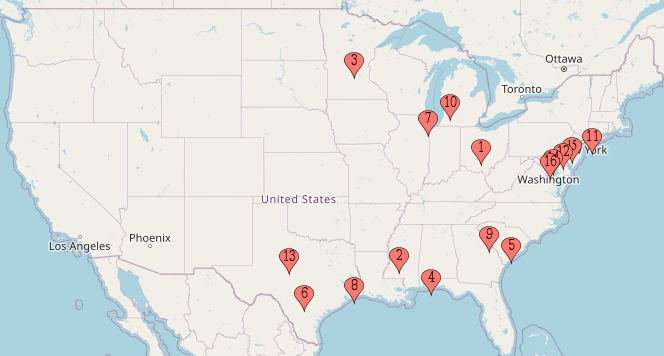
Click map to enlarge
|
|
|
|
|
&uuid=(email)) |
|
|
|

&uuid=(email)) |
|
|
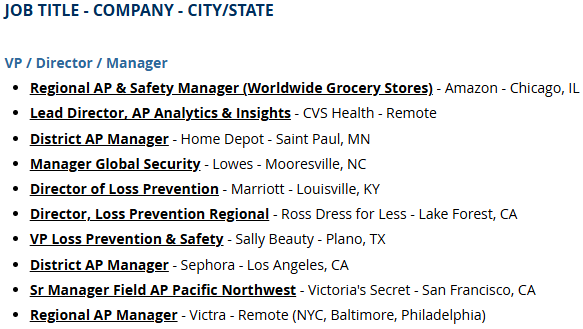
Featured Job Spotlights
|
Help Your Colleagues - Your Industry - Build a
'Best in Class' Community
|
 |
VP Loss Prevention & Safety
Plano, TX
Leads the enterprise-wide strategy for asset protection, loss
prevention, safety, security, and environmental compliance. Accountable for
minimizing financial and operational risk, strengthening internal controls, and
ensuring regulatory compliance across all locations...
|
 |
Lead Director, Asset Protection Analytics & Insights
Remote
The Director of AP Analytics and Investigations is responsible for
leveraging analytics, technology, and investigative strategies to support Asset
Protection operations, investigations, and risk mitigation efforts across the
organization...
|
Featured Jobs
To apply to any of today's Featured Jobs,
Click Here
 |
|
View Featured
Jobs
|
Post
Your Job
|
|
|
|
|
|

Insight,
humor & heart from
one of LP's most trusted voices |
|
|
There Are Two Types of Vendor Meetings.
One ends with everyone talking about
features. The other ends with everyone talking about problems. The
second meeting usually goes much better.
Follow this space every day to see more of 'Hedgie's Hot Takes' |
|
|
|
Not getting the Daily? Is it ending up in your spam folder?
Please make sure to add d-ddaily@downing-downing.com to your contact list,
address book, trusted sender list, and/or company whitelist to ensure you
receive our newsletter.
Want to know how?
Read Here |
|
FEEDBACK
/
downing-downing.com
/
Advertise with The D&D Daily |
|
 |
&uuid=(email))



&uuid=(email))
&uuid=(email))



.png)