&uuid=(email))
 |
|
&uuid=(email))
&uuid=(email))
&uuid=(email))
&uuid=(email))
&uuid=(email))
&uuid=(email))
&uuid=(email))
&uuid=(email))
&uuid=(email))
&uuid=(email))
&uuid=(email))
&uuid=(email))
&uuid=(email))
&uuid=(email))
&uuid=(email))


 |
|
&uuid=(email)) |
|
|
 |
|
 |
John
Opala, PhD named Chief Information Security Officer
for Ralph Lauren
|
 |
Scott
Nelson named Security Manager for South Coast Plaza
|
|
See All the LP Executives 'Moving Up' Here | Submit
Your New Corporate Hires/Promotions or New Position |
|
&uuid=(email)) |
|
|
 &uuid=(email))
|
&uuid=(email)) |
|
Auror joins forces with child protection organization to enable
real-time AMBER Alerts for retailers
Opt-in feature for U.S.
retailers uses license plate recognition (LPR) to detect vehicles
associated with serious child abduction cases
 DENVER
- July 15, 2026 - Global retail crime intelligence platform
Auror
(pronounced ‘aura’) announced today that it has partnered with the
National Center for
Missing & Exploited Children (NCMEC) to enable real-time license
plate recognition (LPR) notifications to surface vehicles associated
with the most serious child abduction cases nationwide. DENVER
- July 15, 2026 - Global retail crime intelligence platform
Auror
(pronounced ‘aura’) announced today that it has partnered with the
National Center for
Missing & Exploited Children (NCMEC) to enable real-time license
plate recognition (LPR) notifications to surface vehicles associated
with the most serious child abduction cases nationwide.
U.S. retailers on the Auror platform are now empowered to opt in for
detection notifications to assist law enforcement during active
AMBER Alerts. Auror is used by many of the largest retailers in the
U.S. to securely record crimes and to identify repeat, violent and
organized offenders.
Read more in today's Vendor Spotlight
column below
The U.S. Crime Surge
The Retail Impact
ORC Financial Investigations
Following the Money in Organized
Retail Crime
 By
the D&D Daily staff By
the D&D Daily staff
Organized retail crime (ORC) investigations have traditionally focused
on identifying theft crews, recovering merchandise and making arrests.
Increasingly, however, retailers and law enforcement are expanding
their focus beyond the theft itself by following the financial activity
that supports organized criminal networks.
Professional theft groups often operate like businesses. They
recruit participants, coordinate thefts across multiple locations, move
stolen merchandise through fencing operations and online resale
channels, and use the proceeds to fund future criminal activity. While
arrests remain an important part of any investigation, identifying the
financial infrastructure behind these operations can have a greater
long-term impact.
An increasing number of retailers are expanding partnerships with
financial crime investigators, online marketplaces and law enforcement
agencies to better understand how organized theft groups generate
and move money. Marketplace transactions, payment records and other
financial data can provide investigative leads that help connect theft
incidents across multiple jurisdictions and identify individuals working
behind the scenes.
Gift card fraud has also become an important investigative focus.
Organized groups continue to exploit gift cards through a variety of
fraud schemes, creating additional financial evidence that can help
investigators uncover broader criminal networks and identify
higher-level organizers.
Retailers are also making greater use of case management platforms,
data analytics and intelligence sharing to connect theft incidents,
identify repeat offenders and uncover relationships between
investigations that might otherwise appear unrelated. As these tools
continue to improve, investigators can develop a more complete picture
of organized criminal activity rather than treating each theft as an
isolated event.
As organized retail crime continues to evolve, successful
investigations increasingly depend on collaboration between retailers,
financial institutions, online marketplaces and law enforcement.
Looking beyond the merchandise itself—and focusing on the financial
networks that support organized theft—can help disrupt entire criminal
operations rather than simply replacing one arrested offender with
another.
For many retailers, following the money is becoming just as important
as recovering the merchandise.
CORCA Marches Closer To Passage
Focus Shifting to Enforcement as Retail Crime Bill Moves Closer to Law
The long-sought Combating Organized Retail Crime Act is getting
closer to becoming law as Senate Judiciary Committee chairman Chuck
Grassley, R-IA, and Ranking Member Dick Durbin D-IL, moved to advanced
the legislation in the United States Senate.
 The
bill would create a central clearinghouse to gather information,
coordinate data and help law enforcement attack retail crime at the
local, national and international levels. The
bill would create a central clearinghouse to gather information,
coordinate data and help law enforcement attack retail crime at the
local, national and international levels.
The Senate version of the Combating Organized Retail Crime Act (CORCA)
has now been placed in a package of amendments attached to the Fiscal
Year 2027 National Defense Authorization Act (NDAA). The bipartisan
CORCA action is focused on improving the Federal response to organized
retail crime and establishing new tools to recover stolen goods.
“As I often remind Iowans at my county meetings, I’m always working to
find bipartisan agreement to solve everyday issues impacting American
families,” Grassley stated as the legislation advanced. “My work with
Senator Durbin on commonsense legislation to curb crime is a prime
example of bipartisanship in action. Together, we’re committed to making
America a safer place to live and raise a family, and we’ll keep
fighting to move our bills forward as part of Congress’ annual defense
legislation.”
Attaching the bill was a means of expediting its movement through the
Senate after the House had passed its own version. Hannah Akey,
press secretary for the Senate Judiciary Committee in Chairman
Grassley’s office, explained that the CORCA bill had not been marked up
and moved, as was the case in the House.
Akey noted: “It will be reviewed alongside all the other NDAA amendments
by the Senate Armed Services Committee (SASC) as well as the Senate
Homeland Security and Government Affairs Committee due to CORCA’s
Department of Homeland Security components. After reviewing the
amendments over the next several weeks, SASC will then release the
final bill text for consideration on the Senate floor.”
The NDAA can be characterized as a must-pass piece of legislation.
Attached to the NDAA, the CORCA legislation has a better chance of
getting signed into law by this year’s end than it would as a
stand-alone bill subject to time constraints and competing
priorities on the Senate floor.
homepagenews.com
Property Crime Drops 25% in San
Francisco
Crime in San Francisco is down — except homicides. Here’s what’s going
on
The first half of 2026 saw decreases in reported violent and property
crimes, according to police data, building on historic declines both
in San Francisco and the state and country more broadly.
Reported crimes of all kinds fell across the board, with
property crimes — burglary, motor vehicle theft
and larceny theft — seeing the largest declines. All were down roughly
25% from January to June this year compared to the same
months last year. Violent crimes were more varied: Assaults were
roughly the same as last year while robberies were down by about 20%.
But homicide numbers in San Francisco are still up compared to last
year. Through the end of June, there were 16 homicides, according to
police data, compared to 12 last year. (One killing that was counted
as a homicide earlier this year was reclassified as accidental, police
said.) Most of the homicides this year happened between January and
March, police data show, but slowed by May and June, which together had
just one reported killing.
Still, police resisted the narrative that this amounted to a trend of
rising violence — or of police inaction. Police Chief Derrick Lew
said in a police commission meeting last week that the homicides in that
area were unrelated acts of violence, making them harder to tackle with
the kinds of violence prevention strategies that help reduce
gang-related or retaliation killings.
Finally, overall gun violence remains down, meaning that, as Lew
previously explained, while fewer people are being shot, more are being
shot and killed.
sfchronicle.com
Prop. 36 Funding Fight
Newsom blasted by sheriff in his own backyard over CA crime as victims
cry foul
Cooper argues Prop 36 is starved of
funding while mental health diversion expansions undermine
voter-approved reforms
While Cooper said the law is already showing results, pointing to
retailers reporting declines in theft, he argued Sacramento has
failed to provide the funding needed to make the initiative successful.
"The issue is no funding, no funding came with it," he said. "It
is working. But without funding, it doesn't go anywhere."
State leaders have said this year's budget includes $375 million to help
implement Proposition 36, though KCRA reported budget documents show
$50 million is specifically directed toward Proposition 36-related court
and pretrial services.
He has also repeatedly criticized lawmakers over Proposition 36,
accusing them of ignoring nearly 70% of California voters by
advancing diversion programs for retail theft offenders instead of
fully funding and implementing the initiative.
"Californians were fed up with retail theft and passed Prop. 36 in
all 58 counties," Cooper wrote in a recent statement, arguing
lawmakers instead responded by proposing new diversion programs that
allow some offenders to avoid convictions.
foxnews.com
Mapped: The Most Dangerous States in the U.S.
How Did Trump Admin’s $1.7B National Guard Deployment Impact Urban
Crime?
&uuid=(email))
In Case You Missed It
Retail AI Industry Survey
Help Shape the D&D Daily's First Retail Crime AI Report
Artificial
intelligence is transforming retail loss prevention, from video
analytics and fraud detection to investigations, reporting and
operational efficiency. Yet one question remains: How are retail
asset protection professionals actually using AI today, and where do
they see the technology heading?
To help answer those questions, the D&D Daily has launched its first
Retail Crime
Prevention and AI Survey.
The brief, two-minute survey is designed to gather insights from
retail asset protection, loss prevention, security and law enforcement
professionals. Rather than focusing on specific products or vendors,
the survey aims to better understand how AI is being adopted across the
industry, the challenges organizations face, and the opportunities
professionals see for the future.
The survey findings will be featured in the D&D Daily's inaugural
Retail Crime Prevention and AI Report—an
executive overview of artificial intelligence's growing role in retail
crime prevention.
The report will be published as both an interactive website and a
downloadable PDF, featuring industry data, visualizations and key
takeaways drawn from survey responses and insights from senior leaders
across retail and law enforcement.
Whether your organization is actively deploying AI, evaluating new
solutions or simply beginning to explore the technology, your
perspective is valuable. Broad participation will help create a more
representative snapshot of where the industry stands today and where
professionals believe it's headed.
The survey takes approximately two minutes to complete, and every
response helps strengthen the final report.
If you work in retail asset protection, loss prevention, security or law
enforcement, we encourage you to participate and share your perspective.
Take the survey today at:
survey.retailcrime.ai
Failing Safety Metrics?
Preventing Catastrophic Safety Incidents:
Do We Have False Confidence In Our Metrics?
Traditional safety metrics often
fail to reveal vulnerabilities in systems designed to prevent
catastrophic events, creating a false sense of security.
Traditional safety metrics mainly measure personal safety and may not
reflect the integrity of systems preventing catastrophic events.
Organizations often confuse strong safety performance with effective
risk control, overlooking vulnerabilities in critical safeguards.
A shift in leadership focus from outcome-based metrics to the health
and verification of safety barriers is essential for high-reliability
operations. Key questions for leaders include understanding
high-consequence hazards, defining and prioritizing controls, and
verifying their effectiveness in real conditions.
Proactive detection of degraded safeguards and operational deviations
requires field-level validation and a culture that encourages speaking
up about failures.
Total Recordable Incident Rate (TRIR) is low. Audits are
complete. Culture surveys are strong. The dashboards look good, the
numbers are trending in the right direction, and by all appearances,
safety is under control.
And yet, major incidents or significant near misses continue to
surprise the team. Not in failing organizations, but in ones that
believed they were performing well. Sites with strong safety cultures,
engaged leadership and years of positive metrics still find themselves
at the center of high-consequence events that “shouldn’t have happened.”
So the question is hard, but unavoidable: Are
we actually monitoring and measuring what prevents catastrophic events?
Across the industry, the pattern is becoming difficult to ignore. The
indicators we celebrate most often tell us very little about whether the
systems designed to prevent rare, high-consequence events are intact,
functioning and effective where it matters most. We are not lacking
effort, investment, or intent. What we may be lacking is visibility into
the conditions that truly determine risk.
ehstoday.com
Autopilot Increases Workplace Risk
When Routine Becomes Risky: The Danger of Autopilot
Autopilot becomes even more important as time-on-task increases.
Researchers describe a phenomenon known as the vigilance decrement,
where the ability to detect critical events gradually declines during
prolonged periods requiring sustained attention. Anthony Zanesco,
Amishi Jha, and their research teams found mind-wandering increases as
vigilance decreases, particularly during repetitive tasks requiring
continuous monitoring. Ironically, highly reliable and predictable
environments often encourage the brain to drift because very little
appears to demand conscious attention. The safer yesterday felt, the
easier it becomes for the brain to expect today will unfold the same
way.
Fatigue magnifies the challenge. As we explored in yesterday's
article, sleep loss, heat, dehydration, and prolonged mental effort
reduce the brain's available cognitive capacity. Under those conditions,
people naturally rely more heavily on automatic processing because
deliberate thinking requires additional energy. Dawson and
Reid's landmark research demonstrated sustained wakefulness produces
impairment comparable to alcohol intoxication. Fatigue does not create
autopilot. Fatigue simply makes the brain more likely to remain there.
Human factors researchers have studied this pattern for decades. Jens
Rasmussen's Skill-Rule-Knowledge framework explains experienced
employees spend much of their day operating at the skill-based level,
where well-practiced behaviors occur automatically with very little
conscious effort. Skill-based performance is remarkably efficient and
highly reliable. It is also where slips and lapses are most likely to
occur because attention has shifted away from the mechanics of the
task. James Reason expanded this thinking through the Swiss Cheese
Model, reminding us injuries rarely result from a single human error.
They develop when predictable human limitations align with weaknesses in
the surrounding system. The objective is never eliminating human error.
The objective is designing systems that anticipate it.
Workers' compensation data reinforce the point. The 2026 Travelers
Injury Impact Report, analyzing approximately 1.2 million workers'
compensation claims, found first-year employees accounted for roughly
thirty-seven percent of workplace injuries. New workers face the
challenges of unfamiliar tasks, equipment, and organizational systems.
At the same time, experienced employees account for a substantial share
of serious injuries because they perform routine work every day and
often assume responsibility for the organization's highest-risk
activities. Autopilot is not an experience problem. It is a human
problem expressed differently across stages of a career.
workerscompensation.com
Businesses Continue to Embrace AI
Survey: Small businesses cite cost and time savings as top AI benefits
Artificial intelligence adoption is
continuing among small- and medium-sized businesses (SMBs).
The 2026 AI and Small Business Adoption Survey from AI-enabled marketing
platform Thryv revealed that AI adoption among U.S. SMBs have risen
to 66%, up from 55% a year ago. One-third of SMBs are spending more
on AI tools than they were 12 months ago, and more than half (53%) are
spending at least $100 per month on the technology.
Seventy percent of those surveyed by Thryv said AI has increased their
revenue over the past year, while 55% reported that it has helped reduce
costs. A large majority (92%) of AI users say the technology saves
them time, with roughly eight-in-10 (79%) expecting to get back between
11 and 60 hours per month, equivalent to several additional
workdays.
When asked whether they would choose AI software or hire a new employee
if both could perform the same task equally well,
nearly half (46%) of owners said they would choose AI.
This is an eight-point jump from 38% in 2025.
Despite the increased adoption, a majority (70%) of owners admit to
needing more training to use the technology effectively. To learn
more about tech adoption, one-third of SMB owners said they turn to AI
tools like ChatGPT to ask how to use AI.
chainstoreage.com
Inflation Slowed to 3.5% in June, as Americans Got a Break From Gasoline
Prices
Men’s Wearhouse owner files for IPO, plots 500 new stores
|
|

|
All the News - One Place - One Source - One Time
Thanks to our sponsors/partners - Take the time to thank them as well
please.
If it wasn't for them The Daily wouldn't be here every day for you.
|
|
|
&uuid=(email)) |
|

&uuid=(email)) |
|
|

|
|
Auror joins forces with child protection organization to enable
real-time AMBER Alerts for retailers
Opt-in feature for U.S. retailers uses license plate recognition (LPR)
to detect vehicles associated with serious child abduction cases
DENVER - July 15, 2026 - Global retail crime intelligence
platform Auror
(pronounced ‘aura’) announced today that it has partnered with the
National Center for
Missing & Exploited Children (NCMEC) to enable real-time license
plate recognition (LPR) notifications to surface vehicles associated
with the most serious child abduction cases nationwide.
U.S. retailers on the Auror platform are now empowered to opt in for
detection notifications to assist law enforcement during active
AMBER Alerts. Auror is used by many of the largest retailers in the
U.S. to securely record crimes and to identify repeat, violent and
organized offenders.
“Nothing is more important than the safety of children,” Auror Head
of Law Enforcement for the Americas and former Deputy Assistant
Director of Homeland Security Investigations Raul Aguilar said.
“It's a privilege to work with the Auror retailer community to
connect them with the incredible work done by NCMEC. While retail
connects us all and is the heart of our communities, the unfortunate
reality is that serious crime can also find its way through retail
settings, so our network has a unique opportunity to support the
community to protect children. We know that immediate action is
critical when AMBER Alerts are issued, and technology has an
important role to play in helping retailers make that connection and
notify law enforcement even faster.”
License plate numbers associated with AMBER Alerts are sent from
police to NCMEC and then immediately linked into the Auror platform,
allowing retailers with LPR capabilities at their sites to detect
those vehicles of interest instantly. Once a vehicle is surfaced,
the retailer can then contact police. Historically, retailers would
manually print out the lists of license plate numbers or posters
associated with AMBER Alerts.
In a recent case, a Texas retailer used the Auror platform to
support a police investigation into a case involving a male
attempting to coerce a minor into his vehicle. The associated
vehicle had been circling the parking lot throughout the day prior
to the incident.
"Every minute matters when a child has been abducted,” said John
Bischoff, vice president of NCMEC’s Missing Children Division. “Our
partnership with Auror allows critical information to reach retail
locations where an abductor may stop, creating valuable
opportunities to identify a missing child’s location so they can be
safely recovered. By connecting technology, businesses and
communities in new ways, we're strengthening our collective ability
to respond quickly when a child's life may be at risk. We're
incredibly grateful for innovative partners like Auror who share our
commitment to protecting children."
Read the press release here
|
|
&uuid=(email)) |
|
|
 |
|
|
Employees: Retail's First Cyber
Defense
The Human Element in Retail
Cybersecurity
By
the D&D Daily staff
Retail cybersecurity often focuses on technology—firewalls, endpoint
protection, multi-factor authentication and advanced threat detection.
While those tools are essential, many cyber incidents still begin with a
much simpler vulnerability: people.
Cybercriminals increasingly target employees because convincing a person
to click a malicious link, approve a fraudulent request or share
sensitive information is often easier than bypassing sophisticated
security systems. Phishing emails have become more convincing
with the help of artificial intelligence, allowing attackers to mimic
executives, vendors and trusted business partners with remarkable
accuracy.
Retail organizations face unique challenges because employees across
stores, distribution centers and corporate offices regularly
interact with vendors, delivery companies, payment systems and
customers. Associates may receive emails about package deliveries,
invoices, scheduling changes or payroll updates—exactly the types of
messages attackers commonly imitate.
Social engineering extends beyond email. Attackers may call
stores pretending to be IT support, corporate leadership or payment
providers to convince associates to reset passwords, install remote
access software or reveal confidential information. Others use text
messages or QR codes directing employees to fake login pages designed to
steal credentials.
Building a strong "human firewall" requires more than an annual
compliance course. Many retailers are shifting toward ongoing
awareness programs that include short, frequent training sessions,
simulated phishing exercises and real-world examples of current scams.
These efforts help employees recognize suspicious requests before they
become costly incidents.
Creating a culture where employees feel comfortable questioning
unusual requests is equally important. Associates should know they
are encouraged to verify unexpected payment instructions, password reset
requests or changes to vendor banking information—even if the message
appears to come from a senior executive. A quick phone call or secondary
verification process can prevent significant financial losses.
Technology remains a critical layer of defense, but cybersecurity
is ultimately a shared responsibility. When retailers combine strong
security tools with informed, confident employees, they reduce the
likelihood that a single click, phone call or text message will turn
into a major cybersecurity incident. In today's threat landscape,
well-trained employees remain one of retail's most valuable security
assets.
'Businesses Should Be On Guard'
Hackers find a new trick to collect Microsoft Entra user data without
raising red flags
Organizations should check their
logs for signs of an increasingly popular obfuscation technique,
Proofpoint said.
Businesses should be on guard for a hacking campaign in which attackers
spoof OAuth client IDs to collect information about targets’ user
directories, the security firm Proofpoint said on Monday.
The security firm said it had observed “multiple campaigns at scale
abusing spoofed OAuth application identifiers, with distinct tooling,
infrastructure, and execution patterns indicating independent adoption
by multiple threat actors.”
The report explains how organizations should monitor their networks
for this reconnaissance technique.
Microsoft Entra, the tech giant’s identity management service, records
hacking attempts in its logs with information that can help defenders
isolate potentially compromised accounts and potentially malicious IP
addresses. In response, hackers have figured out ways to obfuscate their
activities and origins — and in recent months, Proofpoint said,
attackers have taken that “evasive tradecraft” to a new level.
OAuth client IDs tell Microsoft Entra which application is attempting
to access user data. By faking a client ID, hackers can collect
username and password information from the Entra database without
actually operating a genuine application that Entra trusts.
cybersecuritydive.com
Vulnerable Devices At Risk
US authorities warn that state-linked hackers are targeting vulnerable
devices
Hackers linked to Russian
intelligence have exploited vulnerabilities in Cisco Smart Install
devices.
The National Security Agency warned in a joint advisory Monday that
Russian state-sponsored hackers are targeting vulnerable networking
devices to compromise critical infrastructure sectors across the
globe.
Hackers linked to the Russian Federal Security Service Section 16 are
exploiting poorly configured and vulnerable Cisco Smart Install devices
to compromise targets across a range of industries, according to the NSA.
The hackers are tracked under the name Berzerk Bear or Dragonfly.
Cisco networking devices have been a frequent target of state-linked
and criminal actors in recent years, as they provide deep access to
critical systems.
cybersecuritydive.com
New macOS malware steals passwords by posing as Apple’s crash-reporting
tool
UK charges five persons linked to fraud platform behind more than a
million scam calls |
|
|
 |
|
|
AI Fuels Counterfeit Listing Battle
AI and the Growing Challenge of Counterfeit Product Listings
By
the D&D Daily staff
The rapid adoption of artificial intelligence is creating new
opportunities for retailers and consumers, but it is also making
counterfeit products more difficult to identify across online
marketplaces.
Traditionally, counterfeit listings often contained obvious warning
signs such as poor grammar, low-quality images or inconsistent product
descriptions. Today, generative AI can produce convincing product
copy, realistic marketing images and polished storefronts in seconds,
making fraudulent listings appear far more legitimate than in the past.
Counterfeit sellers are also using AI to quickly create large numbers
of listings across multiple platforms, allowing them to reach more
customers while replacing removed listings almost immediately. As
marketplaces improve their detection capabilities, bad actors continue
adapting their tactics to stay ahead.
For retailers and brand owners, the impact extends well beyond lost
sales. Counterfeit products can damage customer trust, increase
return rates and create negative brand experiences when consumers
unknowingly purchase inferior or potentially unsafe merchandise.
Customer service teams are often left handling complaints for products
the retailer never manufactured or authorized.
Technology is becoming an important part of the solution as well.
Many retailers and marketplaces are investing in AI-powered monitoring
systems that analyze product listings, seller behavior, pricing
anomalies and image similarities to identify suspicious activity more
quickly. Digital product authentication, serialization and supply chain
visibility tools are also helping brands verify legitimate merchandise
and trace products throughout the distribution process.
Consumer education remains equally important. Encouraging
shoppers to purchase from authorized sellers, review seller histories
and be cautious of prices that seem unusually low can help reduce
counterfeit purchases before they occur.
As e-commerce continues to expand, the battle against counterfeit
goods is increasingly becoming a technology race. AI is providing
sophisticated new tools for counterfeiters, but it is also giving
retailers, marketplaces and brand protection teams more advanced
capabilities to detect fraudulent activity, protect consumers and
preserve confidence in online shopping.
Buyers Beware
Online School Shopping Scams
More and more every year, back-to-school shopping happens online. This
has great benefits but also brings unique risks compared to shopping in
a physical store. Scammers convince parents to make a purchase and then
never send the promised products or deliver poor-quality products. In
2025, shopping scams were the most reported scam on social media,
according to the Federal Trade Commission, and more than 40% of
people who lost money to a scam on social media said it started when
they ordered a product they saw in an online ad. By knowing how to
identify possible risks, consumers can avoid wasting their money and
energy during the back-to-school season.
Dishonest Ads: Shoppers may receive
an ad on their social media feed, in their text messages, or in their
email promoting school supplies. More expensive items like bags,
clothes, or laptops are commonly advertised as having a limited supply
or only being on sale for a short time. These ads and links can lead to
websites that are dishonest or outright scams.
Copycat Websites: These are
convincing lookalikes that imitate real, well-known sales platforms.
They are carefully designed to trick consumers into a false sense of
familiarity and normalcy. Even if the price of a product seems too good
to be true, consumers may trust the website if it appears to be sold
from a trusted company.
Poor-Quality Products: Whether a
seller uses a fraudulent copycat website or their own third-party sales
platform, consumers should be mindful of low-quality, counterfeit, or
knockoff products. Sellers may provide vague product information or sell
popular items at suspiciously low prices that cannot be found anywhere
else.
Fake Reviews: It’s possible for
scammers to purchase or create fake product reviews and social media
comments. Even if a company has a large number of followers or glowing
testimonials, it could still be fraudulent, dishonest, or a scam. In
addition, fake reviews may come from generic or unverified profiles, or
from customers who were offered a free product or discount in exchange
for a positive review.
kfiz.com
Expert of the day: How to spot online shopping scams
A hidden pipeline brings Amazon and Walmart to African shoppers |
|
|
&uuid=(email))
|
|
Charlotte, NC: DOJ: Leader of Multi-State Auto Theft Ring Sentenced More
Than Eight Years in Prison
The fifth member and leader of an organized auto theft ring that
stole more than 100 high-end vehicles worth millions of dollars from
dealerships located across the United States was sentenced to 97
months in federal prison yesterday, announced Russ Ferguson, U.S.
Attorney for the Western District of North Carolina. Hosea Fernandez
Hampton, 27, of Charlotte, was also ordered to serve three years of
supervised release after completing his prison term. Hampton previously
pleaded guilty to conspiracy to transport, possess, and sell stolen
vehicles in interstate commerce and possession of a stolen motor
vehicle.
justice.gov
Fargo, ND: Two Teens Arrested After Robbing Fargo Gun Store
Two teenagers have been arrested in connection to a burglary that
happened at Outdoorsman in Fargo last Thursday. Fargo Police say
multiple suspects used a stolen vehicle to drive into the business
and take 16 handguns. Police say surveillance video shows a stolen
2015 Hyundai Sonata backing into the store’s front door, causing up
to $60,000 in damage. Police say the video then showed two suspects
break a handgun display case, taking multiple firearms and putting them
into bags before leaving. Police say video from a nearby business showed
another stolen Hyundai Sonata in a parking lot north of the store. One
of the suspects could be seen getting into the second stolen vehicle.
Investigators say the Hyundai cars were stolen when they ignition was
pried apart. Police believe the theft was part of a nationwide trend
involving certain Hyundai and Kia models.
knoxradio.com
Boise, ID: Sporting goods store hit by second smash-and-grab burglary in
three weeks
Surveillance cameras captured two early
morning smash-and-grab burglaries at a Boise Play It Again Sports store
less than three weeks.
Baton Rouge, LA: Woman who allegedly stole $3,500 worth of merchandise
from Lululemon arrested
&uuid=(email))
|
|
|
|
&uuid=(email))
|
|
|
|

|
|
|
Shootings & Deaths
Las Vegas, NV: Update: Suspect wanted for Las Vegas Five Below murder arrested
in Southern California
The 18-year-old suspect wanted for murder in last month's shooting of a Las
Vegas store employee has been arrested in Southern California. Las Vegas
Metropolitan Police said David Vasquez, 19, was taken into custody by the San
Bernardino County Sheriff's Department on Monday, July 13. He is being held at a
detention facility in Barstow and awaiting extradition to Las Vegas.
news3lv.com
Charleston, WV: Update: Man receives maximum sentence for Kanawha City Sheetz
shooting
A Charleston man could spend more than two decades behind bars after being
sentenced for committing a fatal shooting outside a Kanawha County convenience
store in May 2025. Jacob Fields, 19, heard his sentence on Tuesday and received
the maximum 21 years of incarceration for killing 42-year-old Tiffany Adkins of
Marmet at the Sheetz location in Kanawha City. Circuit Judge Maryclaire Akers
sentenced Fields to one year in jail for one count of involuntary manslaughter
and five years apiece for four counts of wanton endangerment.
wvmetronews.com
Robberies, Incidents & Thefts
West Valley City, UT: Valley Fair Mall attack: Stranger stabbed kiosk worker
more than 15 times ‘because of his religion
A stranger walked up to a kiosk worker inside Valley Fair Mall on Monday
afternoon, struck up a brief conversation and then, police say, pulled out a
knife and stabbed him multiple times. The 48-year-old attacker was arrested and
later told West Valley City police that he targeted the worker and intended to
kill him “because of his religion,” according to a probable cause statement. The
document identifies the worker as Muslim. The worker suffered more than 15 stab
wounds and was hospitalized in critical condition, according to a GoFundMe
campaign set up to help pay for his medical bills. The fundraiser, which
identified him only as Sohail, said he needs surgeries on his hands, heart and
lungs.
sltrib.com
Fort Myers, FL: Man Charged in $1M Jewelry Store Heist Lands on FBI Most Wanted
List
One of four men charged with robbing a Florida jewelry store after breaking
through the wall of the business next door has been added to the FBI’s Most
Wanted list. In a superseding indictment filed June 24, the U.S. Attorney’s
Office in Fort Myers, Florida, charged Alberto Perez-Elias and three other
men—52-year-old Ivel Sanchez Rivera and 37-year-old Osmani Barrios Carrera, both
of Hialeah, Florida, and 42-year-old Yunior Lopez-Delgado of Miami—in the
robbery of Tio Jewelers in Cape Coral, Florida. According to an affidavit filed
in the case, the armed robbery happened on the morning of Jan. 6, with Carrera
acting as the lookout and Rivera as the getaway driver.
nationaljeweler.com
Auburn Hills, MI: Police searching for 2 in smash-and-grab at Great Lakes
Crossing jewelry store
Two men used hammers to smash displays and steal jewelry from a diamond store
inside Great Lakes Crossing, now police want help finding them. Auburn Hills
Police were dispatched Helzberg Diamond Outlet store inside the mall for a
smash-and-grab at around 7:30 p.m. on July 13. Allegedly after stealing the
jewelry, the two men fled on foot. According to police the suspects did not
assault or threaten any employees during the theft, and exited the mall through
entry/exit six.
clickondetroit.com
Thomasville, PA: York County man arrested after police say he stole sports cards
worth $14k from a flea market
Washington, DC: Police search for 5 suspects in Chick-Fil-A burglary caught on
camera
Prince George’s County, MD: Man arrested after trying to rob bank with kitten he
stole from pet store
|
|
|
|

•
C-Store – Frankfort,
IL – Armed Robbery
•
C-Store – Clovis, CA –
Armed Robbery
•
C-Store – Monroe
County, PA – Armed Robbery
•
Clothing – Fresno, CA
– Burglary
•
Dollar – Kinston, NC –
Robbery
•
Dollar –
Jeffersontown, KY – Robbery
•
Dollar – Chicago, IL –
Armed Robbery
•
Grocery – Albuquerque,
NM – Armed Robbery
•
Guns – Fargo, ND - Burglary
•
Jewelry – Auburn
Hills, MI – Robbery
•
Jewelry – Whitehall, OH –
Robbery
•
Jewelry – The Woodlands, TX –
Robbery
•
Jewelry – Waldorf, MD
– Robbery
•
Pet – Prince George’s
County, MD – Robbery
•
Pharmacy –
Jeffersontown, KY – Robbery
•
Restaurant -
Washington, DC – Burglary
•
Restaurant – Chicago,
IL – Burglary
•
Restaurant – Matteson,
IL – Armed Robbery |
|
|
Daily Totals:
• 14 robberies
• 4 burglaries
• 0 shootings
• 0 killed |
|
|
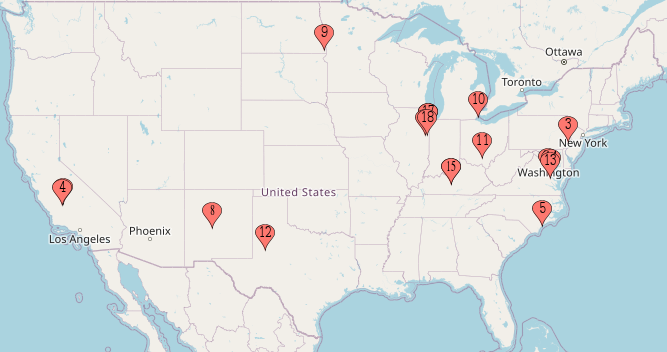
Click map to enlarge
|
|
|
|
|
&uuid=(email)) |
|
|
|

&uuid=(email)) |
|
|
Featured Job Spotlights
|
Help Your Colleagues - Your Industry - Build a
'Best in Class' Community
|

|
District Asset Protection & Safety Manager
South San Francisco
This position provides evaluation, communication, coordination,
recognition, and enforcement in the areas of safety, health, environment, and
asset protection on a district level. This position works with Stores, and
Corporate management to control inventory shrink...
|
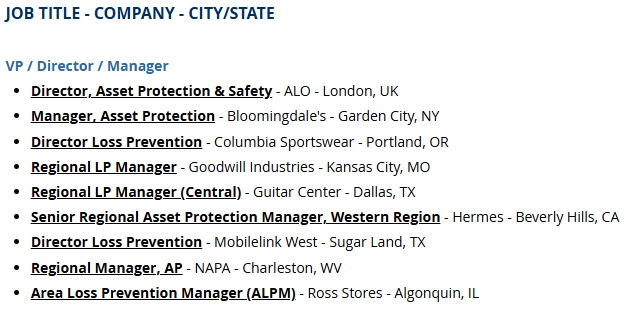
Featured Jobs
To apply to any of today's Featured Jobs,
Click Here
 |
|
View Featured
Jobs
|
Post
Your Job
|
|
|
|
|
|

Insight,
humor & heart from
one of LP's most trusted voices |
|
|
Associates are your best testers.
Want to know if a solution will succeed?
Put it in the hands of associates. If they like it, it’ll fly. If they
hate it, it’s dead. No executive endorsement can save a tool that the
front line despises.
Follow this space every day to see more of 'Hedgie's Hot Takes' |
|
|
|
Not getting the Daily? Is it ending up in your spam folder?
Please make sure to add d-ddaily@downing-downing.com to your contact list,
address book, trusted sender list, and/or company whitelist to ensure you
receive our newsletter.
Want to know how?
Read Here |
|
FEEDBACK
/
downing-downing.com
/
Advertise with The D&D Daily |
|
 |
&uuid=(email))



&uuid=(email))