&uuid=(email))
 |
|
&uuid=(email))
&uuid=(email))
&uuid=(email))
&uuid=(email))
&uuid=(email))
&uuid=(email))
&uuid=(email))
&uuid=(email))
&uuid=(email))
&uuid=(email))
&uuid=(email))
&uuid=(email))
&uuid=(email))
&uuid=(email))
&uuid=(email))
&uuid=(email))


 |
|
&uuid=(email)) |
|
|
 |
|
 |
James C.
Schroeder promoted to Regional Loss Prevention Manager
for David Yurman
|
|
See All the LP Executives 'Moving Up' Here | Submit
Your New Corporate Hires/Promotions or New Position |
|
&uuid=(email)) |
|
|
 &uuid=(email))
|
&uuid=(email)) |
|
Strengthen Retail Security & Enhance Workplace Safety with
Off-Duty Law Enforcement
Discover how off-duty law
enforcement enhances safety and deters crime while protecting employees
and assets.
 Retailers
are under more pressure than ever to prevent theft, ensure employee
safety and maintain business continuity across stores. Criminal
activities are on the rise, and they can severely disrupt operations,
leading to financial losses and a tarnished reputation. Workplace
security not only safeguards assets and sensitive information but also
protects employees and visitors, fostering a safe and productive
environment. Retailers
are under more pressure than ever to prevent theft, ensure employee
safety and maintain business continuity across stores. Criminal
activities are on the rise, and they can severely disrupt operations,
leading to financial losses and a tarnished reputation. Workplace
security not only safeguards assets and sensitive information but also
protects employees and visitors, fostering a safe and productive
environment.
Hiring
off-duty law enforcement is a proven way to level up your retail
security strategy. Off-duty personnel are uniquely positioned to deter
criminal activities, respond swiftly in emergencies and provide an added
layer of protection. By integrating off-duty law enforcement into your
security strategy, you can create a safer, more secure workplace
environment.
Protos Security's workplace security blog explores ways that
off-duty law enforcement can benefit retailers and increase workplace
safety.
Read more here
The U.S. Crime Surge
The Retail Impact
Property Crime: Underreported,
Under-Investigated, Unsolved
Solving Property Crime Starts at the Scene
Property crime is the most common form of criminal victimization in
the United States. Unfortunately, it is also the least likely to
result in accountability. Millions of burglaries, thefts, and vehicle
break-ins go unreported each year, and among those that are, fewer than
one in six is ever solved. Although many of these offenders are
prolific, high-recidivism individuals who may cross over into violent
crime, law enforcement almost never applies one of the most effective
forensic tools available—DNA evidence collection—to property crime
scenes. As a result, our legal system effectively signals to offenders
that property crime carries almost no risk of consequences.
The failure to investigate property crimes doesn’t just embolden
offenders—it erodes public confidence in law enforcement as well.
When victims report a break-in and never hear back, they receive the
message that their loss didn’t matter. That perception grows into a
broader distrust of the system over time, thereby reducing reporting,
cooperation, and community engagement and making the underlying crime
problem harder to solve. Restoring accountability to property crime
isn’t just a public safety imperative; it’s a trust-building one.
Underreported, Under-Investigated, Unsolved
The Federal Bureau of Investigation (FBI) recorded an estimated
5,986,400 property crime offenses in 2024, including roughly
780,000 burglaries, 4.3 million larceny-thefts, and 880,000 motor
vehicle thefts. But these figures dramatically understate the problem.
The Bureau of Justice Statistics’
National Crime Victimization Survey found that only about
30.5 percent of property crime victims reported the crime to police in
2024. Victimization data show that roughly 45 percent of household
burglaries are reported, along with about 25 percent of personal thefts
and approximately 81 percent of motor vehicle thefts; however, these
reports are likely driven by insurance requirements rather than
confidence in law enforcement to follow through.
Even when victims report these crimes, the majority remain unsolved.
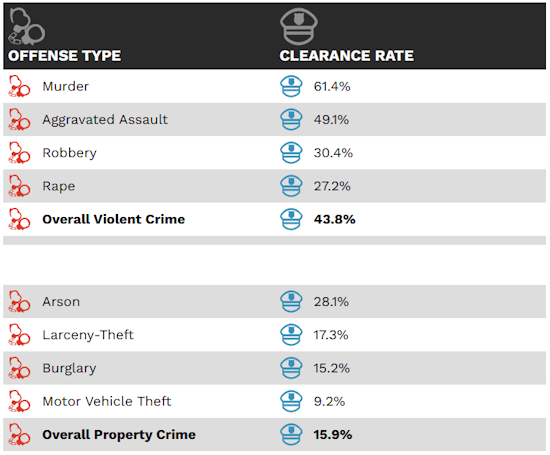
The FBI’s 2024 data show an overall property-crime clearance rate of
15.9 percent. Burglary was cleared at 15.2 percent, larceny-theft at
17.3 percent, and motor vehicle theft at only 9.2 percent compared to
43.8 percent for violent crime overall and 61.4 percent for murder.
These property crime figures represent a marginal improvement from
2023 (13.9 percent overall) and from 2022, when police cleared just 13
percent of burglaries. The long-term trajectory has steadily
declined over decades to where individuals who commit burglary today can
be reasonably sure that their crime will go unsolved. That dynamic has
real implications for crime prevention, as it’s the certainty of being
caught—not the severity of punishment—that drives deterrence.
rstreet.org
ORC Part of New ID Theft Legislation
House Unanimously Approves Legislation to Cut ID Theft
Rep. Steve Bashore, R-Miami, this week unanimously passed legislation in
the House that targets the growing national crisis of identity theft.
Bashore said House Bill 3244 expands the definition and pattern of
these crimes to better encapsulate fraud techniques used by criminals.
It would close a loophole where criminals exploit vulnerable
populations, including the elderly and minors. Third, it would greatly
enhance Oklahoma identity theft laws by expanding the scope of which
items or modes are utilized by criminals.
"Identity thieves are ruthless in their pursuit of stealing our personal
information and using it to rob us of our assets," Bashore said. "This
is a huge issue occurring globally, nationally, and unfortunately right
here in Oklahoma. We must make sure the law is stronger than the
criminal intent. This bill is thorough, listing almost every kind of
identity theft we can think of and matching penalties to fit these
crimes."
Bashore said he received support for the bill from the Oklahoma Bankers
Association, law enforcement agencies statewide and the AARP Oklahoma,
among others
HB3244 includes criminals operating in two or more municipalities, or
when offenses are committed within and without the state or combined
with online or phone fraud. The bill also adds
the crime of organized retail theft, when groups work together to rob
retailers.
The measure also clarifies and broadens punishment for the crime of
using coercion, deception, enticement, intimidation, bartering,
recruiting or other means to exploit someone into committing these
crimes. This includes someone who has a mental illness, is
vulnerable, homeless, intellectually or developmentally disabled,
elderly, a user of drugs or alcohol or is a minor. Again, this adds in
the pattern aspect of these crimes, making the punishment more severe
for those who commit these types of crimes more than once.
okhouse.gov
California's Crime Crackdown Continues
Governor Newsom announces CHP crackdown: 12,600 arrests, 6,400 stolen
cars recovered, 25 million deadly fentanyl doses seized in two years
CHP’s crime suppression teams have achieved significant results,
including 12,645 arrests, 6,475 stolen vehicles recovered, 568 illicit
firearms seized, and the confiscation of over 2,549 pounds of drugs,
including more than 50,110 grams of fentanyl.
Building on a surge in enforcement to remove dangerous weapons,
drugs, and repeat offenders from communities across the state,
Governor Gavin Newsom today announced a significant update toward the
work being done regionally by the California Highway Patrol (CHP) to
increase public safety.
In partnership with local law enforcement, CHP’s crime suppression teams
have delivered significant results in just two years – 12,645
arrests, 6,475 stolen vehicles recovered, and 568 illicit firearms
seized. Officers have also confiscated more than 2,549 pounds of
drugs, including over 50,110 grams of fentanyl—enough for more than 25
million potentially fatal doses.
Last year, the Governor announced ramped-up regional partnerships
between state and local law enforcement to better target crime where it
is most concentrated. Through dedicated regional efforts across San
Diego, the Inland Empire, Los Angeles, the Central Valley, the
Sacramento Valley, and the San Francisco Bay Area, CHP officers are
saturating high-crime areas and increasing public safety.
The state has backed these efforts with significant financial investment
and deeper coordination with local partners, enabling faster, more
targeted enforcement operations. The approach emphasizes visibility,
accountability, and sustained pressure in the areas that need it most.
gov.ca.gov
Crime-Fight Task Force Update
Two bills involving Trump’s Memphis task force advance
Republican state lawmakers from Shelby County advanced two bills this
week targeting the handling of court cases that result from arrests made
by President Donald Trump’s Memphis federal task force.
The Memphis Safe Task Force, a collaboration between several state and
federal agencies and National Guard members tasked with targeting
violent street crime, has made more than 7,300 arrests and issued
nearly 18,000 traffic citations since it launched in late September.
President Donald Trump and several members of his administration visited
Memphis on Monday to meet with Tennessee leaders and commend the task
force as a model for Trump’s nationwide “Make America Safe Again”
objectives.
pressreader.com
Bloomington’s real-time crime data center awarded $557K in federal funds
Pflugerville police detail crime data, AI use and response times
&uuid=(email))
Iran Conflict Pressures Retail
Operations
Iran War Ripples Through Retail Economy
 By
the D&D Daily staff By
the D&D Daily staff
The ongoing conflict involving Iran is creating a wide-ranging ripple
effect across the retail industry, extending far beyond higher gas
prices. While rising fuel costs are the most visible impact, the
broader consequences touch nearly every aspect of retail operations—from
sourcing and logistics to pricing and consumer demand.
At the core of the disruption is energy. Oil prices have surged sharply
amid threats to the Strait of Hormuz, a critical shipping route that
handles roughly 20% of global oil supply. Because fuel accounts for up
to 50–60% of shipping costs, retailers are facing significantly
higher transportation expenses across ocean freight, trucking and
last-mile delivery. These increases are quickly flowing through
supply chains and into product pricing.
Beyond fuel, the conflict is straining the availability of key raw
materials. Global supply chains for inputs such as petrochemicals,
fertilizers and industrial materials are being disrupted, affecting
categories ranging from apparel and home goods to packaged food.
Retailers reliant on global sourcing are encountering delays, cost
volatility and reduced inventory predictability.
Consumer behavior is also shifting. Rising costs for fuel,
groceries and utilities are placing pressure on household budgets,
leading to reduced discretionary spending. Early indicators show
declining consumer confidence and a pullback in non-essential purchases,
particularly impacting apparel, electronics and specialty retail
segments.
Financial conditions add another layer of complexity. Market
volatility and rising interest rates tied to inflation concerns are
increasing borrowing costs for retailers while dampening investment and
expansion plans.
Taken together, the Iran conflict is creating a multi-front challenge
for retailers. Elevated operating costs, supply chain uncertainty
and weakening consumer demand are converging at once—forcing retailers
to balance pricing strategies, inventory management and margin
protection in an increasingly unpredictable environment.
Stores Remain As Important As Ever
In the age of AI, Home Depot’s stores have ‘never been more relevant’
While the retailer has been ramping
up its AI-powered offerings, it aims to provide a frictionless
experience across a customer’s shopping journey, wherever that may be.
 While
AI was top of mind for the more than 10,000 attendees at this year’s
Shoptalk Spring conference, The Home Depot doesn’t see it overtaking
the physical shopping experience. While
AI was top of mind for the more than 10,000 attendees at this year’s
Shoptalk Spring conference, The Home Depot doesn’t see it overtaking
the physical shopping experience.
“Twenty-five years ago, the conversation was, ‘Is the store going to be
relevant in an age of e-commerce?’” Jordan Broggi, executive vice
president of customer experience and president of online at Home Depot
said during a Wednesday session. But now in the
age of AI and agentic commerce, “the store has never been more relevant
than it is today.”
But even though the home improvement retailer views the technology as
just one avenue for customers to shop within its overall ecosystem,
it has made significant strides with AI over the past year.
Home Depot also understands customer shopping preferences vary: Some
customers want to engage with AI tools for assistance, while some know
exactly what they want and can search for it quickly on the retailer’s
website. And still, others prefer speaking to an associate in store
before making a purchase, according to Angie Brown, chief information
officer at Home Depot.
“It’s creating the experience that works for a variety of different
customers, across a variety of different journeys, and meeting them
in the moment for what they need,” Brown said during the Wednesday
session.
retaildive.com
Is Retail Hitting an AI Speed Bump?
Retailers 'stuck' in exploring, planning phases of AI integration
Retailers agree that artificial intelligence is key for the future, but
a majority have yet to fully adopt the technology.
While 83% of retailers indicate that AI is a necessity to compete,
only 6% of retailers rate their current AI capabilities as "mature,”
according to a new survey from Verizon Business and Cisco. Those who
have yet to fully integrate AI say they are stalled in the "exploring"
(31%) or "planning" (37%) phases.
Retailers surveyed cited poor or siloed data (55%) as a deployment
challenge when implementing AI, while system integration challenges
(48%) and lack of specialized talent (44%) also hinder progress.
Data infrastructure (56% overall priority) and upgrading the network
and computing abilities (42%) were noted as the biggest priorities
for getting AI implemented. The survey noted that 61% of retailers
reported revenue loss from slow digital experiences, and 55% from
in-store mobile app crashes, highlighting that network infrastructure
upgrades are needed.
Two-thirds (67%) of network upgrades are driven by AI and machine
learning applications, followed by IoT and sensor networks (56%) and
computer vision (54%). The report noted that the workloads demand
high bandwidth and low latency, pushing traditional infrastructure past
its limits.
chainstoreage.com
Will Costco Benefit from Gas Price
Surge?
Costco gas plans change as pump prices rise
Costco’s new strategy for gas may
surprise members.
Gas prices keep going up, and that’s unlikely to change, unless the
ongoing war in Iran ends. “The national average for a gallon of regular
gasoline is up 10 cents from last week and one dollar since last
month,” according to data from AAA. Prices have been driven higher
by the war.
That creates a short-term opportunity for low-cost gas providers,
including Costco. The warehouse club, however, has chosen to make a
longer-term bet that it can grow its memberships based on gas sales.
Costco, he noted, offers some relief to consumers. Some gas stations
offer lower prices than others, especially those at wholesale membership
clubs, such as Costco, Sam’s Club, and BJ’s Wholesale Club,” De Haan
said. Costco has used low-priced gas to drive memberships.
“When prices are higher, that will tend to cause members to maybe
take the extra mile that it might involve to get to the gas station
because of the incremental value they see there,” Millerchip added.
thestreet.com
Target boosts employee discount; reportedly rolling out new dress code
rules
Store workers will be required to wear
sleeved-red shirts and either blue denim or khaki pants, shorts or
skirts, reported NBC Chicago. (Previously, graphic or patterned red
shirts and jeans of other colors had been allowed.)
Which retailers win and lose from high gas prices? Deutsche Bank sorts
it out
Companies indexed to higher-income customers
are more likely to weather higher gas prices, the firm found.
Instacart increases fuel benefits for shoppers amid gas price surge
Kroger to reportedly open two stores, invest $112 million in Ohio
Designer Brands brings together US, Canada retail businesses
The Bay Area is growing again — but something isn’t adding up
Last week's #1 article --
Retailers Deploy Bodycams to Fight
Rising Theft & Incivility
As Theft and Customer Incivility Rise, Bodycam Adoption in Retail will
Climb
A YouGov poll of American adults from mid-2025 revealed a notable shift
in sentiment around body-worn cameras. Once considered the domain of law
enforcement, bodycams are now increasingly visible across everyday
environments — from stores to medical offices, transit systems and
venues. And it turns out that people are in favor: according to YouGov,
70% of respondents are either comfortable with, or indifferent to,
seeing body-worn cameras worn by employees in more settings.
The National Retail Federation (NRF) and Loss Prevention Research
Council’s October 2025 report, The Impact of Retail Theft & Violence
2025, highlighted how theft, organized retail crime and in-store
violence remain persistent and costly challenges for retailers. For
those navigating rising theft and customer incivility, the shift in
perception of bodycams removes one of the biggest barriers to
adoption — paving the way for more deployments in 2026 and beyond.
Early retail deployments of bodycams focused on stores that were
considered high-risk – those with a track record of higher theft or
incidents of violence. But the scope is widening today as retailers take
a more proactive approach to deterring incivility before it happens.
Major retailers including H&M, Target, Walmart and Aldi all have
publicly acknowledged their use of bodycams as part of their loss
prevention strategies.
The appeal is clear: Bodycams introduce a visible deterrent at the
point of interaction. When potential offenders know an encounter is
being recorded, behavior often changes. In fact, according to the
aforementioned YouGov research, 44% of respondents admitted they would
think twice about their behavior if they knew employees were wearing
body-worn cameras.
Situations de-escalate faster. Associates feel more confident
enforcing policies. And when there is an incident, having objective
footage provides an unbiased, thorough record for internal review, law
enforcement collaboration and legal proceedings — should it get to that
point. Importantly, bodycams don’t replace existing security
infrastructure — they complement it. Fixed cameras show what happened
from afar; body-worn cameras capture an up-front live view of how it
unfolded and what was said.
retailtouchpoints.com
|
|

|
All the News - One Place - One Source - One Time
Thanks to our sponsors/partners - Take the time to thank them as well
please.
If it wasn't for them The Daily wouldn't be here every day for you.
|
|
|
|
|
|

&uuid=(email)) |
|
|

|
|

The loss prevention industry stands at a crossroads. The path you
choose will define what LP looks like for your company in the years
ahead.
After decades of incremental evolution (from tape-based CCTV to
digital video, from manual audits to exception-based reporting), LP
stands on the brink of its most significant upheaval yet: the shift
from reactive operations to AI-powered intelligence.
The path forward is full of questions and uncertainty. What does "AI
in LP" actually mean? How do organizations progress from alert
fatigue to autonomous workflows? What prevents advancement?
Don’t worry. We’ve built a roadmap.
On March
31st at 11:00 AM EST
we’ll share The Loss Prevention Maturity Model—a strategic framework
that maps four stages of LP evolution: from reactive, device-based
operations to data-driven analytics, AI-powered intelligence, and
ultimately autonomous workflows.
 |
|
|
&uuid=(email)) |
|
|
 |
|
|
EU Investigation After Amazon Hack
European Commission investigating breach after Amazon cloud account hack
The European Commission, the European Union's main executive body, is
investigating a security breach after a threat actor gained access to
the Commission's Amazon cloud environment.
Although the EU's executive cabinet has yet to disclose the incident
publicly, BleepingComputer has learned that the breach affected at
least one of the Commission's AWS (Amazon Web Services) accounts.
"AWS did not experience a security event, and our services operated as
designed," an AWS spokesperson told BleepingComputer after publishing
time.
Sources familiar with the incident have told BleepingComputer that the
attack was quickly detected and that the Commission's cybersecurity
incident response team is now investigating.
While the Commission has yet to share any details about this breach, the
threat actor who claimed responsibility for the attack reached out to
BleepingComputer earlier this week, stating that they had stolen over
350 GB of data (including multiple databases).
They didn't disclose how they breached the affected accounts, but they
provided BleepingComputer with several screenshots as proof that they
had access to information belonging to European Commission employees and
to an email server used by Commission employees.
The threat actor also told BleepingComputer that they will not attempt
to extort the Commission using the allegedly stolen data as leverage,
but intend to leak the data online at a later date.
The Commission disclosed another data breach in February after
discovering on January 30 that the mobile device management platform
used to manage its staff's devices had been hacked.
bleepingcomputer.com
‘Do not shift budgets to AI’:
How businesses should and shouldn’t respond to evolving threats
Experts said companies rushing to
buy AI services risk letting their existing, still-vital defensive
measures deteriorate.
Businesses hoping AI can automate away their security woes should
think again, because the technology isn’t a cure-all and is actually
introducing new risks, experts warned at the RSAC 2026 Conference here.
“We’re seeing advantages [with AI for defense], but we’re also seeing
a lot of hiccups as we figure out how to get there,” Adam
Pennington, who oversees MITRE’s ATT&CK framework, said during a panel
about how AI is changing the push-and-pull between attackers and
defenders.
Security teams are using AI in a lot of the same ways as hackers,
Pennington said, especially rapid code-writing. “There does need to
be some caution, though, in using it directly in defense,” he said.
“False positives have always been a problem in trying to apply machine
learning and AI to defense.”
The warnings from Pennington and others on the panel come as
businesses rush to purchase AI security services, often with
seemingly little regard for their efficacy or tradeoffs.
Paul McCarty, the head of security research for the threat intelligence
database OpenSourceMalware, said he had heard from many organizations at
the conference that they were “shifting budgets from existing
security tools to AI because they don’t want to be left behind.”
“That is a terrible, terrible policy,” he said. “Do not shift budgets
to AI.”
cybersecuritydive.com
First Line of Defense?
Identity is the first line of defense, especially in an AI-fueled threat
landscape
Two new reports illustrate why
companies need to do a better job of scrutinizing what their human
employees and AI agents are doing.
The evolving threat landscape has placed identity governance at the
center of cybersecurity, according to a pair of reports released
this week, meaning that organizations should prioritize identity
management as a way to protect sprawling computer networks from
under-the-radar intrusions.
Cloudflare’s report, released Wednesday, and PwC’s report, released
Tuesday, both emphasize the need for companies to do a better job of
monitoring user behavior and scanning for suspicious network activity.
The rise of AI only makes identity governance even more important,
researchers wrote, as the technology helps hackers improve their
impersonation tactics.
In the past, intrusion prevention primarily took the form of
vulnerability management, with intrusion detection focused on prowling
for exploitation of digital flaws or suspiciously repetitive login
attempts. Today, security researchers say, identity abuse makes it
easier for hackers to break into a system without tripping alarms.
cybersecuritydive.com
Espionage campaign targets telecom with stealthy Linux-based backdoor |
|
|
|
&uuid=(email)) |
|
|
 |
|
|
Gap's AI Push
How Gap Inc. is ‘leaning in’ to AI to elevate online shopping
The apparel retailer is accelerating
its digital experience with two new partnerships, CTO Sven Gerjets told
an audience at Shoptalk.
Gap Inc. is entering into a new stage of its online shopping experience.
The apparel company on Tuesday announced two new AI technologies
designed to streamline shopping: personalized fit guidance with Bold
Metrics and a partnership with Google’s Universal Commerce Protocol.
The overarching objective, according to leadership, is to help
customers feel confident about product fit and to streamline
discovery and purchasing with the help of artificial intelligence.
“We have to keep testing and learning because the space is moving so
fast,” Sven Gerjets, chief technology officer at Gap Inc., told an
audience at Shoptalk. “We’re trying to really focus on walking and
chewing gum at the same time and accelerating the strategy forward and
moving the company in new directions.”
Gap Inc. is an early launch partner with Google on its UCP protocol,
a structure that will allow the retailer to bring its experiences into
agentic chat environments. Shoppers will soon be able to discover
the retailer’s products in Gemini and AI Mode in Google Search,
initially completing shopping via Google Pay. UCP will also allow the
retailer to offer loyalty and promotional offers to shoppers.
Relevance on large language models is becoming increasingly critical
as shoppers are gaining familiarity with a richer type of natural
language experience, Gerjets said.
“For us, relevance is super critical,” Gerjets said. “But, we also don’t
want to push our customers out to an experience. We want to maintain the
relationship.” That means not just allowing someone to click a buy
button as an anonymous customer, but bringing Gap Inc.’s brand
essence into another space.
retaildive.com
One-Click Online Shopping
Stripe Unveils One-Click Checkout on Facebook, Streamlining Online
Shopping
Small business owners are increasingly exploring innovative ways to
streamline the purchasing process for their customers. A recent
announcement from Stripe, a leader in financial services technology,
could change the landscape of e-commerce on social media platforms.
Stripe has unveiled a new checkout experience for Facebook, designed to
facilitate one-click purchases directly from ads, potentially
transforming how small businesses engage with consumers in the digital
marketplace.
The new feature enables businesses to integrate their Facebook ads
with Stripe’s payment processing capabilities effortlessly. This
integration allows customers to purchase products directly after
clicking on an ad, significantly reducing the time and steps needed to
complete a transaction. With an emphasis on user-friendly experiences,
potential customers can now leverage their saved credentials from their
Meta wallets, making online shopping more accessible and convenient.
smallbiztrends.com
Amazon planning to build distribution facility in Central Maine
AI dominated the buzz at Shoptalk Spring |
|
|
&uuid=(email))
|
|
Geneva, Switzerland: Nestlé says 413,793 KitKat candy bars stolen en route from
Italy to Poland
Swiss food giant Nestlé says about 12 tons, or 413,793 candy bars, of its KitKat
chocolate brand were stolen after leaving its production site in Italy earlier
this week for Poland. The company, based in Vevey, Switzerland, said in a
statement Friday that "the vehicle and its load are still nowhere to be found."
The shipment of the crunchy bars, made of waffles covered with chocolate,
disappeared last week while en route between production and distribution
locations. The chocolate bars were to be distributed throughout Europe. The
missing candy bars could enter unofficial sales channels across European
markets, the company said, but if this does happen, all products can be traced
using the unique batch code assigned to individual bars. A spokesperson for
KitKat said that as a result, consumers, retailers and wholesalers would be able
to identify if a product is part of the stolen shipment by scanning the on-pack
batch numbers. If a match is found, the scanner will be given clear instructions
on how to alert the company, which will then share the evidence appropriately.
"Whilst we appreciate the criminals' exceptional taste, the fact remains that
cargo theft is an escalating issue for businesses of all sizes," KitKat said in
a statement. "With more sophisticated schemes being deployed on a regular basis,
we have chosen to go public with our own experience in the hope that it raises
awareness of an increasingly common criminal trend," the statement added.
abc7news.com
Hillsborough County, FL: Three Arrested in $75K Liquor Theft Scheme
The Hillsborough County Sheriff’s Office has arrested three individuals
following an investigation into an organized theft scheme targeting a
Tampa-based alcohol distribution company. On March 12, 2026, the company
reported an ongoing internal theft involving a delivery driver, a warehouse
associate, and a third suspect. Detectives determined that beginning February
13, 2026, warehouse associates concealed cases of high-end liquor on pallets
during overnight shifts. The stolen merchandise was then loaded onto delivery
trucks after security seals were broken and reapplied. The delivery driver
knowingly departed the warehouse without reporting the compromised seals and
made unauthorized stops along his route, primarily at a Wendy’s in Seffner. At
these locations, the stolen liquor was transferred to a vehicle operated by the
third suspect. The merchandise was then transported to a home located on the
14000 block of Alistar Manor Drive in Wimauma, where it was stored and sold. On
March 25, 2026, detectives executed a court-authorized search warrant at the
home, recovering approximately $75,000 worth of stolen liquor.
teamhcso.com
Riverside County, CA: $10k worth of stolen Legos, toys and tools recovered in
Riverside County during search warrant
Police recovered nearly $10,000 worth of stolen Legos, toys and tools that were
allegedly taken from Riverside County retail stores during a search warrant on
Wednesday, according to the Hemet Police Department. In a news release shared on
social media, Hemet police said that 37-year-old Hugo Omar Sanchez-Sanchez was
arrested and booked on suspicion of possession of stolen property and organized
retail theft following a search warrant that was served at a home in the 300
block of S. Gilbert Street on Wednesday. Detectives said that they had learned
about a large amount of expensive Lego sets and merchandise that were being
taken from local retailers and then sold at a local swap meet.
cbsnews.com
Solano County, CA: Vacaville Outlet Bust: Cops Nab Four, Sock Stash and Stolen
Cards
A late afternoon shoplifting call at the Vacaville Premium Outlets turned into a
full-blown bust last Thursday, ending with a short foot chase, four arrests and
a sock that was doing a lot more than keeping anyone’s feet warm. Just before 5
PM, a store employee at the outlets called dispatch to report people actively
stealing merchandise, prompting a rapid response from Vacaville officers.
According to a Vacaville Police Department recap, officers quickly spotted a man
and a woman who matched the description given in the 911 call. In its Facebook
post, the department says officers recovered a sock that had been turned into an
improvised stash, concealing small plastic baggies with suspected drug residue.
Police also reported finding credit cards belonging to four other people and a
driver’s license that did not match any member of the group.
hoodline.com
&uuid=(email))
|
|
|
|
&uuid=(email))
|
|
|
|

|
|
|
Shootings & Deaths
Anne Arundel County, MD: 3 arrested, officer injured after Arundel Mills mall
shooting prompts police chase
A shooting at the Arundel Mills mall on Saturday ended with three people
arrested, and several — including a police officer — suffering injuries in a
pursuit. Police were called around 5 p.m. to the Arundel Mills mall in Hanover,
where they found a man in the vestibule near a Burlington store who had been
assaulted by several individuals. Justin Mulcahy, a spokesperson with the Anne
Arundel County Police Department, said at a news conference that the man was
leaving the store when he was approached by the individuals. During the
altercation, the man drew a handgun, and the struggle over the weapon led to one
of the suspects being shot in the wrist. The suspects later fled the mall in a
black Nissan Altima.
wtop.com
Portland, OR: Man with gunshot wound found dead at Plaid Pantry in Northeast
Portland
Tarrant County, TX: Authorities identify 20-year-old killed in shooting outside
Arlington convenience store
Atlanta, GA: Man dies in southeast Atlanta gas station shooting
Robberies, Incidents & Thefts
Medina, OH: Car crashes through front of local Walmart after driver has medical
emergency
Lauderdale Lakes, FL: A man brought his dog into a Florida Aldi. He was ‘sucker
punched’ into a coma
|
|
|
|

•
C-Store – Dover, DE –
Burglary
•
C-Store – Shelton, CT
- Armed Robbery
•
C-Store – Nashville,
TN – Armed Robbery
•
C-Store – Cleveland,
OH – Burglary
•
C-Store – Whiter
Settlement, TX – Burglary
•
Dollar – Augusta, GA -
Armed Robbery
•
Dollar – Wethersfield,
CT - Robbery
•
Hardware – York, PA –
Robbery
•
Jewelry – Scranton, PA – Robbery
•
Liquor – Simi Valley,
CA – Burglary
•
Pharmacy - Washington
DC – Armed Robbery
•
Pharmacy – Perkins
Township, PH – Burglary
•
Restaurant –
Jacksonville, FL – Armed Robbery
•
Restaurant – Waco, TX
– Burglary |
|
|
Daily Totals:
• 8 robberies
• 6 burglaries
• 0 shootings
• 0 killed |
|
|
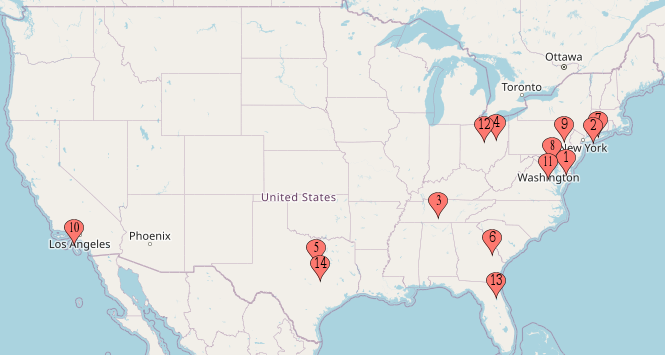
Click map to enlarge
|
|
|
|
|
&uuid=(email)) |
|
|
|

&uuid=(email)) |
|
|
Featured Job Spotlights
|
Help Your Colleagues - Your Industry - Build a
'Best in Class' Community
|
 |
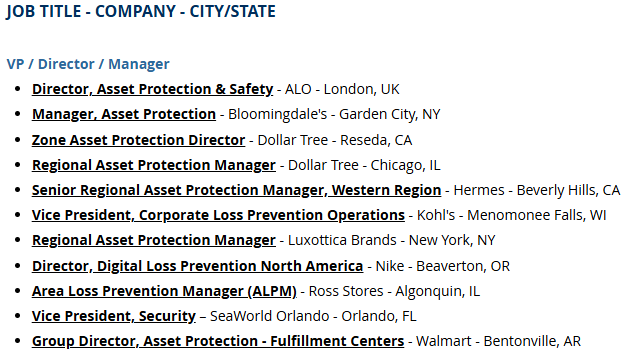
Vice President, Corporate Loss Prevention Operations
Menomonee Falls, WI
The Vice President of Loss Prevention Operations is responsible for
developing and executing a comprehensive strategy to reduce and prevent loss
across all aspects of the company’s operations. This role includes leadership of
the corporate loss prevention team, collaboration with senior management, and
the implementation of risk management programs...
|

|
Group Director, Asset Protection - Fulfillment Centers
Bentonville,
AR
The Group Director, Asset Protection – Fulfillment Centers is
responsible for leading the operations and strategy of the Asset Protection
department across Walmart’s Fulfillment Centers. This role ensures the safety,
security, and profitability of fulfillment operations by overseeing risk
management, crisis response, financial performance, and team leadership...
|
Featured Jobs
To apply to any of today's Featured Jobs,
Click Here
 |
|
View Featured
Jobs
|
Post
Your Job
|
|
|
|
|
|

Insight,
humor & heart from
one of LP's most trusted voices |
|
|
They Notice When Vendors Respect Store Reality
If your rollout plan assumes full
staffing, perfect compliance, and unlimited time for training, they know
you haven’t spent enough time in stores. The vendors who design for real
store conditions - interruptions, turnover, time pressure - consistently
outperform.
Follow this space every day to see more of 'Hedgie's Hot Takes' |
|
|
|
Not getting the Daily? Is it ending up in your spam folder?
Please make sure to add d-ddaily@downing-downing.com to your contact list,
address book, trusted sender list, and/or company whitelist to ensure you
receive our newsletter.
Want to know how?
Read Here |
|
FEEDBACK
/
downing-downing.com
/
Advertise with The D&D Daily |
|
 |
&uuid=(email))



&uuid=(email))

&uuid=(email))