|
|
 |
|
 |
Nancy
Sciascia promoted to Lead Retail Fraud Investigator for
Starbucks
|
|
|
See All the LP Executives 'Moving Up' Here
Submit Your New Corporate Hires/Promotions or New Position
|
|
|
|
 |
|
  |
 |
|
|

The retail environment is changing rapidly. Customers expect
seamless experiences, employees need the right tools to work
efficiently, and retailers must balance operational performance
with safety, security and profitability.
In this webinar, we explore the concept of the Connected Store
and how connected technologies can help bring people, processes
and physical spaces together. We’ll discuss how data, video and
intelligent solutions can support more informed decision-making,
improve visibility across store operations and create a better
experience for both customers and employees.
Register Here

|
The U.S. Crime Surge
The Retail Impact
ORCAs Strengthen Retail Crime
Prevention
Organized Retail Crime Alliances
Play Critical Role in Combating Retail Theft
As organized theft networks grow more sophisticated, regional
partnerships are helping retailers and law enforcement strengthen
investigations and share intelligence.
 By
the D&D Daily staff
As organized retail crime continues to challenge retailers nationwide,
Organized Retail Crime Associations (ORCAs) are playing an
increasingly important role in bringing together loss prevention
professionals, law enforcement agencies and prosecutors to combat
theft and strengthen public safety.
According to the National Retail Federation's 2026 retail theft and
violence report, 40% of surveyed retailers experienced an increase in
organized retail crime-related incidents, while 50% reported
increased repeat offender activity. These findings come despite
broader improvements in shoplifting and merchandise theft rates,
highlighting the evolving nature of organized criminal activity.
ORCAs help address one of the industry's biggest challenges:
criminals operating across multiple retailers and jurisdictions. Through
intelligence sharing, investigative collaboration and professional
networking, these associations allow retailers and police departments to
identify patterns that might otherwise go unnoticed.
A suspect targeting several retailers across neighboring communities,
for example, may appear responsible for isolated incidents until
investigators begin comparing information.
Many ORCAs also provide secure intelligence-sharing platforms,
training opportunities, regional meetings and annual conferences
that strengthen relationships between private-sector investigators and
law enforcement.
The Carolinas Organized Retail Crime Alliance, for example, offers
members access to a real-time intelligence-sharing platform and
educational resources designed to improve investigative coordination.
These partnerships are particularly valuable as organized theft
operations expand beyond traditional shoplifting, increasingly involving
cargo theft, gift card fraud, online resale schemes and other
sophisticated criminal activity.
NRF research found that 49% of surveyed retailers identified
cross-jurisdictional theft as an investigative obstacle, while another
49% cited insufficient information sharing and coordination between
agencies.
For retail asset protection teams, participating in an ORCA can provide
access to investigative resources, professional relationships and
intelligence that individual companies may struggle to develop
independently.
As retailers continue investing in security technology, employee safety
and theft prevention, the collaborative approach offered by ORCAs
remains an important component of the industry's response to organized
retail crime.
Ontario Police Target Organized Retail
Theft
Project Safeguard targets organized retail theft
Project Safeguard is a focused initiative to examine how the
service identifies, investigates and helps prevent organized retail
theft
Protecting Ontario Together means supporting local businesses. Retail
crime is a growing concern in our community. According to a recent
Retail Council of Canada report, retail losses grew to $9.2 billion in
2025. The 2025 Statistics Canada Crime Severity Index, which tracks
police-reported crime in Canada, shows that shoplifting under $5,000 is
the most frequently reported offence in Guelph.
That’s why the Guelph Police Service is launching Project Safeguard,
a focused initiative to examine how the service identifies, investigates
and helps prevent organized retail theft.
Project Safeguard officially launches during Crime Prevention Week and
will run over the next year. It will explore ways businesses and
police can work more closely together to identify, prevent and respond
to shoplifting and retail theft. The project will look to streamline how
incidents are reported and evidence is gathered, and to strengthen
relationships with the retailers most often affected.
Together, police and retailers will explore crime prevention
strategies, identify barriers to reporting and providing evidence,
and gain a better understanding of the concerns of businesses and their
employees. At the same time, police will review their internal processes
to develop a consistent approach to property crime and retail theft,
strengthen analysis and data tracking, and undergo training.
By sharing information, raising concerns and taking proactive steps,
we can help protect local businesses and build safer, stronger
communities.
guelphtoday.com
Police Social Media Transparency
Concerns
What police write on social media carries power; what they leave out may
wield even more
More and more, a department’s transparency is measured by what
they do or do not post
As agencies such as police departments increasingly control information
that residents receive directly, they also shape how a community
receives such news, and — when the actions of the officers are
questionable — set a tone of authority over the early narrative of their
own conduct.
“I learned pretty quick that what you say has a lot of reach and is
really vital to reaching the community,” Galer said of his earlier
days with Pittsburg police, when he was the first to be put in charge of
their digital reach. “But sometimes, it can be what you don’t say or
write that speaks even louder.”
So how complete a picture do departments provide when the work of their
own officers comes into question? In an age when many departments are
working to encrypt scanners and increasingly control the flow of
information, how transparent are they?
In general, “there are always going to be conspiracy theorists,
no matter what you do,” Galer said. “I’d say more information is always
better. You don’t ever want to make your community think that you’re
deceiving them. Perception becomes reality.”
The lack of consistency in what a department chooses to publicize also
can play into the message they may send.
mercurynews.com
Enforcement Shifts Toward Minor
Offenses
Low-level arrests are rising despite national crime declines
Arrests for low-level offenses, including vagrancy and drug
possession, increased nationwide in 2025, even as violent crime
continued to decline, according to a new analysis of federal data.
The analysis, which was released in late October by the criminal justice
advocacy organization FWD.us, found that arrests for vagrancy, an
offense often associated with homelessness, rose 44% between 2024
and 2025, while arrests for marijuana possession increased 6% and
possession of other drugs rose 3%.
Arrests for immigration violations nearly tripled, rising 188%
between 2024 and 2025, amid President Donald Trump’s crackdown on
illegal immigration. The increase continued into 2026, with an average
of 36,093 arrests per month through July — nearly four times the monthly
average in 2024, according to the report.
The findings point to a shift toward more aggressive enforcement of
lower-level offenses, particularly in states that have rolled back
major changes to their criminal legal systems in recent years, according
to the analysis.
stateline.org
New data shows US crime is down across the board
Garfield Heights could seek $200,000 to fight violent crime, boost
police staffing

AI Safety Errors
Survey Finds Errors in AI-Generated Safety Procedures
Workers report mistakes in AI-assisted safety documents, raising
concerns about oversight and accountability.
More than one-third of workers surveyed reported errors in AI-generated
workplace safety documents, while 20% said they witnessed an adverse
outcome linked to those mistakes, according to a study by TRADESAFE.
The study, published Oct. 6, surveyed 514 U.S. workers in manufacturing,
construction, warehousing, logistics and skilled trades about the use of
artificial intelligence in workplace safety documentation.
Among respondents, 36% reported seeing AI-generated documents
containing outdated requirements, vague instructions or missing
hazard information. Reported adverse outcomes included near misses,
injuries, failed inspections and equipment damage.
“Safety procedures can look complete on the surface but still lack
steps to protect people from serious injury,” said Herbert Post,
vice president of TRADESAFE. “That's what makes errors from AI
particularly concerning.”
The research also found that 51% of respondents familiar with how
their organizations create safety documents said their employers use
generative AI to help write them.
However, independent review practices varied by job role. Among company
leaders surveyed, 74% reported that AI-generated safety materials
undergo independent review, compared with 52% of supervisors and
managers, 36% of frontline workers and 23% of safety professionals.
Post said AI can help draft safety procedures but cannot
independently evaluate every hazard associated with equipment or
working conditions.
ohsonline.com
AI's Growing Role in Workplace Safety
Is AI Helping or Hurting EHS?
"AI should help EHS leaders deepen their understanding of risk and
augment their expertise, not outsource their judgment," said John Dony,
CEO of What Works Institute.
A new report, Risk Recalibrated: The 2027 Executive Leadership Report on
SIF, Technology, and the EHS Function, provides a snapshot of how
organizations identify and manage serious-harm risk and the
challenges they face.
The data from Evotix and What Works Institute shows AI use has added
speed, scale and new capabilities to information retrieval, analysis,
training and reporting. Top use cases are:
-
Chatbots and copilots for
procedures or training rose to 70%, up from 44% last year.
-
Predictive analytics for SIF risk
increased to 49%, up from 24%.
While technology is making data collection and reporting easier,
staffing constraints, retiring expertise, administrative demands and
organizational complexity make other aspects of EHS work harder.
Priorities identified for the next 18–24 months rank SIF exposure
tracking first and simplifying safety systems second. Human performance
and learning rose to third, up from sixth in the previous survey.
"The conversation has shifted from whether to adopt AI to how to use
it effectively in managing serious-harm risk," said Jonathan
English, CEO of Evotix, in a statement. "Respondents are finding
practical applications that make information easier to access and
analyze, but turning those capabilities into prevention takes people who
understand the work and can question what the information is telling
them."
ehstoday.com
Executives Learn Frontline Store
Operations
Coffee giant Dutch Bros made all of its executives, including the CEO,
do a two-week bootcamp where they learned how to pour drinks and run
stores
Dutch Bros CEO Christine Barone can do more than steer a $7.5 billion
coffee chain—she can also hold her own behind the store counter.
Like all other top leaders at the beverage giant, she embarked on a
two-week bootcamp to learn the ropes of being a “broista.” And the
chain’s workers weren’t afraid to call her out on mistakes.
The executive’s beverage training is part of the company’s “growth
from within” model. Dutch Bros staffers, from store owners to senior
managers, have been put through the course for years to understand the
hard work of the chain’s 25,000 broistas churning out drinks. During the
training, leaders complete six shifts of hands-on shop training,
sharpening their hospitality skills, perfecting drink orders, and
learning how to deliver on the values of speed, quality and service.
Barone says the broista bootcamp reflects the vision of Dutch Bros’
founders: brothers Travis Boersma and the late Dane Boersma, who named
the company in honor of their grandparents who immigrated from the
Netherlands. Aside from gaining technical and hospitality expertise, she
says the training nurtures “compelling futures” at the company, and
lights a path for employees to work themselves up the chain of command.
fortune.com
Preventing Workplace Injuries
Manual Handling Injuries: The Controls That Matter Before a Claim Is
Ever Filed
Lifting, carrying, pushing and pulling are so ordinary that they rarely
feel like hazards. Yet the 2025 Liberty Mutual Workplace Safety Index
again ranks overexertion involving outside sources (lifting, pushing,
pulling, carrying) as the leading cause of serious, non-fatal workplace
injuries in the US. For employers and claims professionals, manual
handling injuries are a familiar pattern: a back or shoulder strain,
weeks of restricted duty or lost time, and a claim that is often harder
to close than the original injury suggested.
The good news is that most of these claims are shaped long before
anyone fills in a first report of injury. The controls that matter
most are not exotic. They are decisions made about the task, the load
and the workplace, and they are made by supervisors and planners, not
only by the worker doing the lifting.
workerscompensation.com
The Children’s Place, in search of new ownership, files for bankruptcy
The specialty apparel retailer, which
initiated store-closing sales last week, aims to sell itself by the end
of the year, and bids are due in just a month.
PepsiCo to cut around 1,000 jobs in North America, WSJ reports
Food Lion To Acquire Five Winn-Dixie Stores in Southern Georgia
Synchrony: Holiday shoppers stick with brands they know, trust; rewards
use up
|
All the News - One Place - One Source - One Time
Thanks to our sponsors/partners - Take the time to
thank them as well please. If it wasn't for them The Daily wouldn't be here
every day for you.
 |
|
 |
|

 |
|

|
|
New Loss Prevention Research Report by Interface Systems Exposes the
True, Hidden Cost of Commercial False Alarms
Study reveals that
while municipal fines are highly visible, hidden liabilities like guard
response, internal labor drain, and the threat of police non-response
make up 80% of the financial burden for multi-location businesses.

St. Louis, MO – Interface
Systems, a leading provider of AI-powered security and expert remote
video monitoring for restaurants, retailers, and commercial businesses,
published “The Real Cost of Alarm Failure,” a new report from its
2026 Loss Prevention Research Series. The data-driven study models the
cumulative operational expense of false alarms across multi-site
portfolios, utilizing municipal ordinances and fee schedules across 25
U.S. cities, police dispatch policies in 23 cities, federal labor data,
and real-world vendor repair costs.
The report provides critical operational data to help loss prevention,
risk management, and operations leaders identify where safety budgets
are being quietly eroded. The study distinguishes between visible costs,
such as municipal fines, and the broader operational disruptions that
occur long before any city fine is issued.
Key Data and Findings from the Report
-
Fines Are Just the Tip of the Iceberg:
For a standard 10-store retailer averaging 3 false alarms per
location, direct municipal fines total just $1,220 annually.
However, adding unverified guard dispatches, manager keyholder
logistics, and lost labor hours brings the baseline annual cash
drain to $7,230.
-
The Police Non-Response Turning Point:
In 21 of the 23 major cities analyzed (including Los Angeles,
San Francisco, and Houston), local police departments enforce
policies that suspend or entirely revoke emergency dispatch
privileges for properties exceeding a set number of false
alarms.
-
The Worst-Case Exposure: For
a 10-store operator, the risk climbs to a staggering $37,230 in
annual liability if each location experiences a single break-in
after losing local police response privileges.
-
The Insurance Void: The
study reviews clear commercial case precedents where insurance
carriers successfully denied six-figure corporate burglary
claims on appeal because the operator allowed their monitored
alarm system or permits to lapse.
-
The First-Alarm Drain: While
city penalties typically waive the first or second false alarm
event, the operational cost hits on day one. A single false
alarm triggers between $150 and $500 in blended fees, whether
from dispatching a private security unit or requiring a manager
to respond after hours to an empty facility.
"Multi-location operators frequently look at false alarms as a minor
compliance issue because the municipal invoice is relatively small,"
said Sean Foley, Chief Revenue Officer at Interface Systems. "What this
data reveals is that the real damage happens behind the scenes. When a
property crosses a city’s infraction threshold, it triggers an
operational domino effect: managers are pulled away from customers,
administrative teams spend hours fighting permit suspensions, and
ultimately, police units stop showing up. Our goal with this report is
to show organizations how to close those exposure windows before they
result in a serious, uninsurable loss."
How Video Verification Changes Outcomes
The report emphasizes that cities only penalize businesses after
emergency units physically respond to a false alert. Interface Systems
solves this by deploying remote intervention specialists at its
U.S.-based Interactive Security Operations Center (iSOC) to review live
video feeds the exact moment a sensor trips. By visually verifying site
safety before dispatch occurs, Interface clears 95% of commercial alarm
events as false, keeping compliance fines off corporate ledgers and
ensuring properties stay off restrictive municipal non-response lists.
The full 2026 report is
available for download here. |
|
 |
|
|
 |
|
|
The Threat Isn't Over
US government warns of ‘ongoing cyber threat’ amid mass hacks of
industrial retail and military freezers
The U.S. government is warning of an “ongoing cyber threat” facing
industrial refrigeration units, after reports of cyberattacks
targeting freezers and fridges in supermarkets around the world, U.S.
military bases, and at least one blood bank.
U.S. cybersecurity agency CISA, the FBI, and several other federal
government departments warned in a joint statement on Thursday that
hackers are targeting and compromising internet-connected
refrigeration and cold chain monitoring systems in grocery stores and
cold storage facilities. The statement said that the hacks are
hitting critical infrastructure, such as the food, agriculture,
transportation, and medicine-shipping industries.
“If successfully exploited, the actors could change the temperature
and possibly cause physical impacts such as fire hazards, loss of
inventory and changes to the service life of the system,” the agencies
warn.
The warning comes after several waves of cyberattacks targeting
industrial refrigeration units across the United Kingdom and Europe in
recent weeks. Two separate waves of attacks allowed hackers to crank
up the temperature on freezers and chilling units in at least a dozen
countries, spoiling defrosted food and destroying produce. Some of the
affected systems included remote-controlled refrigeration units made by
Danish company Danfoss, which had stopped providing security updates to
its customers’ freezers.
Hackers also targeted a blood bank in France, causing its refrigerated
units to boost temperatures in its cold units containing donated blood
supplies — but were stopped before the attack could compromise blood
stores. The U.S. Department of Defense is investigating a spate of
hacks targeting freezers run by the military, according to Reuters.
The hacks were first reported by Signal and Silence.
The U.S. has not attributed the hacks to a particular group or
government, but security researchers have broadly attributed the attacks
to Iran; U.S. officials also reportedly suspect Iran is the likely
culprit.
techcrunch.com
Using AI to Steal Credentials
An average of 8 minutes is all hackers need to log in with stolen
credentials
Attackers used stolen credentials to log in an average of eight
minutes after infection across 27 confirmed infostealer cases,
according to a report from Elastic Security Threat Command. Researchers
also documented misuse of AI applications to execute commands and
digitally signed remote monitoring tools to maintain access.
“An agent that holds credentials and can reach the internet is a new
attack surface, whether it’s misconfigured or abused. When an
attacker is behind it, its activity looks exactly like the employee who
installed it. So the question for defenders isn’t whether a tool is
approved; it’s what that tool is actually doing,” said Mike Nichols,
General Manage, Security at Elastic.
Attackers run commands through AI applications
Coding assistants such as Claude Code and Cursor can execute system
commands. Their ability to work with files, credentials, and other
applications gives attackers ways to act through software installed for
everyday work.
Researchers documented intrusions involving Claude Code on Windows and
the ChatGPT desktop application on macOS.
In the Windows case, an attacker connected remotely to a computer and
used Claude Code through its Visual Studio Code extension to prepare
tools and reach an outside server through a concealed connection.
On macOS, commands run through the ChatGPT desktop application
read an internal infrastructure document and then accessed the user’s
saved password store.
These cases involved misuse after attackers obtained access. They
do not establish that the applications contained a vulnerability or that
their providers were compromised.
helpnetsecurity.com
Deepfake CEOs Scamming Businesses
Trio accused of using deepfake CEOs and bogus lawyers to scam businesses
out of $129 million
Three men allegedly used deepfakes of company CEOs and law firm
attorneys to trick employees into wiring more than $129 million
to accounts the group controlled, the Justice Department said.
The indictment names the three as Jacob Soall, 41, Sharon Hazan, 54, and
Guy Sheetrit, 42. Soall used the alias “Rocky Balboa,” and Hazan went by
“Superman Cash,” “Impossible Mission” and “Fat Boy,” among others.
The scheme ran from 2024 to 2026 and usually opened with someone posing
as the victim company’s chief executive, using AI to mimic the
executive’s voice or image on calls.
“While pretending to be the CEO, they would direct the employee to get
in touch with lawyers at large international law firms who they said
were also working on the sham financial transaction,” the Justice
Department wrote.
“They would then also impersonate those lawyers to further make the
employee believe that the financial transaction was real. A member of
the conspiracy, impersonating one of those lawyers, would ultimately
direct the employee to wire a large sum of money in furtherance of that
sham financial transaction to a particular bank account, which was in
fact controlled by members of the conspiracy,” they added.
helpnetsecurity.com
87% say their AI controls need to work better
Companies struggle to know what normal looks like for AI agents |
|
 |
|
|
|

|
|
|
Amazon Expands AI Shopping
Capabilities
How Will Amazon’s Move To Corner Agentic Online Retail Play Out?
Amazon has been extremely aggressive as of late in promoting its
agentic AI e-commerce solutions, with expansion of its Shop Direct
platform to include a new merchant workspace dovetailing with the
improvement of its Alexa for Shopping tool – and that same tool being
integrated seamlessly into the newly launched Shop Direct Merchant
Workspace.
In brief, Alexa for Shopping gained more than 100 new common shopping
capabilities for users, as Retail Dive reported, while an Amazon
News release from Jacquelyn Smith outlined that the company’s new
self-service portal for merchants will allow them to leverage full
access to customers through both the Alexa for Shopping tool as well as
the Amazon website itself.
“Selection connected to Shop Direct may be displayed to Amazon customers
in relevant searches and within Alexa for Shopping. Customers who are
interested in learning more about a product or buying it can tap the
‘Shop Direct’ button on the product page to be directed to the
merchant's store. They’ll receive a notification that they're leaving
Amazon before being directed to the merchant site to see product details
and complete the purchase,” Smith wrote, adding that the agentic “Buy
for Me” tool will allow the purchase journey to be completed on the
customer’s behalf.
And as for Alexa for Shopping’s upgrades announced just days before the
introduction of the Shop Direct Merchant Workspace, these include the
ability for customers to create and alter product registries,
subscription management, management of delivery instructions, and
immediate answering of queries around billing and payments.
That’s paying off already, according to Amazon CEO Andy Jassy.
“U.S. customers using Alexa for Shopping are spending 50% more per
order than those who don’t,” Amazon CEO Andy Jassy said to analysts
during a Q3 earnings call. “Though we anticipate working with horizontal
agents, we believe Alexa for Shopping is going to be the primary
shopping agent customers use to shop Amazon.”
retailwire.com
AI Shopping Agents Put to the Test
Visa tested AI shopping agents – here’s how they performed
Shopping agents tested by Visa in what it called "first-of-its-kind"
benchmark tests have plenty of room improvement as shopping tools.
The first round of benchmark tests Visa conducted involved 22
different AI models from 12 labs taking on 15 shopping challenges like
buying a TV, laptop, or personal care appliance. Across testing,
selected AI models achieved an overall benchmark pass rate of 57.2%. The
best performing models passed 82.2% of attempts, the worst 28.9%.
Other results are below.
-
The five AI models that uncovered the
most hidden buying factors using conversation flows with the
consumer averaged a 70.2% pass rate. The five that uncovered
the least passed less than half (44.4%) of the time.
-
The five models with the highest average
cost per run (standard set of shopping-related operations) passed
67.1% of runs, compared with 50.2% for the five least expensive.
-
Every model got three attempts at each
shopping scenario. Across all models and scenarios, all three
attempts passed just 34.2% of the time.
-
More than half (54%) of failed runs
still ended in the AI making a purchase. Either the AI
recommended a purchase that did not meet the customer’s identified
requirements, or it failed to uncover all the customer’s
requirements.
chainstoreage.com
Amazon to increase, streamline shipping and logistics fees in 2027
The 2027 growth opportunity for e-commerce; wellness brands positioned
to benefit |
|
|
|

|
Ventura County, CA: Riverside County suspect arrested in $113,000
fuel theft investigation
A man was arrested in Ventura County for his alleged role in a fuel
theft scheme that resulted in $113,000 worth of losses. Tigran
Gabrielian, 61, of Murrieta, was taken into custody at a gas station
in Newbury Park. On Oct. 17, deputies were contacted about a data
breach that resulted in the fraudulent use of a Ventura County
company’s credit cards. The victim reported that more than $113,000
had been fraudulently charged to the company’s accounts, with large
purchases made at gas stations throughout Ventura County. During the
investigation, detectives learned the suspect was buying as much as
$2,500 worth of fuel during a single visit and using multiple stolen
credit cards to complete the transactions.
ktla.com
Overland Park, KS: Overland Park Police report 7 arrests in 6 days
in holiday retail theft initiative
Overland Park police have made seven arrests in six days as part of
their Holiday Retail Theft Initiative, which police say is bigger
this year. They said there are more plainclothes detectives inside
stores and more officers outside who are watching for thieves.
Officer John Lacy said detectives have worked the floors of small
shops and large department stores since Nov. 1. Lacy said eight to
10 detectives work the stores every day. When an employee or manager
sees something suspicious, they contact a detective who is already
in the store, he said. The detective watches from a distance. If the
suspect leaves the store, an officer is waiting outside. “We want
shoppers to know that it’s safe to shop here in Overland Park,” Lacy
said. Lacy said police have made seven arrests since the initiative
began this month.
kctv5.com
Glendale, AZ: Man stole kayak, UTV and trailer worth nearly $20,000
from Glendale Bass Pro Shops store
Surveillance video captured a man accused of breaking into a
Glendale Bass Pro Shops and making off with roughly $20,000 worth of
merchandise, according to court records. Court documents say the
surveillance footage shows Josue Arratia Varela attempting to break
into the store and taking some of the biggest items the store sells.
According to a recently filed probable cause statement, Glendale
police responded to the store at approximately 4:22 a.m. on May 3
after a burglary alarm activation, but officers did not locate any
subjects at that time. A review of surveillance footage showed the
defendant on the property as early as 2:45 a.m. on May 3, court
records say. Police say the 32-year-old used an unknown tool to cut
a cord securing kayaks outside the front entrance, removed one kayak
and secured it to the roof of a car.
abc15.com
Iredell County, NC: Over $4,300 in stolen merchandise found after
Mooresville Dick’s Sporting Goods theft, high-speed chas
Alberta, Canada: Shoe store employee charged after alleged $72K
theft from CrossIron Mills

|
|
|
 |
|
|
 |
|
|
|
 |
|
|
Shootings & Deaths
Gloucester Township, NJ: Armed suspect shot during confrontation with police at
CVS store in Gloucester Township
An armed suspect was shot during a confrontation with police inside a CVS store
in Gloucester Township, New Jersey, on Friday. The prosecutor's office
identified the suspect as 65-year-old Michael Dougherty. Officers were called to
the store in the 700 block of College Drive around 4:45 p.m. for a report of an
armed robbery. During the incident, prosecutors say Dougherty pointed a firearm
at the officer. The officer took cover and ordered Dougherty to drop his weapon,
but prosecutors say instead Dougherty advanced toward the officer. The officer
fired at Dougherty, striking him multiple times. Prosecutors say two firearms
were recovered by police. One handgun was recovered next to Dougherty at the
scene and another was located on his person. Dougherty has been charged with
Armed Robbery, Unlawful Possession of a Weapon, Possession of a Weapon for an
Unlawful Purpose, and Aggravated Assault by Pointing a Firearm at Law
Enforcement.
6abc.com
2 shot, 1 hit by car after argument at Bessemer Stop N Go
Two people were shot- one of them critically- outside the Stop N Go in Bessemer.
A third person was hit by a car in the chaos. The shooting happened just after
10:30 am today at the Dartmouth Avenue shopping center. Bessemer police Det.
Kortney Abernathy said police were dispatched to the store initially on a report
of one person shot and another hit by a vehicle. About 20 minutes later,
Midfield police notified Bessemer authorities that a gunshot victim had driven
to a McDonald’s in that city seeking help. All three males were taken to UAB
Hospital. Police said the shooting stemmed from an argument and was not random.
There is no threat to the general public.
al.com
Robberies, Incidents & Thefts
Monroe County, MI: 2 arrested after Meijer theft leads to police chase, crash in
Monroe County
Two people were arrested after a vehicle pursuit that began following a reported
theft at a Meijer store in Frenchtown Township, according to the Monroe County
Sheriff’s Office. The incident occurred on Thursday (Nov. 5) around 6 p.m., when
police said the two individuals broke into an electronics display case at the
Meijer store at 1700 N. Telegraph Road. The sheriff’s office also believed the
suspects were connected to several other recent retail thefts at Meijer
locations across the Downriver area. Police said they located the suspects’
vehicle traveling northbound on Monroe Street near Mall Road. When they
attempted to stop the vehicle, the driver accelerated and fled northbound. The
vehicle continued onto southbound I-275 before transitioning to southbound I-75.
The pursuit ended when the vehicle left the roadway and crashed in a
construction zone near South Otter Creek Road. Both occupants exited the vehicle
and fled on foot, according to the sheriff’s office. Officers established a
perimeter and used an aerial drone to locate the suspects hiding in a nearby
field.
clickondetroit.com
Sandy, OR Sandy police ask public for help identifying suspect in gun store
theft
Phoenix, AZ: Two masked men crash stolen car into Phoenix gun store, taking two
rifles
Casper, WY: Jury convicts co-defendant of felony shoplifting trips to Casper
Menards store
Winston-Salem, NC: Police investigate incident at Hanes Mall Dave & Buster's
after gun reported |
|
|
|

•
Beauty – Las Vegas, NV
– Robbery
•
C-Store – Oklahoma
City, OK – Armed Robbery
•
C-Store – New Haven,
CT – Armed Robbery
•
Clothing – Colorado
Springs, CO – Robbery
•
Electronics – Monroe
County, MI – Robbery
•
Gaming – Ludington, MI
– Burglary
•
Gas Station – Ventura
County, CA – Robbery
•
Guns – Sandy, OR –
Robbery
•
Guns – Phoenix, AZ -
Burglary
•
Hardware – Hot
Springs, AR – Robbery
•
Hardware – Casper, WY
– Robbery
•
Jewelry – Hartford, CT
– Armed Robbery
• Jewelry – Edgewater, NJ – Robbery
• Jewelry – Lakeland, FL – Robbery
• Jewelry – Glendale, AZ – Robbery
•
Liquor – Hesperia, CA
– Armed Robber
•
Pharmacy – Fort Worth,
KY – Armed Robbery
•
Sports – Glendale, AZ
- Robbery
•
Sports – Iredell
County, NC - Robbery
•
Walmart – Silvis, IL –
Robbery
•
Walmart – Bensalem Township, PA – Robbery
|
Daily Totals:
• 19 robberies
• 2 burglaries
• 0 shootings
• 0 killed |
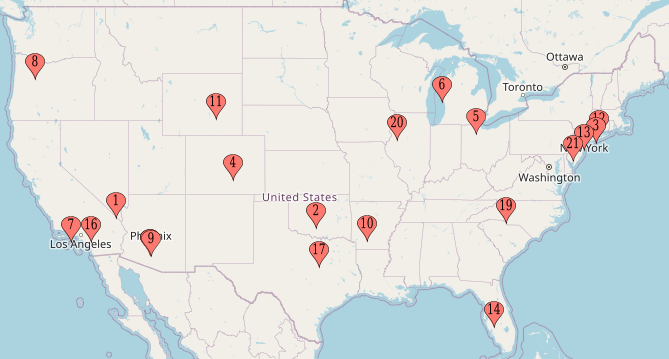
Click map to enlarge
|
|
|
|
|
 |
|
|


Feature Your Job Here For 30 Days -
70% Aren't On The Boards
Post your job listing |
|
|
Featured Job Spotlights
Staffing
'Best in Class' Teams
Help Your Colleagues - Your Industry
- Build a
'Best in Class' Community

National Account Manager
Bohemia, NY
The National Account Manager is responsible
for managing and growing a portfolio of strategic customer accounts while
identifying opportunities to expand Delta Lock's products and services within
existing and prospective customers. This role serves as the primary business
relationship owner for assigned accounts...

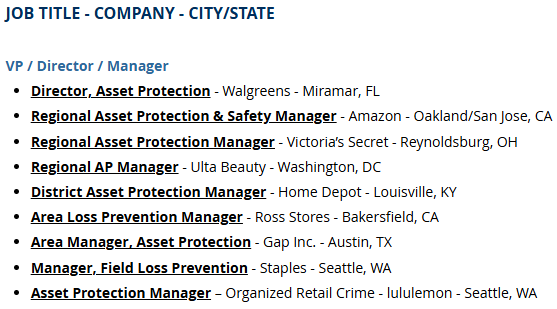
Director, Asset Protection
Miramar, FL
The Director, Asset Protection Operations &
Execution (APD) is responsible for the development and execution of the asset
protection plan, Asset Protection talent and resources, as well as resource and
expense budgets...

VP Loss Prevention & Safety
Plano, TX
Leads the enterprise-wide strategy for asset protection, loss prevention,
safety, security, and environmental compliance. Accountable for minimizing
financial and operational risk, strengthening internal controls, and ensuring
regulatory compliance across all locations...
|
|
Featured Jobs
To apply to any of today's Featured Jobs,
Click Here
|
|
|
|
|
 |
|
|
 |
|
|
 |
|
 |
|
|
 |
|

Insight,
humor & heart from
one of LP's most trusted voices |
|
|
A Bank Can Put the Money Behind Glass.
A Retailer Has to Put the Merchandise Under Good Lighting.
Banks separate customers
from the assets they're protecting. Critical infrastructure restricts
access altogether. Retailers do almost the opposite because customers
need to see, touch, try on, compare, and ultimately fall in love with
the product. AP isn't securing a vault. It's securing a showroom. That's
why anybody who thinks retail security is simply “physical security in a
store” probably hasn't spent enough time in one.
Follow this space every day to see more of
'Hedgie's Hot Takes' |
|
|

|
|
See More Events |
Recruiting?
Get your job e-mailed to
everyone... everyday
Post on our
Featured Jobs Board! |
|
|
Not getting the Daily?
Is it ending up in
your spam folder?
Please make sure to add d-ddaily@downing-downing.com to your contact list, address book, trusted sender
list, and/or company whitelist to ensure you receive our newsletter.
Want to know how?
Read Here
|
|
 |

copyright 2009-2029
all rights reserved globally |