|
|
|
&uuid=(email)) |
|
 &uuid=(email)) |
&uuid=(email)) |
|
Siffron's Shogun Tag™ Duo
Small Tag. Big Protection.
 The
Shogun Tag™ Duo
is a versatile retail security solution that simplifies product application
while delivering powerful protection. Offering two easy application
methods—removable adhesive or reusable elastic banding—the Shogun Tag™ Duo makes
it simple to secure merchandise across multiple surfaces and packaging types.
This streamlined setup reduces installation time for associates while ensuring
consistent, reliable theft protection. The
Shogun Tag™ Duo
is a versatile retail security solution that simplifies product application
while delivering powerful protection. Offering two easy application
methods—removable adhesive or reusable elastic banding—the Shogun Tag™ Duo makes
it simple to secure merchandise across multiple surfaces and packaging types.
This streamlined setup reduces installation time for associates while ensuring
consistent, reliable theft protection.
Built with all the standard Shogun Tag™ functions, the Duo also adds the
flexibility of reusable banding, allowing tags to be reapplied as often as
needed. Clear banding can be used for a discreet application that won’t distract
from branding or product presentation, while integrated slots on the device
allow banding to be applied cleanly and securely.
Click here to learn more
The U.S. Crime Surge
The Retail Impact
Beyond Store Theft
Retail Crime Is Moving Beyond the Store
The stereotypical retail crime event begins and ends inside a store.
Increasingly, the real investigation may stretch far beyond it.
NRF's latest research found organized retail crime continuing to evolve
across multiple methods, including cargo and supply chain theft, gift card
fraud, loyalty fraud and phone scams. The organization says ORC groups
operate across physical and online environments and can move products and
profits beyond U.S. borders.
The trend illustrates how organized retail crime can exploit the entire retail
ecosystem rather than a single location.
A retailer's assets exist on trucks, inside distribution centers, in digital
accounts, on gift cards and throughout increasingly complex supply chains.
Each creates a potential point of attack.
Organized groups can also operate across jurisdictions, creating investigative
challenges that individual stores or local police departments aren't necessarily
equipped to see on their own.
That's one reason collaboration has become central to the industry's ORC
strategy. Store-level incident reporting remains important, but the real
value often comes when information from multiple events is connected.
A theft in one city may appear routine until investigators discover similar
activity elsewhere. Merchandise recovered hundreds of miles away may provide
intelligence about an operation that no single jurisdiction could identify
independently.
The expansion of retail crime also has implications for how companies
structure their asset protection teams.
Traditional store investigations remain essential, but organizations
increasingly need expertise involving intelligence, supply chains, digital fraud
and external partnerships.
It also means that a successful theft-prevention strategy cannot be evaluated
solely by what happens inside the four walls of a store.
A retailer could reduce one category of loss while organized groups adapt and
attack another part of the business.
The physical store isn't becoming less important. It's becoming one node
in a much larger network of potential retail loss.
For AP departments, understanding that network may be one of the defining
challenges of modern organized retail crime investigations.
nrf.com
Fast-food chains are going old school with an innovative customer service update: human cashiers.
The push for touch-screen kiosks, mobile app deals, and digital ordering has been sweeping across favorite fast-food chains for years.
McDonald’s, Burger King and Starbucks have all offered exclusive in-app promotions to nudge customers online, while installing self-service kiosks in place of traditional counter service. But after facing customer frustration and growing demand for personal service, these chains are beginning to backtrack.
Self-pay kiosks have been a deterrent for some customers, whether it be price surges at Shake Shack or forced tipping at Popeyes.
Multiple chains are now launching programs and messaging that emphasize customer service and traditional hospitality, reversing course after years of prioritizing tech-infused automation.
Just two years ago, McDonald’s rolled out advanced digital kiosks designed to reduce reliance on human cashiers. Now, the company has announced its “Make it Golden” initiative to retrain two million global employees on customer service skills.
The fast-food giant also plans to issue more customer service evaluations to pinpoint areas needing hospitality improvements. McDonald’s isn’t scrapping kiosks entirely but wants to strike a balance, so an employee is always on hand for customers who prefer human interaction.
Starbucks and Burger King are similarly refocusing on the customer experience, according to the Wall Street Journal. Burger King is redesigning its restaurants to place ordering kiosks alongside walls rather than directly in front of the lobby entrance where patrons typically queue up.
Burger King President Tom Curtis said the company wants to cater to guests seeking a friendly face—even though Burger King’s CEO claimed in 2023 that digital kiosks eliminate “stressful interactions” at counter registers, according to Business Insider.
Meanwhile, Starbucks is pouring $1 billion into a comprehensive storewide makeover in an effort to attract guests who feel “lonely and disconnected.” Over the past nine months, 1,000 locations have received updates featuring upholstered leather seating, rugs, bookshelves, houseplants, ceramics, curtains, mirrors, and fresh paint.
The coffee giant has added 25,000 extra seats and additional power outlets to encourage patrons to stay, reinforcing the coffeehouse as a traditional “third place” between home and work.
They’ve also worked to bring back personalized cup messages, buying around 200,000 Sharpies to bring cup messages back. nypost.com
State Representative Haraz N. Ghanbari (R-Perrysburg) was honored by the Ohio Council of Retail Merchants with its inaugural Retail Crime Fighter of the Year Award for his leadership in passing the FORCE Act and strengthening Ohio’s response to organized retail crime. Ghanbari joined representatives from the Ohio Attorney General’s Office and Walgreens for a panel discussion examining the FORCE Act and its implementation. Other summit sessions focused on statutory updates, real-world organized retail crime cases, intelligence sharing, emerging technology and the development of specialized investigative units. ohiohouse.gov
&uuid=(email))
Inventory Accuracy is Critical
Inventory Accuracy Is Becoming an LP
Priority
 By
the D&D Daily staff By
the D&D Daily staff
A customer finds an item online, sees that a nearby store has it available and
drives across town to buy it. The shelf is empty. The system says otherwise.
That scenario is often viewed as a customer experience or
inventory-management problem. It also represents something fundamental to
loss prevention: The retailer doesn't know exactly where an asset is.
Inventory accuracy has become increasingly important as physical stores double
as fulfillment centers for digital orders.
Buy-online-pickup-in-store, ship-from-store and same-day fulfillment all depend
on inventory systems accurately reflecting what's physically available.
When they don't, the consequences multiply.
Employees waste time searching for merchandise that isn't there. Digital orders
can be canceled. Customers encounter out-of-stocks despite systems indicating
availability. Replenishment decisions can be based on incorrect information.
Loss prevention has a natural role in addressing those discrepancies
because determining why physical and recorded inventory don't match has always
been central to the profession. The cause may be theft.
But it could also be receiving errors, incorrect product movement, mis-scans,
damages, returns, inaccurate adjustments or other process failures. That
makes inventory accuracy an unusually useful bridge between AP and operations.
Rather than waiting until a physical inventory reveals the size of a
discrepancy, retailers can increasingly use data to identify unusual patterns
earlier and investigate why they are occurring.
That distinction matters. Knowing that inventory is missing tells the
business what happened to the number. Understanding why it went missing
creates an opportunity to prevent the next discrepancy.
Omnichannel retail has raised the stakes because inventory records are
increasingly visible to customers in real time. What once might have remained an
internal accounting problem can now directly affect a customer's purchasing
decision.
Inventory accuracy is therefore no longer simply about knowing how much
merchandise was lost. Increasingly, it's about ensuring retailers can
confidently sell the merchandise they still have.
|
All the News - One Place - One Source - One Time
Thanks to our sponsors/partners - Take the time to
thank them as well please. If it wasn't for them The Daily wouldn't be here
every day for you.
 |
|
&uuid=(email)) |
|

&uuid=(email)) |
|

|
|
Sloth Lock and Fixture Security Additions Help Retailers Protect High-Risk
Merchandise
The New Reality of Retail Theft
 Today's
retailers face a difficult balancing act. Excessive security can cause friction
and frustrate shoppers, while insufficient protection can lead to unacceptable
shrink levels. Organized retail crime (ORC), grab-and-run incidents, and
opportunistic theft have forced retailers to seek solutions that secure products
while preserving open merchandising strategies that drive sales. Today's
retailers face a difficult balancing act. Excessive security can cause friction
and frustrate shoppers, while insufficient protection can lead to unacceptable
shrink levels. Organized retail crime (ORC), grab-and-run incidents, and
opportunistic theft have forced retailers to seek solutions that secure products
while preserving open merchandising strategies that drive sales.
One of the most effective approaches is combining merchandise protection with
fixture-level security. CIS
Security Solutions has developed a strategy that addresses both challenges
through its Sloth Lock and a range of other fixture additions designed to allow
both accessibility and security, as well as appearance.
Meet the Sloth Lock
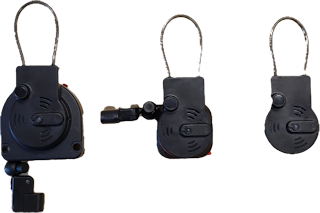
The Sloth Lock is simple, yet highly effective. It slows down unauthorized
product removal from retail displays by locking onto the rack and tethering the
item. The rack lock is engineered as part of the alarm top, which is used with
several styles of the CIS alarming tethers.
The Sloth Lock advantages:
-
Discourages opportunistic theft attempts.
-
Creates a visible deterrent effect.
-
Gives associates more opportunities to engage customers.
-
Supports open merchandising without requiring products to be
locked away.
Beyond the Product: Securing the Fixture
While merchandise protection devices receive most of the attention, thieves
often exploit the fixture itself. Displays, hooks, pegboards, and merchandising
hardware can become vulnerabilities when not adequately secured.
Recognizing this challenge, CIS Security Solutions offers a variety of fixture
additions that enhance overall display security, such as the Boot, the H-Run
Flex, the Sleeve, and the new Echo system.
Layered Protection Delivers Better Results
Loss prevention professionals understand that no single solution stops theft.
Operations and Merchandising want aesthetics and sales. The most successful
retail security programs use layered protection strategies to satisfy everyone.
The combination of using the Sloth Lock or other fixture additions combined with
the tethers supports this philosophy by:
-
Delaying unauthorized product removal.
-
Increasing offender visibility.
-
Preserving customer engagement.
-
Supporting associate intervention opportunities.
-
Reducing shrink without sacrificing sales.
Security That Supports the Shopping Experience
Solutions that effectively slow theft while keeping products accessible are
important.
The Sloth Lock proves thoughtful security design can support Asset Protection
objectives and Operations/Merchandising goals. Retailers can create a more
secure environment while continuing to offer the open, interactive shopping
experiences customers expect and want.
For more information contact
info@cisssinc.com or 772-287-7999
www.cisssinc.com |
|
&uuid=(email)) |


Curtis Alan Bridges
Dec 8, 1946 — Sep 12, 2026
|
I'm saddened to report that Curtis Bridges, one of our long time Loss Prevention Industry leaders has passed away. Curtis Alan Bridges, born December 8, 1946, in Detroit, Michigan, passed away in Wellington, CO on September 12, 2026. Curtis lived a life of dedication in his both his personal life and professional endeavors. Curtis graduated from Eastern Michigan University and later received his Master's in Business Administration.
Answering the call to serve his community as a Police Officer, first in Detroit, Michigan and later in Lakewood, Colorado, his commitment to protecting others extended into Loss Prevention, where he served as a Director/ Vice President of Denver Dry Goods, Pace Membership Warehouse, Kmart and American Coin. At the same time, balancing a passion of raising and showcasing his love for Clydesdale horses. Throughout his career, Curtis was known for his dedication to law enforcement, his business sense, his love for horses and a strong personality, while sharing many stories with us all along the way.
Curtis is now reunited with his beloved wife, Kathy Bridges. He leaves behind two sons and numerous grandchildren, all of whom will greatly miss his stories, love, support and advice.
I had the honor to work for many years as a DLPM for Curtis at Pace Membership Warehouse (Div of Kmart). Many people say that you can measure the impact of a person if you remember the first time you met…with Curtis you just remember Everything. Curtis was a Loss Prevention Professional…everyone on our Team of 15 had a Bachelor degree, that was not common at the time. Along with your Loss Prevention duties, you were required to take and pass the ASIS CPP exam… it was part of your annual review to maintain membership and certifications. Curtis was most proud of winning (several times) Best Department within the Organization, voted on my store managers, field operations/ HR and corporate office personnel.
Curtis did not want the Loss Prevention department to be siloed, being part of Store Operation and knowing your sales, inventory and shrink numbers was the key to being more than just an investigator. As Sam’s Club took over Pace…The department fractured into 15 folks going in different directions… Like a Great Coaching Tree, Curtis sent a group of LP Professionals out into the world, many went on to Director / VP roles.
God Speed buddy, you were one of the best!
Gordon
|
|
 |
|
|
Vulnerability Risk
Software Vulnerabilities Have Become the Front Door
For years, cybersecurity awareness campaigns have taught employees to watch for
suspicious emails and protect their passwords. Attackers haven't abandoned those
methods. But they're increasingly finding another way in.
Verizon's 2026 Data Breach Investigations Report found 31% of
breaches now begin with exploitation of software vulnerabilities, overtaking
stolen credentials as the leading initial access vector. Across the broader
breach dataset, vulnerability exploitation appeared in 32% of breaches, roughly
double the prior year's share.
Retail faces an even sharper version of the problem.
In Verizon's retail-specific findings, exploitation of vulnerabilities
accounted for 42% of initial access in confirmed breaches, compared with 14%
for credential abuse and 9% for phishing.
The findings put renewed attention on one of cybersecurity's least glamorous
disciplines: patching. Retail environments can make that particularly
complicated.
Large retailers may operate enormous technology footprints encompassing
stores, distribution facilities, corporate offices, cloud services, e-commerce
platforms and third-party applications.
Identifying a vulnerability is only the beginning. Teams must determine where
affected systems exist, evaluate risk, test changes and deploy fixes without
unnecessarily disrupting operations.
And the clock is running while they do it. The growing importance of
vulnerability exploitation also demonstrates why cybersecurity cannot rely
solely on employee awareness.
Training remains essential, particularly against phishing and social
engineering. But even the most security-conscious associate cannot prevent
an attacker from exploiting an exposed, unpatched system.
Retail cyber defense therefore increasingly requires multiple layers:
strong identity controls, employee education, network visibility, vulnerability
management and the ability to identify unusual activity after an attacker gets
inside.
The fundamentals may sound less exciting than the latest cybersecurity
technology. But attackers don't need an exotic method when an existing
weakness still works.
There is no single front door to a modern retailer. That's precisely the
problem.
verizon.com |
|
 |
|
|
|

|
|
|
Checkout Friction
The Hidden Cost of Frictionless E-Commerce
Online retailers have spent years removing friction from shopping. Fewer
clicks. Faster checkout. Easier account creation. Faster refunds.
Every unnecessary step removed from the customer journey can improve the
experience. Unfortunately, some of those same conveniences can make life
easier for fraudsters. That tension is becoming increasingly apparent as
retailers attempt to distinguish between legitimate customers who expect speed
and bad actors who benefit from it.
NRF's
updated Retail Fraud Taxonomy describes modern fraud actors using
automation and anonymity tools while operating across physical and digital
retail environments. The challenge for retailers isn't simply adding more
controls.
It's deciding where controls belong.
Requiring every shopper to jump through additional verification steps may
reduce certain risks while simultaneously creating frustration for legitimate
customers. Making refunds universally slower may discourage abuse but punish
a retailer's best customers along with fraudsters.
The alternative is increasingly risk-based friction.
A familiar customer making an ordinary purchase from a recognized device may
require very little additional scrutiny. A transaction containing multiple
unusual characteristics may justify additional authentication or review.
The same philosophy can extend through the customer lifecycle, from account
creation and checkout to delivery and returns.
Returns demonstrate how delicate that balance can be. NRF and Happy
Returns found 82% of consumers consider free returns important when shopping
online and 76% are more likely to choose a return option offering an instant
refund or exchange. Yet 9% of all returns are estimated to be fraudulent.
That turns fraud prevention into something more sophisticated than a
binary decision to approve or reject a transaction. It becomes an exercise in
deciding when additional friction is worth the cost. The goal isn't a
frictionless environment at any cost.
It's maintaining a low-friction experience for trustworthy customers while
introducing enough resistance at the right moments to make abuse more
difficult and less profitable.
nrf.com |
|
|
|
&uuid=(email))
|
Four suspects are being sought after a stolen minivan was driven into a jewelry store in Kent, WA, and thieves made off with an undisclosed amount of merchandise, KOMO News reported. Police responded to Taj Jewelers just after 2:30 p.m. on Saturday. According to investigators, the four suspects, wearing Tyvek protective suits and gloves, drove a Toyota Sienna minivan into the storefront, then rushed inside armed with clubs and machetes to smash display cases and steal jewelry. Police did not immediately have the total value of the stolen goods available. The suspects fled in a second stolen vehicle, a Hyundai Tucson. At least one jewelry store employee sustained minor injuries after being assaulted by one of the suspects, police told KOMO news. instoremag.com
Federal authorities have indicted 12 people in an alleged cargo theft conspiracy that targeted Nike’s logistics center in Memphis, and one of the defendants is from Olive Branch. Michael Perkins, 40, of Olive Branch, Mississippi, was among the 12 named in a federal grand jury indictment returned May 21, charging all of them with conspiracy to commit interstate transportation of stolen property. The case is before U.S. District Judge Thomas L. Parker in the Western District of Tennessee. Prosecutors say the group stole at least $2 million in Nike merchandise between July 2021 and June 2024. According to court records, Nike employees involved in the scheme identified high-value shoe cartons inside the warehouse and attached unauthorized UPS shipping labels that redirected the shipments to addresses across the country instead of their intended destinations. Roughly 3,119 UPS labels were successfully used during the operation, with destinations including California, Wisconsin and Indiana.
The investigation was led by the FBI’s Cargo Theft Task Force with assistance from FBI field offices in Chicago and Los Angeles. One of the highest-profile defendants is Bereket Abraham, 39, of Los Angeles — co-founder of the popular sneaker retailer CoolKicks — who prosecutors allege helped create fraudulent UPS shipping labels to move the stolen merchandise. desotocountynews.com
The Hemet Police Department’s Organized Retail Theft Unit conducted an undercover retail theft “blitz” on Saturday, Sept. 5, 2026, at JCPenney and Harbor Freight, police said. The operation partnered with store loss-prevention personnel and investigators from the Riverside County District Attorney’s Office, according to a Sept. 12 Hemet PD release. Undercover officers and retail staff worked in and around the stores identifying and apprehending people engaged in theft-related crimes, police wrote. Three suspects were arrested. Charges included shoplifting, repeat theft offenses, and probation violations under Penal Code sections 490.5(a), 666.1(a), and 1203.2(a), according to the release. The department did not name the suspects. hsjchronicle.com
&uuid=(email))
|
|
|
&uuid=(email)) |
|
|
&uuid=(email)) |
|
|
|
 |
|
|
Shootings & Deaths
Two men were rushed to the hospital after a shooting was reported at a Wynwood restaurant early Tuesday, according to authorities. Miami Fire Rescue said paramedics responded at 12:10 a.m. to Dukunoo Jamaican Kitchen at 316 Northwest 24th Street. Once there, they found an 18-year-old man and 23-year-old man suffering from gunshot wounds. Cellphone video captured the chaotic aftermath as people rushed to help the victims before police and paramedics arrived. One person could be seen pressing a shirt against a man's wounds. Another said he took off his own belt to control the bleeding. The men were treated and taken to Jackson Memorial Hospital's Ryder Trauma Center in serious but stable condition, fire rescue officials said. nbcmiami.com
An incident report from the Anderson Police Department states that a woman was arrested in connection with a late-night shooting at a Wendy’s restaurant.
Officers responded to the Wendy’s on E. Greenville Street around 10:31 p.m. on Monday for an attempted murder call. When officers arrived, the report states that the suspect had already left the scene. In the report, the suspect was identified as 46-year-old Lekisher Armelin. She faces charges of attempted murder and aggravated assault. According to the report, the complainant and a witness at the scene told officers that Armelin and the victim got into an argument over a drive-thru order.
According to the report, the argument escalated into a physical altercation in the parking lot. Investigators reviewed surveillance footage showing the physical confrontation and the suspect firing a single shot. foxcarolina.com
Robberies, Incidents & Thefts
A man is accused of stealing from Paycor Stadium the day after the Bengals home opener. Joshua Griffin is accused of taking several mini-helmets, hats, ponchos and footballs worth at least $1,000 Monday. They were for sale at Paycor Stadium. Police say Griffin still had the items when they rolled up. He faces a theft charge and did not have to post a monetary bond to get out of jail. dayton247now.com
|
|
|
|

- Beauty – Opelika, AL – Robbery
- C-Store – Bay City, MI – Armed Robbery
- C-Store – Orland Park, IL – Armed Robbery
- C-Store – Kona, HI – Robbery
- Clothing – Mitchell, MN – Robbery
- Clothing – Allen Park, Mi – Burglary
- Dollar – Tulsa, OK – Armed Robbery
- Dollar – Cheltenham Township, PA – Armed Robbery
- Dollar – Montgomery County, PA – Armed Robbery
- Grocery = Stroud Township, PA – Robbery
- Grocery – San Francisco, CA – Burglary
- Jewelry – Kent, WA – Armed Robbery
- Jewelry – Concord, NC – Robbery
- Jewelry – St Peters, MO – Robbery
- Kohl’s – Brookfield, WI – Robbery
- Liquor – Los Angeles, CA – Burglary
- Restaurant – Burlington, VT – Armed Robbery
- Restaurant – Cave City, CA – Burglary
- Restaurant – Sierra Vista, AZ – Burglary
- Restaurant – San Francisco, CA – Burglary
- Restaurant – San Francisco, CA – Burglary
- Sports – Brookfield, WI – Robbery
- Target – Medford, NY – Robbery
- Walmart – Clovis, CA – Robbery
- Walmart – Warrington, PA – Robbery
|
Daily Totals:
• 17 robberies
• 7 burglaries
• 0 shooting
• 0 killed |
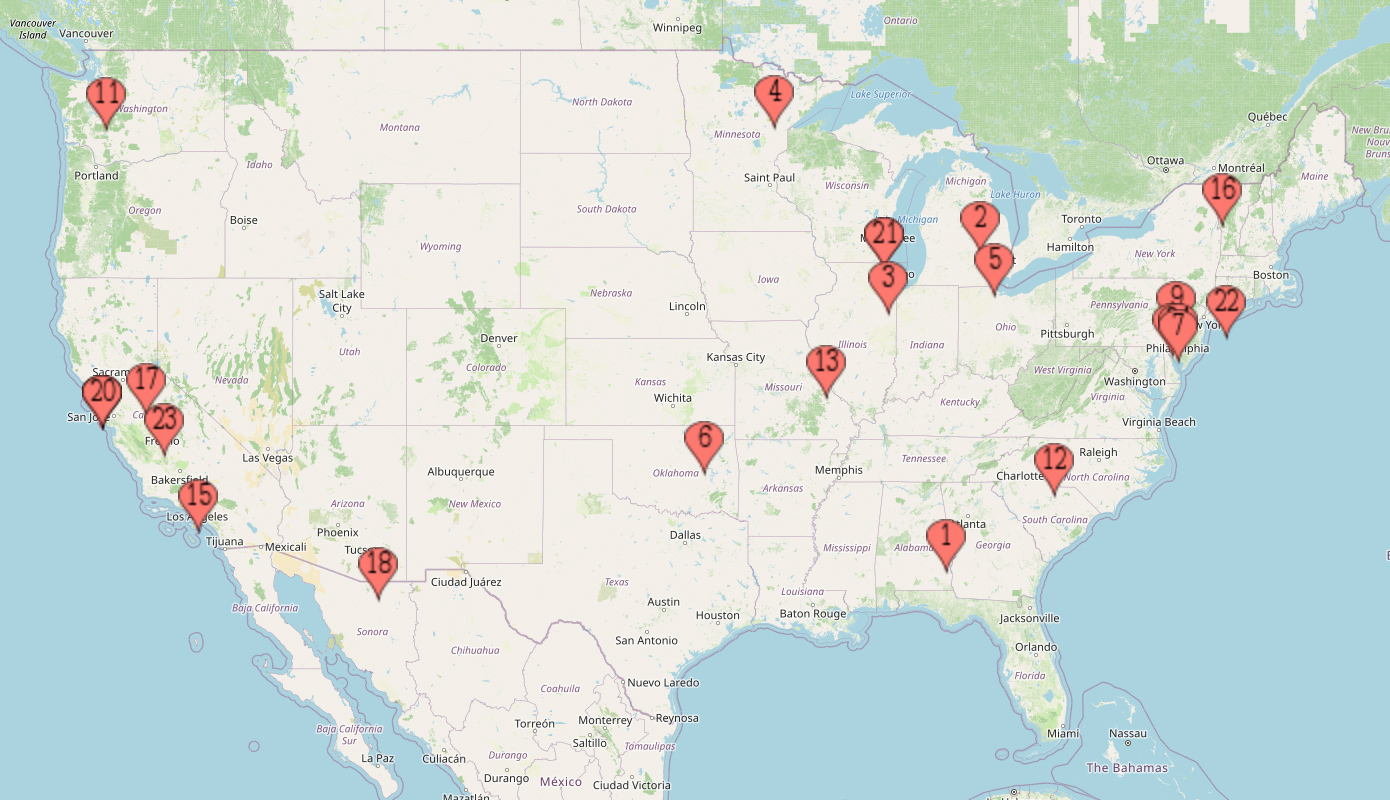
Click map to enlarge
|
|
|
|
|
|
|
|

&uuid=(email))
Feature Your Job Here For 30 Days -
70% Aren't On The Boards
Post your job listing |
|
|
Featured Job Spotlights
Staffing
'Best in Class' Teams
Help Your Colleagues - Your Industry
- Build a
'Best in Class' Community

National Account Manager
Bohemia, NY
The National Account Manager is responsible
for managing and growing a portfolio of strategic customer accounts while
identifying opportunities to expand Delta Lock's products and services within
existing and prospective customers. This role serves as the primary business
relationship owner for assigned accounts...

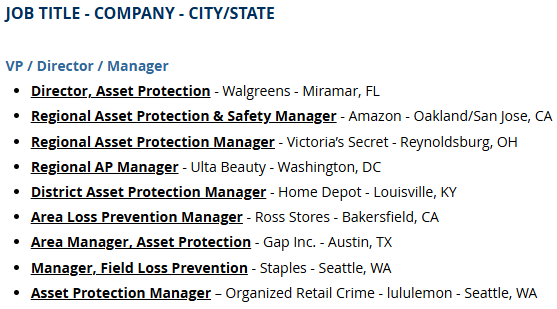
Director, Asset Protection
Miramar, FL
The Director, Asset Protection Operations &
Execution (APD) is responsible for the development and execution of the asset
protection plan, Asset Protection talent and resources, as well as resource and
expense budgets...

VP Loss Prevention & Safety
Plano, TX
Leads the enterprise-wide strategy for asset protection, loss prevention,
safety, security, and environmental compliance. Accountable for minimizing
financial and operational risk, strengthening internal controls, and ensuring
regulatory compliance across all locations...
|
|
Featured Jobs
To apply to any of today's Featured Jobs,
Click Here
|
|
|
|
|
 |
|
|
&uuid=(email)) |
|
|
&uuid=(email)) |
|
&uuid=(email)) |
|
|
&uuid=(email)) |
|

Insight,
humor & heart from
one of LP's most trusted voices |
|
|
Things It Took Me 30 Years to Learn
About Retail Asset Protection
Most "Overnight Successes" Took
About Ten Years.
Every conference seems to
introduce "the next big thing." What people don't see are the years of
product revisions, failed pilots, skeptical customers, and founders
wondering if they should keep going. Persistence isn't glamorous. It's
just surprisingly common among the companies that survive.
Follow this space every day to see more of
'Hedgie's Hot Takes' |
|
|

|
|
See More Events |
Recruiting?
Get your job e-mailed to
everyone... everyday
Post on our
Featured Jobs Board! |
|
|
Not getting the Daily?
Is it ending up in
your spam folder?
Please make sure to add d-ddaily@downing-downing.com to your contact list, address book, trusted sender
list, and/or company whitelist to ensure you receive our newsletter.
Want to know how?
Read Here
|
|
 |

copyright 2009-2029
all rights reserved globally |
&uuid=(email))




&uuid=(email))
&uuid=(email))
&uuid=(email))
&uuid=(email))

.png)