|
|
|
&uuid=(email)) |
|
 &uuid=(email)) |
&uuid=(email)) |
|
Gatekeeper's Purchek
Stops Pushout Theft
Stopping the Cart, Not the Person
How Cart-Based Technology Is
Helping Retailers Stop Pushout Theft While Reducing the Need for
Confrontation
As retailers look to reduce
confrontation, cart-based technology offers another way to address
pushout theft while keeping merchandise inside the store
 By
the D&D Daily staff By
the D&D Daily staff
As we wrote about
earlier this week in the D&D Daily, one of the biggest challenges in
retail loss prevention is stopping theft without creating a more
dangerous situation in the process.
Pushout theft illustrates that challenge particularly well. An
offender can load a shopping cart with unpaid merchandise and attempt to
walk directly out of the store, leaving employees with a decision
about whether — and how — to respond.
Increasingly, technology is giving retailers another option: stop the
cart instead of confronting the person pushing it.
Cart-based pushout prevention systems are designed specifically for
that purpose.
Gatekeeper Systems' Purchek technology, for example, uses its
SmartWheel technology to prevent unauthorized carts containing unpaid
merchandise from being pushed out of the store.
Rather than identifying or physically stopping an individual, the
technology focuses on the shopping cart. When the system determines
that a cart has not met the criteria for an authorized exit, the cart
can be disabled at the door, keeping the merchandise inside the store.
 It's
a relatively simple idea with potentially important implications for LP
teams. It's
a relatively simple idea with potentially important implications for LP
teams.
Preventing the cart from leaving can interrupt the theft while
reducing the need for an associate to physically confront, chase or
apprehend the individual. In many cases, the goal becomes
merchandise protection without escalating the encounter.
The technology can also be paired with additional intelligence
capabilities. Gatekeeper offers Theft Intelligence Services that
use event-based video from pushout incidents to help retailers classify
events, identify theft trends and investigate potential repeat or
organized retail crime activity.
Technology alone won't eliminate retail theft, and pushout prevention
addresses one particular method of stealing rather than the broader
shoplifting problem. But it represents an important direction for modern
loss prevention: finding ways to intervene in the theft itself
without necessarily intervening with the person.
As retailers continue balancing shrink reduction with employee and
customer safety, sometimes the most effective intervention may be the
one that stops the merchandise at the door.
Learn more about Gatekeeper's solution
here.
The U.S. Crime Surge
The Retail Impact
Repeat Offender Risk
Repeat Offenders Remain at the Center of
Retail Theft
Retail theft statistics can measure incidents. They don't always reveal who is
responsible for them.
That distinction remains important as retailers attempt to understand an
evolving theft environment.
NRF's latest research shows that while overall shoplifting incidents
declined between 2024 and 2025, repeat offenders and organized retail crime
remain significant concerns.
Half of retailers reported an increase in repeat-offender activity, while 40%
reported an increase in ORC-related shoplifting.
For asset protection teams, repeat activity changes the nature of the problem.
An isolated shoplifting event may create a relatively contained loss.
A prolific offender repeatedly targeting the same retailer, multiple locations
or several retailers can produce a much larger cumulative impact.
It also creates an intelligence opportunity.
Individual incidents that appear unrelated at the store level can begin forming
recognizable patterns when retailers connect information across locations —
merchandise targeted, methods used, vehicles, timing, identities and potential
resale activity.
That is one reason information sharing has become increasingly important to
organized retail crime investigations. It also demonstrates the limitations
of evaluating store performance exclusively through incident totals.
Two stores could experience the same number of theft events while facing
substantially different risks if one location is being repeatedly targeted by
individuals connected to a larger operation.
The industry has invested heavily in deterrence and store-level security in
recent years, and NRF's latest numbers suggest some of those efforts are
contributing to declining shoplifting incidents. But fewer incidents don't
necessarily mean less organized activity.
If repeat offenders account for a disproportionate share of loss, identifying
and connecting those events becomes just as important as preventing an
individual theft.
The next incident report may therefore be valuable for more than documenting
what happened at one store on one day.
Placed alongside information from other locations and retailers, it could
become the piece that turns a series of seemingly routine thefts into a larger
investigation.
nrf.com
Deloitte predicts holiday retail sales this season will hit an estimated $1.7 trillion and $1.71 trillion between the season's November to January timeframe. The research firm expects e-commerce sales to grow between 7.5% and 8.4%, year over year, hitting $361.1 billion and $318.9 billion. Last year's spend was $294 billion, according to a press release. The news comes on the heels of Bain & Company's annual U.S. retail holiday forecast that also predicts sales to exceed $1 trillion for the first time ever, based on an expected 4.5% year-over-year retail sales increase this holiday shopping season. retailcustomerexperience.com
The NRF Foundation has named seven executives to its 2027 list of people helping shape the future of retail, recognizing leaders whose roles span stores, technology, marketing, creative strategy and international growth.
The honorees on The List of People Shaping Retail’s Future 2027 will be recognized at the annual NRF Foundation Honors in New York City on Jan. 10.
This year’s honorees are Emilie Arel, president of Mitchell & Ness; Amiee Bayer-Thomas, chief retail officer at Ulta Beauty; Kim Gallagher, executive director of marketing and customer success at Nuuly; John C Jay, president of global creative at Fast Retailing; Steve Peters, senior vice president and head of stores and operations at Old Navy; Sandeep Seth, chief growth officer and president of Tapestry International at Tapestry; and Fiona Tan, chief technology officer at Wayfair.
“The 2027 honorees on The List of People Shaping Retail’s Future exemplify the talent and vision moving retail forward,” said Steve Preston, president and CEO of Goodwill Industries and chairman of the NRF Foundation Board of Directors. “Their leadership pairs bold innovation with ingenuity, shaping what the future of retail will look like.”
The mix of executives reflects the increasingly broad range of disciplines shaping the industry. The honorees hold leadership positions encompassing brick-and-mortar operations, e-commerce, technology, customer engagement, branding and global expansion at companies ranging from specialty and apparel retailers to digital businesses.
The NRF Foundation said the award is designed to recognize the range of companies, roles and products that are important to the retail industry and its customers. Previous recipients have included executives from established brands as well as emerging companies.
“Retail offers countless opportunities to build a meaningful and rewarding career, and the honorees this year exemplify that potential,” said Adam Lukoskie, NRF senior vice president and NRF Foundation executive director. “Their leadership, innovation and dedication are shaping and evolving the industry while paving the way for the next generation of trailblazers.” massmarketretailers.com
&uuid=(email))
Operational Shrink
When Store Procedures Create Their Own
Shrink
When retailers talk about shrink, theft tends to dominate the conversation.
But merchandise doesn't have to be stolen to become a loss.
Administrative mistakes, damaged and expired merchandise, receiving errors
and other process failures can all contribute to shrink. The National Retail
Federation notes that shrink is a broad inventory measurement that includes not
only external and internal theft, but also administrative errors, damages,
expired goods and spoilage.
That distinction creates an important opportunity for loss prevention teams.
Unlike many external threats, operational losses often originate within
processes a retailer can directly change.
A receiving procedure performed incorrectly across dozens of locations can
repeatedly create inventory discrepancies. The same can happen when merchandise
transfers aren't properly recorded, damages aren't processed consistently or
inventory adjustments are made without identifying why the discrepancy occurred.
Individually, each error may appear insignificant. Repeated across thousands
of transactions, the losses can become substantial.
NRF specifically points to process errors and training gaps as types of shrink
retailers can often control through operational improvements. Its loss
prevention guidance also recommends clear procedures covering inventory receipt,
sales, returns and damages, along with regular inventory checks and cash audits
to identify discrepancies and patterns earlier.
That puts LP in a useful position. Asset protection teams already know how to
investigate exceptions. The same approach used to determine whether a suspicious
transaction represents dishonesty can help identify a process that simply isn't
working.
The objective isn't to turn every operational mistake into an LP investigation.
It's to recognize when repeated mistakes have become a measurable source of
loss.
Theft may be more visible, but preventing $10,000 in recurring process errors
has the same bottom-line impact as preventing $10,000 from walking out the
door.
nrf.com
|
All the News - One Place - One Source - One Time
Thanks to our sponsors/partners - Take the time to
thank them as well please. If it wasn't for them The Daily wouldn't be here
every day for you.

|
|
&uuid=(email)) |
|

&uuid=(email)) |
|

|
|
New Benchmark Report by Interface Systems Reveals What Really Drives
Restaurant Security Incidents
Loitering and disturbances
account for more than 70% of high-priority restaurant security
incidents, while robbery, burglary, and
theft account for less than 3%
St. Louis, MO–
Interface
Systems, a leading provider of AI-powered security and expert remote
video monitoring for restaurants, retailers, and commercial businesses, released its
2026 Restaurant Security Benchmark Report, an annual study based
on 1.1 million monitoring events across 9,392 U.S. restaurant locations
representing 78 quick-service, fast-casual, and casual dining brands.
The report provides operational data at a scale to help restaurant
security and operations leaders understand when risk peaks, where it
concentrates, which threats escalate fastest, and which intervention
strategies prove most effective across thousands of monitored locations.
“Restaurant operators are balancing employee safety, customer
experience, and operational efficiency across hundreds or even thousands
of locations,” said Brent Duncan, CEO of Interface Systems. “This report
provides real-world operational data that helps them understand where
risk is greatest, when intervention matters most, and how to make more
informed security decisions.”
Key Data and Findings
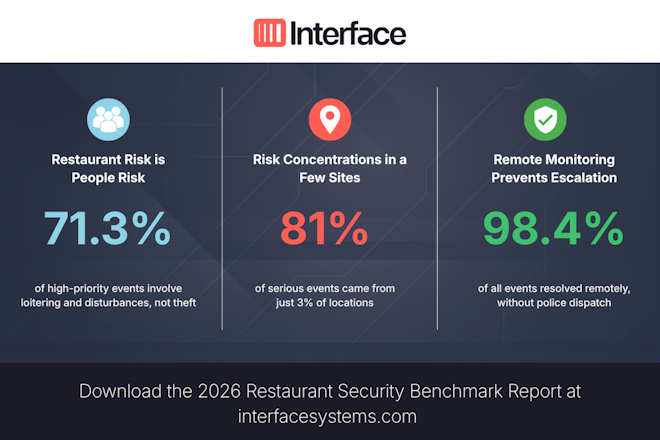
Protecting people is the primary security challenge. Loiterers
and panhandlers (49.8%) and disturbances (21.5%) together account for
over 70% of high-priority events. Theft and loss, the dominant threat in
retail, barely registers at restaurants. Other threats tracked included
battery and assault, burglary, robbery, property damage, and medical
emergencies.
Risk is highly concentrated in a small set of locations. Three
percent of monitored locations generate 81% of all high-priority events,
and the top 100 sites alone account for 59%. Uniform security spend
across a portfolio overprotects most sites and underprotects the few
that carry the risk.
Risk extends across the clock. High-priority events stay elevated
around the clock, peaking at 6 PM during the dinner rush, while roughly
30% occur overnight between 10 PM and 6 AM when restaurants run skeleton
crews or sit closed. January was the worst month, running 61% above the
summer low.
Interactive remote monitoring resolves most incidents before police
response is required. Of 1.1 million events, only 1.6% required a
police, fire, or medical dispatch. Trained intervention specialists with
live video and two-way audio resolved 98.4% remotely.
False alarms remain a significant operational burden. Restaurants
generated more than 296,000 false alarms during the reporting period,
with nearly half occurring during morning opening procedures. Video
verification resolved more than 97% before emergency dispatch, helping
operators avoid unnecessary fines while preserving first responder
resources.
Employees rely on live support during vulnerable windows. Staff
initiated more than 82,000 requests for monitoring assistance over the
year, approximately 225 every day, including live monitoring, voice-down
interventions, and employee escorts during opening, closing, and
cash-handling activities.
Risk surrounds holidays. Christmas Day recorded the fewest
incidents of the year, while Christmas Eve saw three times as many. The
day after Presidents Day produced the highest incident volume of any
holiday period as restaurants returned to normal operations.
The 2026 Restaurant Security Benchmark Report is based on anonymized
event metadata collected between June 1, 2025 and May 31, 2026 across
9,392 restaurant locations nationwide. In addition to benchmarking data,
the report offers practical guidance to help restaurant operators
improve employee safety, reduce operational disruption, and align
security resources with actual risk.
Download the Full Report
The complete 2026 Restaurant Security Benchmark Report is available now
at
https://interfacesystems.com/remote-video-monitoring/2026-restaurant-security-benchmark-report.
The full report includes detailed charts, a restaurant-versus-retail
threat comparison, and actionable takeaways for restaurant loss
prevention and operations leaders.
Restaurant leaders can also request a free security assessment to
benchmark their incident profile and identify where interactive remote
video monitoring and AI-enabled perimeter deterrence can reduce risk at
their locations. Schedule a free security assessment:
https://interfacesystems.com/free-security-risk-assessment/ |
|
&uuid=(email)) |
|
|
 |
|
|
Ransomware Risk
Ransomware Isn't Going Away — Even as Companies Resist Paying
Ransomware's business model is facing resistance. The threat itself isn't
disappearing.
Verizon's 2026 Data Breach Investigations Report found ransomware
involved somewhere in the attack chain in nearly half — 48% — of breaches
analyzed. At the same time, Verizon found that 69% of ransomware victims did not
ultimately pay a ransom. For retailers, that distinction matters.
The financial impact of ransomware isn't limited to whether an organization
ultimately transfers money to an attacker.
Systems can still be encrypted. Data can still be stolen. Operations can
still be disrupted. Investigation and recovery can consume resources long
after the original intrusion is contained. And few industries are as
operationally dependent on technology as modern retail.
Stores rely on networks for payment processing, inventory, workforce management
and numerous other functions. Distribution and fulfillment systems coordinate
product movement. E-commerce platforms operate continuously. Corporate systems
connect thousands of employees and vendors.
A ransomware attack therefore has the potential to turn a cybersecurity incident
into a broader business interruption.
Verizon's separate 2026 Breach Impact Study reinforces the point. Across
ransomware-related insurance claims in its dataset, business interruption
accounted for a significant portion of overall losses alongside extortion and
data restoration costs.
That's why resilience is increasingly as important as prevention. Retailers
need defenses designed to keep attackers out, but they also need to know what
happens when those defenses fail.
Which systems are essential? Are backups protected and usable? Can stores
continue operating? How quickly can critical functions be restored? Who makes
operational decisions while technology teams respond?
The encouraging development is that refusing payment can weaken the economics
supporting ransomware. The less encouraging reality is that an unsuccessful
extortion attempt can still be enormously expensive.
For retailers, the objective isn't merely avoiding a ransom payment. It's
avoiding the moment when an attacker gets to decide whether the business can
operate normally tomorrow.
verizon.com |
|
 |
|
|
|

|
|
|
Omnichannel Fraud
Retail Fraud No Longer Fits Into Online and In-Store Boxes
Retailers spent years eliminating the boundaries between their physical and
digital businesses. Fraudsters appear to have noticed.
The National Retail Federation's newly updated
Retail
Fraud Taxonomy describes fraud actors operating across both physical and
digital environments, using automation and anonymity tools, sharing
knowledge online and frequently specializing in different stages of fraud
operations.
That creates an increasingly difficult challenge for organizations whose fraud
defenses may still be separated by channel.
An account can be compromised online. Merchandise can be ordered digitally. A
refund can be requested through another channel. Gift cards can move value
elsewhere. Products can eventually appear inside an entirely different
marketplace.
Viewed separately, individual transactions may not necessarily appear
remarkable. Viewed together, they can tell another story.
That's one reason NRF's taxonomy is notable. Rather than treating retail fraud
as a collection of isolated schemes, it establishes a common framework for
describing fraud tactics, techniques, detection methods and mitigations.
Version 2.0, released in July, expands the original framework with additional
schemes, techniques, detection sources and classification methods designed to
provide broader coverage of fraud across channels.
The implications extend beyond terminology. Retailers can collect enormous
amounts of risk information, but its usefulness declines when one department
cannot easily recognize that another department is seeing another piece of the
same activity.
A store investigation, suspicious account, unusual gift card transaction and
questionable return could theoretically represent four different events — or
four parts of the same scheme.
For e-commerce fraud teams and loss prevention departments, the next major
advancement may therefore be less about another individual control and more
about connecting the controls and intelligence that already exist.
Retailers spent the last decade creating an omnichannel experience for
customers. Increasingly, they need an omnichannel view of the people
attempting to exploit it.
nrf.com |
|
|
|
&uuid=(email))
|
A two-week operation to combat smash-and-grab robberies in San Bernardino County resulted in six arrests and the recovery of hundreds of dollars’ worth of merchandise, authorities announced Monday. The multi-agency task force conducted the retail theft operation in the Rancho Cucamonga shopping corridor area between Aug. 29 and Sept. 11, the San Bernardino County Sheriff’s Department said in a news release. The Sheriff’s Department did not identify the stores involved in the operation, but Rancho Cucamonga’s major shopping areas include Victoria Gardens and retail centers along Foothill Boulevard. Investigators made two felony arrests and four misdemeanor arrests, according to the Sheriff’s Department. The task force also recovered $585 worth of stolen property during the operation. ktla.com
Four people were arrested Sunday, September 13, following two separate shoplifting incidents at the Target store on Enterprise Drive, according to the Opelika Police Department. Police responded to the Target located at 2640 Enterprise Drive at approximately 2:40 p.m. after receiving a report of two individuals attempting to leave the store with shopping carts filled with home appliances. Target Asset Protection stopped Priscilla Lynne Denton, 44, of Montgomery, while responding officers detained Eric Wayne Giles, 35, of Tallassee, outside the business. Denton and Giles were transported to the Lee County Jail and charged with Organized Retail Theft. Later that evening, at approximately 8:14 p.m., Opelika Police responded to the same Target after Asset Protection alerted officers to two individuals allegedly concealing merchandise in the jewelry department. cnaw2news.com
A total of seven people ranging from 37 to 65 years old were arrested during a retail theft operation in Perris on suspicion of theft, authorities announced Saturday. The operation was conducted by the Perris Sheriff's Station Robbery Burglary Suppression and the Special Enforcement Team on Friday in the 3100 block of Case Road, according to the Riverside County Sheriff's Department. patch.com
State Representative Haraz N. Ghanbari (R-Perrysburg) was honored by the Ohio Council of Retail Merchants with its inaugural Retail Crime Fighter of the Year Award for his leadership in passing the FORCE Act and strengthening Ohio’s response to organized retail crime. Ghanbari joined representatives from the Ohio Attorney General’s Office and Walgreens for a panel discussion examining the FORCE Act and its implementation. Other summit sessions focused on statutory updates, real-world organized retail crime cases, intelligence sharing, emerging technology and the development of specialized investigative units. ohiohouse.gov
&uuid=(email))
|
|
|
&uuid=(email)) |
|
|
&uuid=(email)) |
|
|
|
 |
|
|
Shootings & Deaths
The suspect of a fatal shooting that occurred early Sunday morning in the parking lot of the Potomac Woods Plaza shopping center remains at large, according to Montgomery County Police spokesperson Degan Bartels. Bartels told Bethesda Today on Monday morning that police are still searching for the suspect who shot and killed a man at the shopping center. As of Monday morning, police have shared few details about the case, including the identity of the man who was shot. In a statement Sunday morning, police said they had no information about the suspect. Shortly after 2 a.m. on Sunday, officers and Montgomery County Fire and Rescue Service crews responded to a report of a shooting in the 1000 block of Seven Locks Road in Potomac, police said Sunday in the statement. When first responders arrived at Potomac Woods Plaza, they found an adult man with “serious injuries” and began to provide medical aid, police said. Despite all efforts, the man was pronounced dead at the scene. bethesdamagazine.com
A man has pleaded guilty in an April 17 shooting that injured three people at Triangle Town Center Mall. Raleigh police said three 17-year-olds arrived at the mall that day and then confronted and assaulted a man working there. According to the police, the man had a handgun, and shots were fired. Court records show that on Tuesday, Sept. 8, Marcus Stephon Neal pleaded guilty to two of the assault with a deadly weapon with serious injury charges in exchange for having the remaining five charges dropped. Neal was given supervised probation for 24 months. wral.com
Robberies, Incidents & Thefts
Today, Governor Jim Pillen, Lt. Governor Joe Kelly, and Attorney General Mike Hilgers praised the Nebraska State Patrol following two high-profile criminal interdiction cases this month. In the two cases, troopers have taken nearly 20,000 pounds of drugs off the street and recovered a semi-trailer full of stolen electronics and other items in separate incidents this month in Dawson County. “The Nebraska State Patrol is a tremendous law enforcement agency. Our troopers do amazing work to keep us safe – through their patrols in the air, as well as on the ground,” said Governor Jim Pillen. “Both of these seizures happened because our troopers are highly trained and are ready to investigate when it appears criminal activity is underway.” ruralradio.com
Four teens and a 21-year-old are facing charges after being arrested shortly after a jewelry store smash-and-grab robbery in Montreal. On Friday at around 12:35 p.m., Montreal police (SPVM) officers were called to a jewelry store on Clark Street near Viger Avenue in Chinatown after suspects smashed the front door and a display window before stealing jewelry and fleeing in a vehicle. Officers arrested the five individuals around 30 minutes later, 15 kilometers away at the intersection of Saint-Louis Street and Alexis-Nihon Boulevard in the Saint-Laurent borough. “The stolen jewelry was also recovered,” the SPVM said in a news release. “As for the employee who was inside the robbed store, he was not injured.” ctvnews.ca
More than six months after he was stolen, the Bichapoo puppy was found nearly 300 miles away wandering the streets in Illinois. ksdk.com
|
|
|
|

- Beauty – Evanston, IL – Armed Robbery
- C-Store – Williston, VT – Armed Robbery
- C-Store – Ft Myers, FL – Armed Robbery
- C-Store – St Louis, MO – Robbery
- C-Store – Rochester, NY – Armed Robbery
- C-Store – Detroit, MI – Armed Robbery
- C-Store – Eugene, OR – Armed Robbery
- Clothing – Perris, CA - Robbery
- Dollar – Bloomfield Township, MI – Burglary
- Gaming – Frederick, MD – Burglary
- Pet – Fenton, MO – Robbery
- Pharmacy – Chicago, IL – Robbery
- Restaurant – Chicago, IL – Burglary
- Tobacco – Hatboro, Pa – Robbery
- Target - Opelika, AL – Robbery
- Tobacco – West Lafayette, IN – Robbery
- Walmart – Bloomington, MN – Robbery
|
Daily Totals:
• 14 robberies
• 3 burglaries
• 0 shooting
• 0 killed |
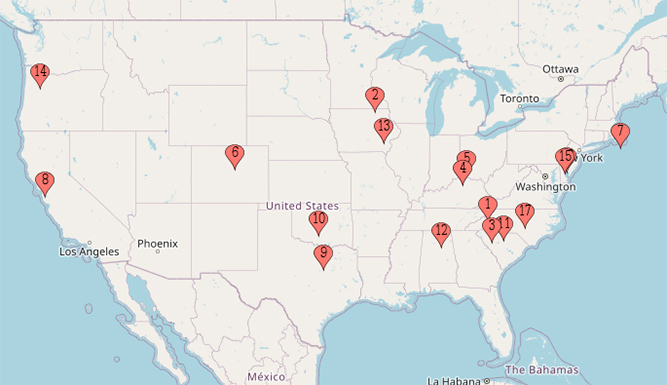
Click map to enlarge
|
|
|
|
|
|
|
|

&uuid=(email))
Feature Your Job Here For 30 Days -
70% Aren't On The Boards
Post your job listing |
|
|
Featured Job Spotlights
Staffing
'Best in Class' Teams
Help Your Colleagues - Your Industry
- Build a
'Best in Class' Community

National Account Manager
Bohemia, NY
The National Account Manager is responsible
for managing and growing a portfolio of strategic customer accounts while
identifying opportunities to expand Delta Lock's products and services within
existing and prospective customers. This role serves as the primary business
relationship owner for assigned accounts...

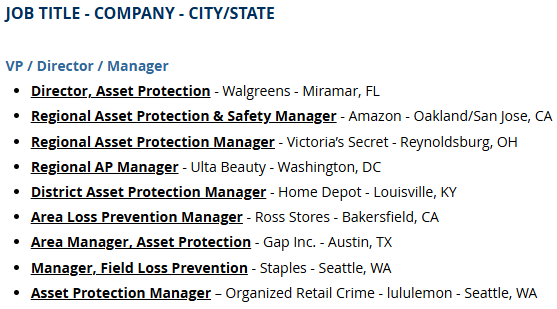
Director, Asset Protection
Miramar, FL
The Director, Asset Protection Operations &
Execution (APD) is responsible for the development and execution of the asset
protection plan, Asset Protection talent and resources, as well as resource and
expense budgets...

VP Loss Prevention & Safety
Plano, TX
Leads the enterprise-wide strategy for asset protection, loss prevention,
safety, security, and environmental compliance. Accountable for minimizing
financial and operational risk, strengthening internal controls, and ensuring
regulatory compliance across all locations...
|
|
Featured Jobs
To apply to any of today's Featured Jobs,
Click Here
|
|
|
|
|
 |
|
|
&uuid=(email)) |
|
|
&uuid=(email)) |
|
&uuid=(email)) |
|
|
&uuid=(email)) |
|

Insight,
humor & heart from
one of LP's most trusted voices |
|
|
Things It Took Me 30 Years to Learn
About Retail Asset Protection
The Industry Has a Long Memory.
People remember who returned
phone calls. Who owned mistakes. Who stayed after the sale. Who treated
everyone...from the receptionist to the CEO...with respect.
Products evolve. Companies merge. Titles change. Reputations tend to
stick around a lot longer.
Follow this space every day to see more of
'Hedgie's Hot Takes' |
|
|

|
|
See More Events |
Recruiting?
Get your job e-mailed to
everyone... everyday
Post on our
Featured Jobs Board! |
|
|
Not getting the Daily?
Is it ending up in
your spam folder?
Please make sure to add d-ddaily@downing-downing.com to your contact list, address book, trusted sender
list, and/or company whitelist to ensure you receive our newsletter.
Want to know how?
Read Here
|
|
 |

copyright 2009-2029
all rights reserved globally |
&uuid=(email))




&uuid=(email))
&uuid=(email))
&uuid=(email))
&uuid=(email))