|
|
|
&uuid=(email)) |
|
 &uuid=(email)) |
&uuid=(email)) |
|
The CIS Boot has been proven to be highly effective, with great ROI
-
 Enhanced
Durability: Robust materials to withstand both physical tampering and
environmental wear, ensuring long-term reliability. Enhanced
Durability: Robust materials to withstand both physical tampering and
environmental wear, ensuring long-term reliability.
-
Tamper-Resistant
Design: Designed to resist forced entry, providing additional
layer of security, discouraging theft.
-
Seamless Integration:
Its compatibility with existing fixture styles.
-
Visible Deterrence:
Serves as physical barrier and psychological deterrent, reducing
likelihood of theft.
See more CIS
solutions here
The U.S. Crime Surge
The Retail Impact
Take Our Survey: Retail Crime & AI
The AI Insights Report on Retail Crime Prevention
 The
D&D Daily is launching new content to cover AI adoption and governance.
We're starting with an executive insights report focused on retail crime
and AI. The
D&D Daily is launching new content to cover AI adoption and governance.
We're starting with an executive insights report focused on retail crime
and AI.
This report will gather and analyze survey data, industry interviews,
and original research.
How you can get involved:
-
Take
the short survey here: The average time to take this
survey is about two minutes. Your responses will be anonymous.
We only request emails as a validity measure.
-
Participate in a
short interview: Talk to our publishing team for 10-15
minutes. You will have the opportunity to review and approve (or
decline) named inclusion in the report.
Contact us here.
Share your thoughts and stay tuned!
- The D&D Daily Team
RetailCrime.ai
is presented by The D&D Daily in partnership with
Telakus, a technology
training firm with direct experience publishing research content for
loss prevention and asset protection professionals.
Modern Tools for Retail Security
Facial Recognition Continues to Gain Traction in Retail Security
 By
the D&D Daily staff By
the D&D Daily staff
Facial recognition technology continues to gain traction in retail as
more organizations invest in proactive tools to address repeat theft and
organized retail crime. One of the latest examples comes from the San
Francisco Bay Area, where several Grocery Outlet locations have deployed
SAFR Guard to help identify known repeat offenders entering their
stores.
One of the greatest strengths of facial recognition is its ability to
help retailers identify known repeat offenders before theft occurs.
Rather than relying solely on employees to recognize individuals or
reviewing surveillance footage after merchandise has already been
stolen, the technology provides real-time awareness that allows asset
protection teams to respond earlier. Whether that means increasing
observation, enhancing customer service, or preparing an appropriate
response, earlier awareness can play an important role in preventing
losses before they happen.
Repeat offenders are responsible for a disproportionate amount of retail
theft in many markets, making them a logical focus for retailers looking
to maximize the impact of their security efforts. Facial recognition
helps shift loss prevention from a reactive model toward a preventive
one by identifying individuals who have already demonstrated a
history of theft or other criminal activity at a retailer's locations.
The technology can also improve operational efficiency. Automated
alerts allow security and store teams to focus their attention when it
matters most instead of requiring constant monitoring of entrances or
depending on employees to remember individuals from previous incidents.
This enables retailers to use their resources more effectively while
helping create safer environments for both associates and customers.
As retailers continue investing in layered security strategies,
facial recognition is increasingly being adopted alongside AI-powered
video analytics, electronic article surveillance, license plate
recognition, and advanced case management platforms. Together, these
technologies provide greater visibility into criminal activity while
helping retailers intervene earlier in the theft cycle.
As retail crime continues to evolve, many organizations are placing a
greater emphasis on prevention rather than simply documenting incidents
after they occur. The continued expansion of facial recognition
technology reflects that shift, giving retailers another tool to deter
repeat offenders, strengthen situational awareness, and better protect
their people, merchandise, and customers.
2026 National ORC Blitz Event:
August 1-9
National Blitz Event Highlights Power of
Collaboration in Fight Against ORC
Retail crime has become increasingly organized, sophisticated and
far-reaching, making it a challenge no single retailer or law
enforcement agency can solve alone. That's the idea behind the 2026
National Blitz Event, scheduled for August 1-9, which will bring
together retailers, law enforcement agencies, prosecutors and Organized
Retail Crime Associations (ORCAs) from across the country for a
coordinated national enforcement effort.
 The
event is designed to unite public and private sector partners in a
series of intelligence-driven operations aimed at disrupting organized
retail crime networks. By coordinating investigations across
multiple jurisdictions, participants can identify patterns, connect
cases that might otherwise appear unrelated and target larger criminal
organizations rather than isolated theft incidents. The
event is designed to unite public and private sector partners in a
series of intelligence-driven operations aimed at disrupting organized
retail crime networks. By coordinating investigations across
multiple jurisdictions, participants can identify patterns, connect
cases that might otherwise appear unrelated and target larger criminal
organizations rather than isolated theft incidents.
Beyond the arrests and recoveries that often result from these
operations, the National Blitz serves another important purpose:
strengthening relationships. Organized retail crime frequently
crosses city, county and state lines, making communication between
retailers, investigators and prosecutors essential. Events like this
create opportunities to share intelligence, establish new partnerships
and develop strategies that continue long after the blitz concludes.
The initiative also highlights the growing role of ORCA organizations
throughout the United States. These regional associations have
become valuable hubs for information sharing, helping retailers and law
enforcement quickly distribute suspect information, identify emerging
crime trends and coordinate responses to repeat offenders and organized
theft crews.
Click
here to register
Crime is a Key Political Issue
Opinion: Democrats’ real vulnerability is on crime, not economics
Between 2022 and 2023, left-wing governments held power in 13 countries
across Latin America. Today, that number has collapsed to roughly five.
The same contraction is visible in Europe, where Nordic countries long
celebrated as models of humane governance have overhauled their
criminal justice systems in response to surging gang violence —
embracing punitive policies that would have been unthinkable a decade
ago.
In neither case was the collapse driven by rejection of left-wing
economics. It was driven by crime — and that distinction matters
more for Democrats than most party strategists would like to admit.
Democrats have struggled to bring themselves to address these concerns
due to fears that a return to tough-on-crime rhetoric will betray the
communities most harmed by aggressive policing — including
communities still processing the wrongful death of people like George
Floyd and the movements they ignited.
A serious criminal justice platform would distinguish between serious
violent offenses, where the system’s response must be unambiguous,
and less serious offenses, where rehabilitation and diversion programs
have demonstrated measurable success.
Mamdani seems to understand this — but the pressures are showing. After
striking a deal with City Council Speaker Julie Menin on New York City’s
budget, he omitted the 580-officer NYPD expansion he had championed.
Meanwhile, in Congress, 59 Democrats voted
against the Combating Organized Retail Crime Act, including prominent
progressive members. Rather than challenge that momentum,
moderate Democrats have largely gone quiet.
Crime is different, though. It is the one issue on which the Democratic
Socialists of America has no coherent answer and on which voters,
including Democratic voters, are openly demanding a tougher response
to criminals. If centrist Democrats cannot find the will to govern
on the one issue where the socialist left cannot, they will not lose the
party in a fight. They will lose it by forfeiting.
thehill.com
New report shows crime down in Fall River, with key exceptions
Terrorism probe launched after suspect hurls ‘incendiary device’ at NYC
ICE office
&uuid=(email))
AI & Store Operations
From Reactive to Real-Time: How AI Is Reshaping Store Operations
At the same time, retailers are navigating rising cost pressures,
geopolitical uncertainty, and increasingly fragile global supply chains.
The result is a fundamentally different operating environment—one where
scale alone is no longer enough. What matters now is responsiveness:
the ability to adapt in real time to shifting conditions across stores,
systems, and customer interactions.
Increasingly, retailers are turning to artificial intelligence (AI) to
meet this moment. AI is helping stores function more intelligently in
real time, for both customers and employees, transforming operations
in ways that are often invisible, but deeply impactful.
To manage this complexity, retailers must move beyond reactive IT
models. In an always-on, omnichannel environment, even minor
disruptions can ripple across channels— impacting customer satisfaction,
revenue, and brand trust.
AI-driven operations (AIOps) are enabling a shift from reactive
troubleshooting to proactive, predictive management. By analyzing
real-time data across store infrastructure, AI can detect early warning
signs—such as performance degradation, unusual transaction patterns, or
system bottlenecks before they escalate into larger issues.
More importantly, AI helps prioritize what matters most. Instead of
overwhelming IT teams with thousands of alerts, intelligent systems
surface the issues that have the greatest impact on customer experience
and business outcomes. This allows teams to respond faster, allocate
resources more effectively, and maintain consistent operations across
large store networks.
While customers may experience AI through personalized recommendations
or faster service, its broader impact is happening behind the scenes
transforming nearly every aspect of store operations.
Inventory management and restocking, once manual and reactive, can
now be optimized in real time. AI helps ensure the right products
are available at the right location, supporting services like BOPIS and
same-day delivery without adding operational strain.
In-store experiences are also becoming more dynamic. Intelligent
queue management, real-time inventory visibility, and digital assistants
help customers navigate stores more efficiently, especially during peak
periods when demand is highest.
rfidjournal.com
Human Oversight Remains Key for Safety
Policies
When AI Writes the Safety Policy, Who Owns the Mistake?
AI can help safety teams create
policies, procedures and training faster, but unreviewed AI-generated
content can create serious compliance and due diligence risks.
AI can assist in drafting safety documents but cannot replace the
need for competent human review to ensure accuracy and compliance.
Overreliance on AI without controls can lead to safety gaps, legal
violations, and serious workplace injuries or incidents.
Effective AI integration requires classification of risk, jurisdictional
identification, source verification, and version control to maintain a
defensible safety system. Organizations must distinguish between
training completion and actual worker competence, especially when using
AI-generated content.
Regular audits and updates are essential to keep safety content
current, accurate, and aligned with evolving laws, standards, and
workplace conditions.
In regulated environments, a polished document isn’t enough.
Someone competent still has to know whether the document is right,
whether it matches the law, whether it applies to the operation, and
whether it can stand up to inspection.
Workplace safety has the same problem, only the consequences can be
more immediate. An employer can ask AI to write a fall protection
policy, a forklift safety talk, a lockout procedure, a HazCom refresher,
a confined space entry checklist, or a workplace violence prevention
plan. Within seconds, the organization has something that looks
structured, professional and usable. It may have headings. It may have
steps. It may use the right vocabulary. It may even sound more polished
than the internal document it’s replacing.
But looking like a safety procedure isn’t the same thing as being one.
A real safety procedure has to match the law, the task, the equipment,
the work environment, the worker group, the hazards, the supervision
model, and the employer’s actual controls. A real training program has
to do more than transfer information. It has to prepare workers to
recognize hazards, follow procedures, ask questions, stop unsafe work
when needed, and prove they understood what they were taught. A real
compliance system has to create records that show what was done, when it
was done, who reviewed it, who received it, and how the employer
verified that it worked.
ehstoday.com
Retailers Using RFID to Fight Waste
RFID technology is transforming meat management for retailers
Food waste has been an issue for
retail for quite some time, but new technology is beginning to change
that.
Supermarkets are facing rising costs and unpredictable demand for
products. Sustainability targets are becoming more essential, making
smart inventory systems a necessity. New research from companies
like Avery Dennison suggests that meat waste could cost retailers across
the globe billions, making it the most expensive category of waste, next
to fresh produce.
Visibility is a major issue here because even though retail technology
is rapidly advancing, supermarkets are still relying on traditional
systems and processes. Things like this can make it more difficult
to monitor expiry dates.
That’s where RFID technology comes in. RFID tags give every
product an identity, so retailers can monitor stock levels and expiry
dates while rotating products effectively. UK supermarkets like M&S are
the pioneers of RFID technology. They use it on clothing and homeware,
achieving 15,000 scans per hour. The company is trialling scan-free
checkout.
Even though Tesco uses RFID on non-food pallets, individual tagging
is a challenge due to metal packaging and water content. Across the
world, Walmart is embracing RFID labels across fresh food. There are
hopes that one day it will be used on meat to connect inventory systems
more efficiently.
RFID technology is a staple across numerous industries, as it’s one
of the best ways for businesses to track assets while also automating
processes. Clothing stores and brands use RFID tags to monitor stock
levels in real-time. This helps to speed up inventory counts, and it
also helps to improve supply chain visibility.
retailtechinnovationhub.com
Giving Back to the Community
Lowe's marks Habitat for Humanity 50th anniversary with funding, events
Lowe’s Companies Inc. is funding grants supporting more than 200
projects across local 20 affiliates of the non-profit organization
Habitat for Humanity International to support home repair and rehab
projects. This renewed of a longstanding partnership between Lowe’s and
Habitat for Humanity is intended to help more than 300 individuals
remain in their homes.
Lowe's will fund grants supporting the project, which are designed to
address urgent needs such as roofing and HVAC, energy efficiency,
accessibility and fall-prevention modifications and disaster
preparedness upgrades. During July 2026, Lowe's will also help
Habitat celebrate its 50th anniversary with 20 pop-up events held at
Lowe's stores across the U.S. These community engagement events will
offer hands-on activities and interactive build experiences designed to
raise awareness of Habitat.
chainstoreage.com
Trump to Impose 50% Tariff on Many Canadian Goods
The administration will use an untested
legal provision to put significant duties on Canadian exports,
reigniting a clash with one of America’s biggest trading partners.
EU’s ban on destruction of unsold clothing, shoes take effect
From season to sentiment: How the pace of consumer trends reshapes
retail planning
|
All the News - One Place - One Source - One Time
Thanks to our sponsors/partners - Take the time to
thank them as well please. If it wasn't for them The Daily wouldn't be here
every day for you.
 |
|
&uuid=(email)) |
|

&uuid=(email)) |
|
|

|
|

Why felony theft thresholds vary by state, what recent
legal changes mean for retailers, and why prevention remains critical regardless
of local laws.
Retail theft laws are not the same across the country. Felony theft thresholds
differ from state to state, influencing how theft cases are prosecuted, how
repeat offenders are handled, and how retailers approach loss prevention
strategies.
While some states have lowered thresholds or strengthened enforcement,
legislation alone does not stop theft from occurring. Retailers still need
effective, proactive solutions that reduce losses before merchandise leaves the
store.
Learn more about:
-
Key felony theft threshold updates
for 2025–2026
-
How state laws can affect retail
risk
-
Why prevention matters regardless
of legal thresholds
-
How
Purchek® helps retailers deter pushout theft while improving safety and
protecting merchandise
Continue Reading Here
|
|
&uuid=(email)) |
|
|
 |
|
|
Why Retail Cybersecurity Budgets
Matter
Retail Cybersecurity Investment Priorities
By
the D&D Daily staff
As cyber threats continue to evolve, retailers are increasingly
viewing cybersecurity budgets as long-term business investments rather
than discretionary technology expenses. While security spending may
not generate direct revenue, it plays a critical role in protecting
operations, customer trust, and business continuity.
Retail organizations face a wide range of cybersecurity risks,
including ransomware, phishing attacks, credential theft, payment fraud,
and supply chain compromises. The growing use of cloud platforms,
connected devices, and digital commerce has expanded the number of
potential entry points for attackers, making ongoing investment in
cybersecurity an operational necessity.
Budget discussions often focus on balancing immediate costs with
long-term risk reduction. Security leaders frequently present
cybersecurity investments in terms of business outcomes rather than
technical features. Instead of emphasizing software or hardware
purchases alone, proposals may highlight how investments can reduce
downtime, strengthen regulatory compliance, protect sensitive customer
information, improve incident response capabilities, and minimize the
financial impact of a potential breach.
Many retailers are also adopting a risk-based approach to
cybersecurity budgeting. Rather than attempting to eliminate every
possible threat, resources are directed toward the areas that present
the greatest potential business impact. Regular risk assessments,
vulnerability management, employee security awareness training,
multi-factor authentication, endpoint protection, and continuous
monitoring are commonly prioritized as foundational investments.
Cybersecurity budgets also extend beyond prevention. Retail
organizations increasingly allocate funding for incident response
planning, disaster recovery, cyber insurance, third-party security
assessments, and business continuity exercises. These measures help
retailers recover more quickly if an incident occurs while limiting
operational disruption.
Demonstrating the value of cybersecurity spending can be challenging
because successful security often means preventing incidents that never
become visible. As a result, many retailers measure return on investment
through metrics such as reduced security incidents, faster response
times, improved compliance outcomes, lower business disruption, and
strengthened organizational resilience.
As cyber threats continue to grow in frequency and sophistication,
cybersecurity budgeting is becoming less about responding to isolated
attacks and more about maintaining the security, stability, and
continuity of retail operations over the long term.
Security Vulnerabilities
The Windows 10 hangover is becoming a security problem
Windows 11 now runs on 78.8% of Windows devices after Microsoft ended
support for Windows 10 on 14 October 2025, according to Lansweeper.
Windows 10 still accounts for 16.9% of devices and no longer receives
security updates, leaving newly discovered vulnerabilities unpatched.
“There’s a temporary bridge that we need to consider when looking at
these numbers. Microsoft’s consumer Extended Security Updates program
keeps eligible Windows 10 devices patched for one extra year, until
October 12, 2027. But this is a paid extension, a temporary
solution, not a destination, and it excludes most enterprise, LTSC, and
domain-joined configurations,” Laura Libeer, Technical Content
Copywriter at Lansweeper, said.
In the European Economic Area (EEA), eligible Windows 10 users can
receive free ESU until 14 October 2026 without enabling Windows
Backup or syncing settings, apps, or credentials to the cloud. Outside
the EEA, consumers must pay for ESU, redeem Microsoft Rewards points, or
enable Windows Backup to receive an additional year of security updates.
helpnetsecurity.com
Surge in ransomware hacks deepens divide over whether to pay
Governments look at banning ransom payments
as organisations face increasingly sophisticated threats
The five step plan that cuts security budget waste
More alerts are making your team slower, and an outcome-based SOC fixes
that |
|
 |
|
|
|

|
|
|
Deadly Strike on Russian Retail
Warehouses
Russian online retail warehouses hit by deadly Ukrainian strikes
Eight people have been killed and 62 injured after Ukrainian drones
struck two warehouses belonging to Russia's biggest online retailer,
Wildberries, according to Russian officials.
Seven deaths and 25 injuries occurred at a warehouse in the city
of Tambov, roughly 295 miles (475km) south-east of Moscow. One death
and 37 injuries occurred at another Wildberries warehouse in
Elektrostal in the Moscow region.
Ukrainian President Volodymyr Zelensky said the attacks had struck "major
logistics facilities" which had been used to "supply sanctioned
components for drone production and navigation equipment".
He added that Ukraine had also struck targets in the Sea of Azov, the
Black Sea, and Russian-annexed Crimea.
Images from the scene of one of the warehouse strikes showed flames
and huge plumes of black smoke rising from a vast logistics building,
with dozens of workers running into a car park area.
The attacks appear to have started at night, with some videos showing
terrified and injured staff attempting to flee as explosions continue.
Another clip appears to show the walls of a warehouse disintegrating as
they are engulfed by flames.
Zelensky said Ukraine's operations were in response to "Russian strikes
on our civilian infrastructure and on our cities and communities".
Overnight into Wednesday, 14 people were killed in Russian attacks
across Ukraine.
Wildberries is often described as the Russian equivalent of Amazon.
The merged RWB group, which combines Wildberries with advertising
company Russ, was valued at about $12.6bn (£9.3bn) by Forbes Russia in
2026.
bbc.com
E-Commerce's Next Challenge
AI is creating ecommerce’s next optimization challenge: The intent gap
While results will vary by retailer and category, the broader trend
is becoming difficult to ignore. How shoppers arrive increasingly
influences how they behave once they get there.
The cart, checkout and confirmation pages frequently remain static
regardless of how the shopper arrived or how much of the buying
journey they have already completed.
We think of this growing disconnect as the intent gap. It is the
mismatch between the context a shopper brings into the transaction and
the experience they find when they get there. As AI moves more
research, comparison and evaluation upstream, that gap is likely to
widen.
This doesn’t mean every shopper needs a completely different checkout
experience. It does suggest retailers should begin treating arrival
context as another signal of relevance alongside behavioral and
transactional data. Someone who has already compared five products
may be looking for reassurance that inventory, pricing or delivery align
with what they were shown elsewhere. A loyal customer may be more
receptive to complementary recommendations or exclusive offers. A
convenience-driven shopper may simply value the shortest possible path
to completing a purchase.
retaildive.com
Amazon closes another major facility, nearly 500 workers affected
More than 11K toaster ovens sold online through Amazon, Costco recalled |
|
|
|
&uuid=(email))
|
Sacramento County, CA: Repeat offender busted again less than 24 hours
after release in brazen jewelry store theft case
A California man accused of stealing jewelry was back behind bars less
than 24 hours after walking out of jail, allegedly pulling off the exact
same type of crime while already on pretrial probation, authorities
said. Andre Wiley, 19, was arrested last week after Sacramento County
Sheriff's Office detectives said he teamed up with two other men in an
alleged jewelry store theft just hours after being released from the
Placer County Jail on his own recognizance for burglary, conspiracy and
grand theft charges. Investigators said Wiley and 18-year-olds Andrew
Ivy and Kameryus Mayhand entered a local jewelry store together.
Authorities allege Ivy and Mayhand distracted employees by browsing
merchandise while Wiley sat at a consultation desk and stole two pieces
of jewelry before the trio fled. A short time later, the Rancho Cordova
Police Department's Crime Suppression Unit located the suspects'
vehicle, leading to their arrests and the recovery of the stolen items,
authorities said.
foxnews.com
Lompoc, CA: Police Turn to the Public for Help Investigating Friday’s
Ulta Burglary
Investigators are turning to the public for help investigating a Friday
evening burglary at an Ulta by a pair of suspects connected to similar
crimes across the state. On July 17, around 5:55 p.m., two women, shown
in the images below, entered into the local beauty product store and
concealed 216 items of makeup, cologne, and perfumes shared the Lompoc
Police Department in a press release Monday. Ulta's asset protection
system lists the duo as potentially sisters and have linked them to
multiple thefts across the state shared the Lompoc Police Department.
After concealing the items in the store, the pair left the scene with an
estimated $6,575 worth of merchandise without paying noted the Lompoc
Police Department.
keyt.com
Sherwood, OR: 3 arrested, over $10K worth of stolen items found during
Sherwood traffic stop
Three people were arrested and thousands of dollars worth of stolen
merchandise was recovered during an Ulta theft investigation, according
to the Tigard Police Department. Police said a detective was notified on
June 26 by a loss prevention investigator with Ulta that theft suspects
were in McMinnville and heading toward Washington County.
kptv.com
North Charleston, SC: SC woman wanted for shoplifting at Marshalls
arrested while shoplifting at mall
A South Carolina woman wanted for shoplifting at Marshalls last month
was arrested while shoplifting at the mall on Saturday, according to
police. According to the North Charleston Police Department (NCPD),
officers responded about 6 p.m. June 30 to a reported shoplifting in
progress at Marshalls on Rivers Avenue. Police said that store loss
prevention personnel told officers that two known shoplifters were
inside gathering merchandise to steal and said the group had targeted
the store between 15 and 20 times. Officers said once the two left
the store with the stolen merchandise, police tried to stop them but
they threw the stolen items onto the ground and ran toward their car.
Police said Ja'Mya Latavia Nelson, 24, drove away while ignoring an
officer's command to exit the car. Officers reported that during a
chase, Nelson ran multiple red lights and a stop sign, weaved through
traffic, and drove on the shoulder to pass other vehicles during the
chase. The chase ended near College Park Road because of safety
concerns, officers said. They said shortly after the chase was
terminated, Berkeley County deputies reported the suspect vehicle had
crashed with another vehicle on College Park Road.
wyff4.com
&uuid=(email))
|
|
|
&uuid=(email)) |
|
|
&uuid=(email)) |
|
|
|
 |
|
|
Shootings & Deaths
Los Angeles County, CA: LA County detectives investigating man's death at
Lucille's Smokehouse in Cerritos
An investigation is underway in Cerritos, where a man who was allegedly armed
with a knife was fatally shot by a customer inside a barbecue restaurant on
Sunday afternoon. Deputies were called to the 11000 block of South Street at
around 2:15 p.m., where there were reports of a man armed with a knife at
Lucille's Smokehouse Bar-B-Que in the Promenade Cerritos shopping center, Los
Angeles County Sheriff's Department officials told CBS LA.
cbsnews.com
Tulsa, OK: Deadly overnight shooting at Tulsa shopping center sparks safety
concerns
Tulsa police say a late-night gathering outside businesses near 71st Street and
Memorial turned deadly over the weekend, leaving one man dead and nearby
business owners calling for more to be done to stop recurring crowds. Police say
Ladrae Doyle was arrested after investigators say he shot and killed Ahmod Henry
during a gathering in a shopping center parking lot early Saturday morning.
Surveillance video captured the moments after gunfire broke out just after 4:15
a.m., showing people running across the packed parking lot. Police say Henry and
Doyle were among a large group gathered outside businesses when the shooting
happened. Investigators are still working to determine what led up to the
gunfire. Tulsa Police Officer Andre Baul said large crowds outside businesses
late at night can create unpredictable situations.
newson6.com
Baker, LA: Man fatally shot outside Baker convenience store
Denver, CO: 1 critically injured in daylight shooting at Commerce City gas
station
Jacksonville, FL: Man shot 8 times outside Buffalo Food Store in Panama Park
Southfield, MI: Gun store robbery suspect in custody after shots fired outside
store
Robberies, Incidents & Thefts
Dover, DE: Woman arrested after returning for AirPod following robbery of
Wendy’s
A woman who, police say, attacked a worker and robbed a Wendy's restaurant in
Dover, Delaware after complaining about her order was arrested on Sunday when
she returned to the fast-food eatery for an AirPod she left behind. According to
police, the incident unfolded at about 9:09 p.m. on Sunday night at a Wendy's
restaurant in Dover when Shadaria Harris, requested a cash refund after
complaining about her order. Officials said Harris "became agitated" after
workers at the restaurant told her that she would need to contact management
with her concerns as a cash refund couldn't be processed at the restaurant.
During the incident, police claim, Harris went behind the service counter at
the restaurant, entered an employee-only area and removed about $15 from a cash
register. As she stole from the register, officials claim, Harris assaulted
an employee that was attempting to stop the theft.
nbcphiladelphia.com
Rifle, CO: Four handguns stolen in Rifle sporting goods store burglary
Portland, OR: 11 arrested, 7 guns seized during two-day enforcement mission |
|
|
|

•
Beauty – Lompoc, CA -
Robbery
•
Beauty - Sherwood, OR
- Robbery
•
C-Store – Kalihi, HI –
Armed Robbery
•
C-Store – Jessup, MD –
Armed Robbery
•
C-Store – Rapides
Parish, LA – Burglary
•
Grocery - Madison, WI
– Robbery
•
Guns – Rifle, CO –
Burglary
•
Guns – Southfield, MI
– Robbery / shots fired
•
JC Penney –
Wilkes-Barre Township, PA – Robbery
•
Jewelry – Sacramento
County, CA - Robbery
• Jewelry – Columbus, OH – Robbery
• Jewelry – Durham, NC – Robbery
•
Liquor – Cloquet, MN –
Burglary
•
Restaurant – Winooski,
VT – Burglary
•
Restaurant – Tulsa, OK
– Burglary
•
Restaurant – Dover, DE
– Robbery
•
Restaurant – Pensacola
Beach, FL – Burglary
•
Restaurant – New
Orleans, LA – Burglary
•
Tobacco – San Jose, CA – Robbery
|
Daily Totals:
• 12 robberies
• 7 burglaries
• 1 shooting
• 0 killed |
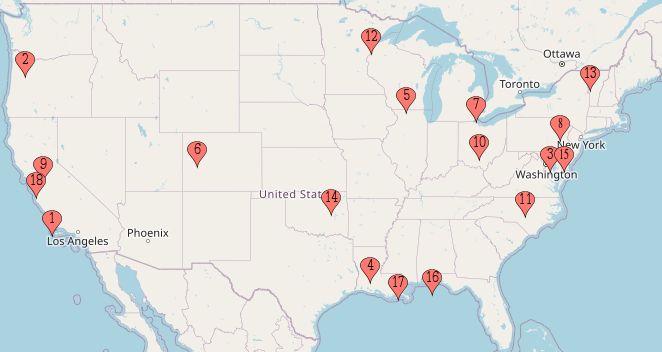
Click map to enlarge
|
|
|
|
|
&uuid=(email)) |
|
|

&uuid=(email))
Feature Your Job Here For 30 Days -
70% Aren't On The Boards
Post your job listing |
|
|
Featured Job Spotlights
Staffing
'Best in Class' Teams
Help Your Colleagues - Your Industry
- Build a
'Best in Class' Community

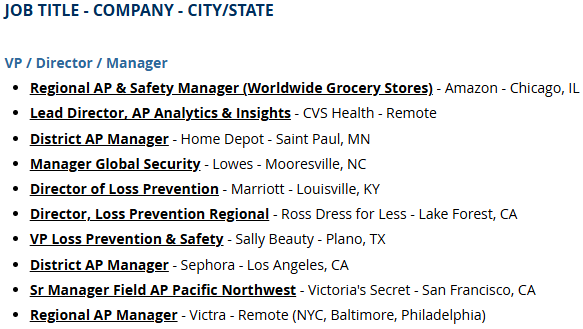
VP Loss Prevention & Safety
Plano, TX
Leads the enterprise-wide strategy for asset protection, loss prevention,
safety, security, and environmental compliance. Accountable for minimizing
financial and operational risk, strengthening internal controls, and ensuring
regulatory compliance across all locations...

Lead Director, Asset Protection Analytics & Insights
Remote
The Director of AP Analytics and Investigations is responsible for leveraging
analytics, technology, and investigative strategies to support Asset Protection
operations, investigations, and risk mitigation efforts across the
organization...
|
|
Featured Jobs
To apply to any of today's Featured Jobs,
Click Here
|
|
|
|
|
 |
|
|
&uuid=(email)) |
|
|
&uuid=(email)) |
|
&uuid=(email)) |
|
|
&uuid=(email)) |
|

Insight,
humor & heart from
one of LP's most trusted voices |
|
|
Every Retailer Thinks Their Stores Are Different... And They're Right.
After enough store visits, you realize
something interesting. Every retailer believes they're unique, and
somehow...they all are. The layouts differ. The culture differs. The
customer base differs. That's why the best partners don't show up with
cookie-cutter answers. They show up with adaptable ones.
Follow this space every day to see more of
'Hedgie's Hot Takes' |
|
|

|
|
See More Events |
Recruiting?
Get your job e-mailed to
everyone... everyday
Post on our
Featured Jobs Board! |
|
|
Not getting the Daily?
Is it ending up in
your spam folder?
Please make sure to add d-ddaily@downing-downing.com to your contact list, address book, trusted sender
list, and/or company whitelist to ensure you receive our newsletter.
Want to know how?
Read Here
|
|
 |

copyright 2009-2029
all rights reserved globally |
&uuid=(email))




&uuid=(email))
&uuid=(email))
&uuid=(email))
&uuid=(email))